


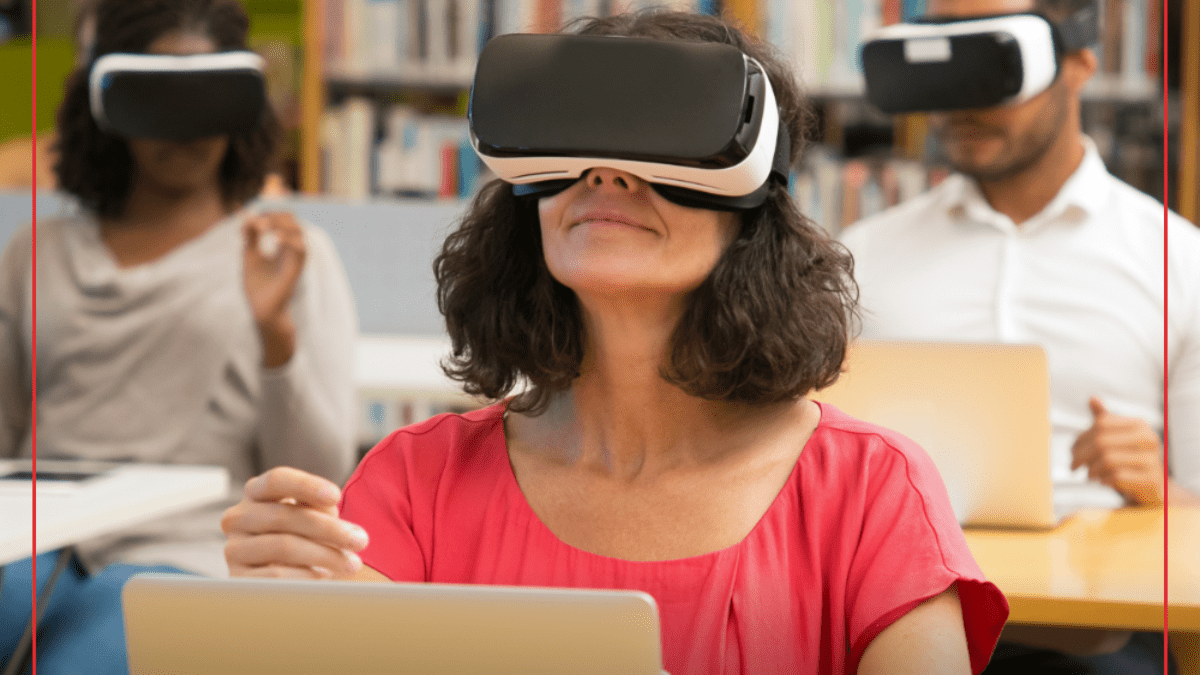
Virtual reality (VR) technology has emerged as a powerful tool with the potential to revolutionize education and training. In today’s rapidly evolving world, where traditional teaching methods are often inadequate to meet the needs of learners, VR offers immersive and interactive experiences that captivate students’ attention and enhance their understanding. This article delves into the benefits, applications, challenges, and future possibilities of integrating VR into educational and training settings.
Benefits of Virtual Reality in Education and Training:
How is virtual reality in classrooms beneficial?
- One of the primary advantages of VR in education and training is its ability to enhance engagement and motivation. By providing learners with immersive experiences, VR captures their attention and encourages active participation.
- Realistic simulations enable practical learning in fields such as medicine, where surgical training can be conducted in a virtual environment, or in industries that require technical skills development.
- Moreover, VR offers accessibility and flexibility, overcoming geographical limitations and catering to various learning styles and abilities.
Applications of Virtual Reality in Education
In the realm of education, VR in classrooms opens up new avenues for learning and exploration.
- Science and exploration can be brought to life through virtual field trips to distant locations, simulated space exploration, or deep-sea dives.
- Historic and cultural preservation can be encouraged by offering virtual tours of historical sites and museums, allowing learners to immerse themselves in different cultures and time periods.
- Virtual Reality in classrooms has been seen making an evident impact on the Neural Conditions of the brain.
- Language learning can also benefit from VR through virtual language immersion environments and practice with native speakers in simulated scenarios.
Virtual Reality in Professional Training
In addition to education, VR has extensive applications in professional training.
- Medical and healthcare professionals can benefit from surgical simulations, patient interactions, and empathy training.
- Aviation and military training can utilize flight simulators for pilot training and combat simulations for military personnel.
- Businesses and industries can leverage VR for safety training in hazardous environments, as well as team-building exercises and leadership development.
Challenges and Limitations of Virtual Reality in Education and Training
While the potential of virtual reality in education and training is promising, several challenges must be addressed.
- Cost and infrastructure requirements can pose barriers to widespread implementation.
- Technical limitations must be overcome, such as the discomfort caused by wearing VR headsets for extended periods.
- Furthermore, designing effective educational content for VR necessitates careful consideration and expertise.
Top Virtual Reality Tools Revolutionizing Education in 2025
Virtual reality has transformed the education sector fully. The traditional school/college set up is long gone – and being replaced by various digital tools and tech like artificial intelligence and virtual reality.
These techs are shaping how students learn, teachers teach, and institutions innovate to keep up with the sector growth. From immersive holograms to creative content platforms, here are the top VR tools making education more engaging for all:
1. Axon Park
It is advanced 3D education platform that uses AI to personalize learning experiences on VR headsets, mobiles, and desktops. It is popular for training in medicine, engineering, and architectural domains.
2. Prisms VR
Math just got a whole lot better and more fun with Prisms VR. It helps students visualize and interact with abstract math concepts through immersive, multi-user VR lessons on Meta Quest.
3. Strivr
Designed for enterprise training, Strivr blends VR with cognitive science to help learners build skills in workplace safety, operations, and teamwork. Top companies and sports teams rely on it for effective training sessions.
4. ClassVR (Avantis Systems)
Perfect for K-12 classrooms, ClassVR offers standalone headsets loaded with educational content. It’s simple to set up and used globally to bring virtual field trips and simulations directly to students.
5. zSpace
An AR/VR laptop that delivers hands-on 3D simulations especially in STEM and medical fields. It’s widely adopted in schools for interactive science and vocational lessons.
6. EON Reality
With one of the largest VR content libraries, EON Reality supports educational institutions worldwide. Their VR Innovation Academies help spread immersive learning even in developing countries.
7. Labster
Virtual labs that let students safely conduct science experiments in biology, chemistry, and physics through realistic simulations, accessible both in VR and web browsers.
8. Engage XR
A collaborative VR platform where teachers and businesses create and share interactive lessons and training in real-time, supporting immersive group learning and workshops.
9. Nearpod
Mixing VR field trips with interactive 3D lessons. Nearpod makes it easy for educators to create engaging multimedia classes accessible on multiple devices.
10. Google Expeditions
Though integrated into other Google products now, Expeditions set the standard for VR field trips, letting students explore everything from ancient ruins to coral reefs through immersive tours.
These tools prove that education in 2025 isn’t just about textbooks and lectures anymore. It’s about stepping into new worlds, experimenting hands-on, and learning by doing – all thanks to VR and mixed reality technologies.
The Future of Virtual Reality in Education
Virtual reality in education is gradually becoming a part of how we learn, with exciting and immersive ways of learning subjects. Imagine stepping inside the virtual world of history lessons, conducting science experiments, or practicing surgeries, all through VR anytime, anywhere.
What makes this even more effective is the use of AI within these virtual environments. Lessons can shift based on how each student learns at their own pace and style, offering extra help as needed, making education more effective and inclusive.
VR also breaks down barriers by connecting students and teachers globally in shared virtual classrooms, fostering collaboration beyond physical limits. With affordable, advanced devices and growing accessibility, VR combined with AI is shaping an education that’s hands-on, adaptive, and truly engaging. The future of learning lets students experience knowledge in vivid, interactive ways like never before.
Case Studies and Success Stories
Numerous institutions and organizations have already embraced virtual reality in education and training, for virtual Reality in the classroom positively impacts students’ learning experience.
For instance, Stanford University’s virtual anatomy lessons provide students with hands-on experience in a virtual environment. Further, Google Arts & Culture Expeditions offer virtual field trips that transport learners to various locations worldwide.
Positive outcomes and feedback from learners and trainers will continue to underscore the transformative potential of virtual reality in education and training.
Conclusion
The potential of virtual reality in education and training is immense. By offering immersive and interactive experiences, VR enhances engagement, facilitates practical learning, and overcomes geographical limitations. Despite challenges, the continued research and development in this field promise to transform the future of learning. Embracing VR technology in education and training can unlock new opportunities for learners, enabling them to explore, experience, and acquire knowledge in unprecedented ways.
Struggling to keep up with the recent tech and science news, or interested in reading in-depth analyses on the dynamic tech world but haven’t yet found one comprehensive place to do that? I find the Yaabot blog to be particularly useful! They even have a sweet newsletter you can subscribe to, so you can just sit back as regular tech and science updates get delivered to your inbox every month!
FAQs (Frequently Asked Questions):
1. What is virtual reality (VR)?
Virtual reality is a technology that uses computer-generated simulations to create an environment that can be interacted with and experienced by users through sensory devices, typically through the use of a headset.
2. How does virtual reality enhance engagement in education and training?
Virtual reality provides immersive experiences that capture learners’ attention and encourage active participation. Virtual Reality in classrooms has proved to be a successful way for students to inculcate things easily. By creating a sense of presence in a simulated environment, VR makes learning more engaging and memorable.
3. Are there any specific fields where virtual reality particularly benefits practical learning?
Yes, VR has proven to be highly beneficial in fields such as medicine, where surgical training can be conducted in a virtual environment, and in industries that require technical skills development. VR simulations offer a safe and realistic environment for learners to practice and hone their skills.
4. Is virtual reality accessible to all learners?
VR technology is becoming more accessible, but there are still barriers to widespread implementation. Cost and infrastructure requirements can pose challenges for educational institutions. Additionally, ensuring inclusivity and accessibility for learners with different abilities remains an important consideration in developing and using VR applications.
