

Most people think the biggest risk with the OpenAI IPO is missing it. I’d argue the bigger risk is not understanding what you’re actually buying.
The IPO isn’t just a regular tech listing. It would rank among the largest public debuts in market history if they enter the arena with a $1 trillion valuation. More than that, it would be the first time regular investors can own a direct stake in the company that made AI mainstream.
In this blog, we’ll learn about the OpenAI IPO. Also, try to understand its valuation numbers with their IPO timeline. We’ll try to find out whether retail investors can invest in the OpenAI IPO and how to do so. And also brush up on stock alternatives for AI investment opportunities beyond ChatGPT‘s owner, with some upcoming tech IPOs.
Key Takeaways
- OpenAI is targeting an IPO in Q4 2026 on Nasdaq, with a possible 2027 listing as a fallback.
- OpenAI’s current valuation is $852 billion after a record $110 billion funding round in February 2026.
- Retail investors will get an allocation, as confirmed by OpenAI’s CEO.
- You cannot buy OpenAI stock today through a regular brokerage. Pre-IPO investing routes exist, but mostly require accredited investor status.
- The competitive threat from Anthropic is real and growing faster than most coverage admits.
OpenAI IPO: Quick Answer
OpenAI is still private as of April 2026.
- Expected IPO: Q4 2026–2027
- Estimated valuation: $852 billion–$1 trillion
- Retail access: likely limited
- Current stock availability: unavailable on public exchanges
- Pre-IPO access: mostly accredited investors only
Why the OpenAI IPO Is Drawing Global Investor Attention
For years, the AI investment opportunity has been locked inside private funding rounds that only institutions and high-net-worth individuals could access. Retail investors wanting exposure had to buy Microsoft, Nvidia, or AI ETFs and settle for second-order returns. That’s about to change.
OpenAI’s CFO said that the company will “for sure” hold a slice for retail when it goes public. She explicitly framed it as AI needs to “garner trust,” and that means everyone participates, not just a small group.
ChatGPT now serves more than 910 million weekly active users, up from 700 million in mid-2025. Millions of those users have never had a direct way to invest in the product they use every day. The OpenAI IPO would close that gap in a way that previous AI investment opportunities never did.
OpenAI’s Journey: From Research Lab to AI Leader
Non-profit origins and founding vision
OpenAI was founded in 2015 as a non-profit AI research lab. The original backers included Elon Musk, Sam Altman, Greg Brockman, and Ilya Sutskever. Initially, the vision was to develop AI that benefits humanity rather than becoming a commercial entity. That mission survived until the computational requirements of frontier AI made private fundraising at a non-profit scale impractical.
Transition to capped-profit structure
In 2019, OpenAI restructured into a capped-profit model, where investor returns were capped at 100x. In October 2025, OpenAI recapitalized again and converted itself into a PBC. That PBC structure is what legally allows them to get publicly listed.
Strategic partnership with Microsoft
Microsoft’s relationship with OpenAI goes deeper than just an investment. It embedded OpenAI models across its Copilot suite and became the de facto distribution arm for OpenAI’s enterprise products. Microsoft holds roughly 27% of OpenAI, valued at around $135 billion. That 27% is also why buying Microsoft stock has been one of the only practical ways retail investors could get OpenAI exposure before any IPO.
OpenAI Valuation: How Much Could the Company Be Worth?
Latest valuation estimates
The valuation pattern here is worth tracking closely:
- March 2025: $40 billion raised at $300 billion post-money valuation.
- October 2025: The secondary share sale price was set at $500 billion.
- February 2026: $110 billion funding round closed at $852 billion post-money valuation.
- IPO target: Bloomberg and Reuters have cited internal discussions pointing to a $1 trillion valuation.
That’s a 3x jump in the OpenAI valuation within a year.
Revenue growth and AI market demand
OpenAI’s revenue growth is actually impressive. They crossed $25 billion in annualized revenue by February 2026, up from $6 billion at Q4 2024. That’s 4x growth in just 14 months, which is faster than any enterprise software company at a comparable scale.
But at $852 billion, OpenAI trades at approximately 34 times annualized revenue. A $1 trillion IPO valuation would push that to roughly 40x.
The financial picture also has some constraints:
- Cash burn is projected at $17 billion in 2026, rising to $35 billion in 2027.
- Gross margins are 33%, constrained by inference costs that hit $8.4 billion in 2025.
- Positive cash flow isn’t expected until 2030.
Comparison with other AI leaders
Comparison with other AI leaders
| Company | Approx. Valuation | Annualized Revenue | Revenue Multiple |
| OpenAI | $852B | ~$25B | ~34x |
| Anthropic | ~$380B | ~$19B | ~20x |
| Nvidia | ~$2.5T | ~$130B | ~19x |
| Microsoft | ~$3T | ~$270B | ~11x |
NVIDIA and Microsoft are profitable at scale. OpenAI and Anthropic are not. The multiple gap reflects growth expectations, not current earnings power.
OpenAI IPO Timeline: When Could OpenAI Go Public?
Current signals and industry reports
Reuters reported in late 2025 that the OpenAI IPO is expected as early as H2 2026. CFO Sarah Friar has suggested 2027 as more realistic for the actual listing, with an S-1 filing potentially coming earlier. OpenAI has been hiring for IPO readiness: a new chief accounting officer, a business finance officer, and Cynthia Gaylor (former DocuSign CFO) as its first head of investor relations.
Informal conversations with Wall Street banks are underway. No S-1 has been filed with the SEC as of April 2026.
Possible timeline for the IPO
Based on the current indicators, the most likely scenario would be,
- S-1 filing in the Q3 2026.
- IPO listing during Q4 2026 at the earliest, with H1 2027 as the fallback.
- And Nasdaq is the target exchange.
There’s also a competitive pressure accelerating the timeline. Anthropic is reportedly targeting an October 2026 listing. OpenAI’s board is said to be concerned that if Anthropic goes public first, it could drain retail demand for AI IPO exposure. If Anthropic captures that wave, OpenAI IPO loses pricing leverage.
Pre-IPO developments
These are the signals worth watching before committing:
- The S-1 SEC filing is when real, audited financials become public.
- Quarterly revenue updates showing whether the $25B run rate is holding.
- Anthropic’s IPO timeline, which directly influences the OpenAI IPO schedule.
- Any FTC or DOJ action on AI market concentration.
- Microsoft’s continued financial participation.
OpenAI Stock: Can Investors Buy Shares Before the IPO?
As of April 2026, OpenAI is still a private entity. There’s no OpenAI stock on any public exchange.
But accredited investors can access pre-IPO shares through the secondary market, where existing shareholders sell their stakes. Platforms include EquityZen, Forge Global, and UpMarket.
Key things to know about pre-IPO investing this way:
- High minimums. UpMarket lists a $50,000 minimum for most OpenAI offerings.
- Accreditation required. You need to meet SEC criteria, with generally $200K+ annual income or $1M+ net worth excluding your primary home.
- Opaque pricing. Secondary shares trade at market estimates, not verified valuations.
- Illiquid. You’re locked in until IPO or another liquidity event, with no guarantee of either.
For most people reading this, this route isn’t realistic. The alternatives in the next section are more practical.
Will Retail Investors Get Access to the OpenAI IPO?
Yes, but the OpenAI IPO allocation will be small, and demand will be enormous.
OpenAI CFO Sarah Friar confirmed retail participation on CNBC, drawing on her experience building Square’s retail-focused IPO program. This isn’t vague goodwill. It’s a stated structural plan.
Potential OpenAI IPO allocation structure
Typical IPOs reserve 5-10% of shares for retail. But SpaceX, by comparison, is planning 30% retail OpenAI IPO allocation in its upcoming IPO, which is a bit unusual. Even though OpenAI hasn’t disclosed an exact percentage. But some references suggest a dedicated direct retail program.
But the float math is uncomfortable. The entire US IPO market raised around $45 billion in 2025. OpenAI, SpaceX, and Anthropic combined could require more than $240 billion in fresh capital from public markets in a single 6-month window. That supply-demand parity means most retail investors who want to get a piece won’t get them at the IPO price.
Regulatory considerations
OpenAI’s PBC structure is genuinely novel. The non-profit foundation retains control rights over the for-profit entity. This creates a governance issue that public market investors aren’t used to dealing with. Expect the SEC to scrutinize how shareholder rights interact with foundation control. The prospectus will need to address that clearly.
Comparison with recent tech IPO access models
- Coinbase, 2021: Direct listing, shares available immediately at opening. No formal retail allocation.
- Robinhood, 2021: Reserved 20-35% for retail investors via its platform. Stock dropped 8% on day 1.
- Rivian, 2021: Heavy institutional oversubscription, minimal practical retail access despite huge retail interest.
OpenAI is likely to structure something closer to the Robinhood model based on Friar’s stated intent. That still doesn’t guarantee a good entry price.
How to Invest in OpenAI as a Retail Investor
Buying shares at IPO vs. after listing
If you get IPO allocation, you’re buying at the offering price. If the stock opens higher on day one, it’s likely given the pent-up demand, and you capture that pop. The long-term question is whether a $1 trillion OpenAI valuation holds once quarterly earnings face public scrutiny for the first time.
Buying after listing is less exciting but more rational. You see the real price, post-lockup selling pressure, and analyst downgrades before you decide.
Brokerage access and eligibility
Most major firms like Fidelity, Schwab, TD Ameritrade, etc. offer IPO access to clients who fulfill the eligibility criteria, which is generally linked to the account size and trading history. Setting up and funding an account now puts you in a position to request OpenAI stock allocation when the offering is announced.
Indirect investment routes
1. Microsoft (MSFT): Microsoft owns 27% of OpenAI and has co-built the Copilot suite around its models. It’s the highest-quality indirect bet on the OpenAI IPO, and trades at a fraction of OpenAI’s revenue multiple.
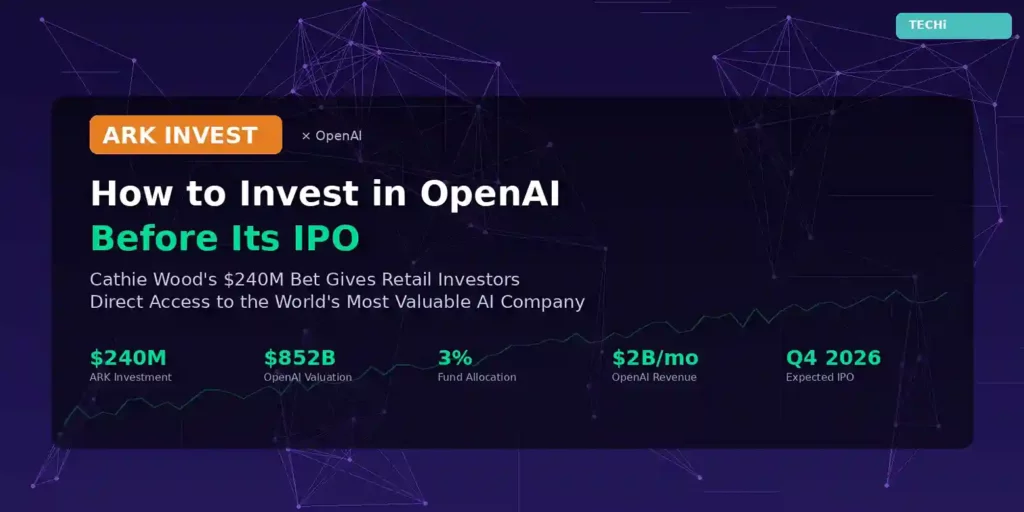
2. ARK venture fund (ARKVX): Ark Investment Management allocated $240 million to OpenAI in March 2026, which was distributed across the Ark Innovation ETF, Ark Next Generation Internet ETF, etc. Retail investors can access the venture fund through SoFi or Titan Global Capital Management, or through registered investment advisors.
3. Fundrise innovation fund: Fundrise offers OpenAI exposure with no accreditation requirement at a minimum investment of $10. It’s one of the few pre-IPO investing routes that doesn’t lock out regular investors.
4. Nvidia (NVDA): Nvidia committed $30 billion in GPU capacity to OpenAI as part of the February 2026 round. It invested in both OpenAI and Anthropic. And as AI infrastructure plays, it has real earnings backing its valuation in a way that neither AI lab does.
Best AI Stock Alternatives to OpenAI
If OpenAI’s 34x revenue feels stretched to you (it should), then these public options offer better AI exposure with a more defensible valuation:
The Hardware & Infrastructure Layer
- NVIDIA (NVDA): Dominant AI hardware. High multiple but backed by actual free cash flow..
- Broadcom: Benefits from custom AI chip demand and networking infrastructure growth.
- Taiwan Semiconductor Manufacturing Company: Manufactures the chips that both Nvidia and most custom AI silicon run on.
- Advanced Micro Devices: A growing challenger in AI chips as hyperscalers look to diversify beyond Nvidia
The Platform & Cloud Giants
- Microsoft (MSFT): Deep OpenAI integration via Copilot, and with better valuation than its OpenAI stake implies.
- Alphabet (GOOGL): Gemini models, AI search, and Google Cloud. AI spend looks cheap against its revenue base.
The Enterprise Software Layer
- Palantir Technologies: Enterprise AI software, government contracts, and one of the few AI software companies that’s actually profitable.
- Salesforce: Embedding AI into existing enterprise workflows with lower risk than betting on frontier AI labs.
- ServiceNow: Using AI to expand automation products across enterprise customers.
- Workday: Adding AI capabilities to HR and finance software with an existing enterprise customer base.
AI ETFs
- Global X AI & Technology ETF (AIQ): Broad AI exposure across hardware, software, and other services.
- ARK Innovation ETF (ARKK): Higher concentration with higher risk. But includes indirect OpenAI exposure via ARKVX.
- iShares Exponential Technologies ETF (XT): Broader tech diversification with AI-leaned infrastructure.
Upcoming Tech IPOs to Watch Alongside OpenAI IPO
The OpenAI IPO doesn’t exist in isolation. 2026 is shaping up as the most crowded IPO window in history. Three companies alone could require more capital than the entire US IPO market has raised in the past two years:
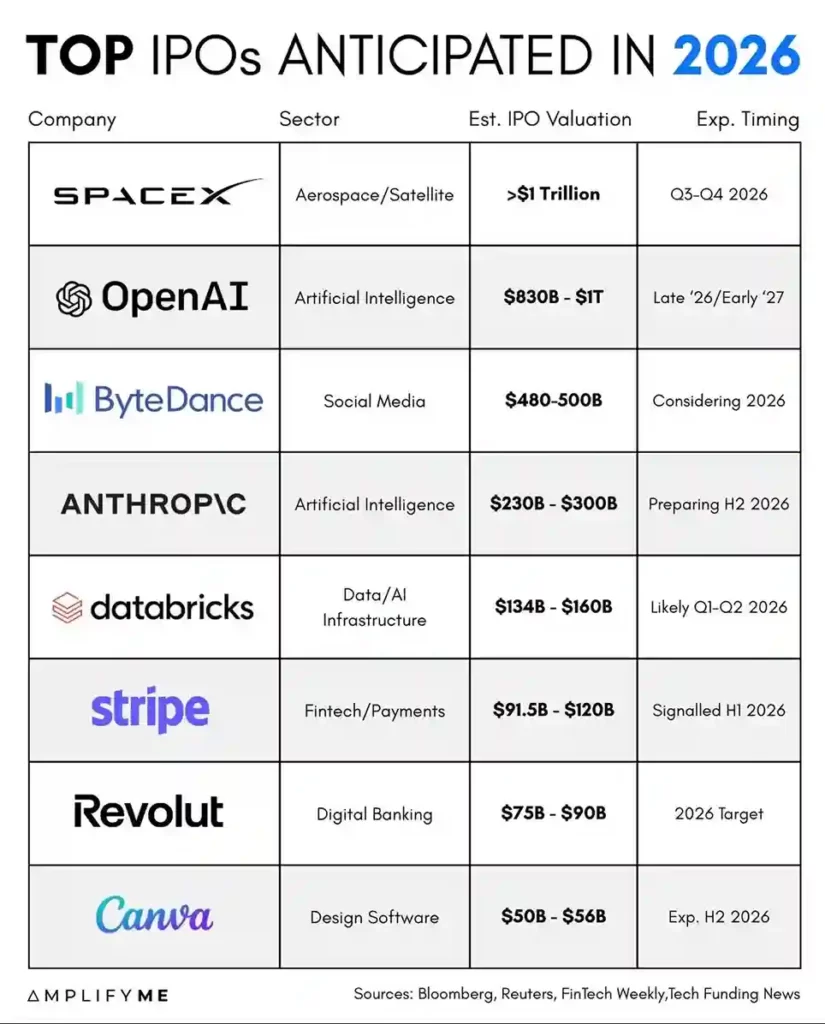
- SpaceX IPO: Targeting a June 2026 launch at roughly $75 billion in fundraising, with Musk reportedly reserving up to 30% for retail.
- Anthropic IPO: They’re targeting an October 2026 listing, raising over $60 billion at an approximately $380 billion valuation.
- OpenAI IPO: Q4 2026 target, gunning for $1 trillion valuation.
Combined, these three companies could require $240+ billion from public markets in a single quarter. From 2016 to 2025, the entire US IPO market raised $469 billion in total. The timing pressure matters as much as the individual company quality.
Key Risks Investors Should Consider
Valuation uncertainty
At $852 billion pre-IPO and 34x annualized revenue, OpenAI already prices in extraordinary execution. A $1 trillion IPO valuation would push that multiple even higher, on a company not expected to reach cash flow positive until 2030. Salesforce, at its peak, traded at around 12x revenue. The gap between OpenAI and any comparable SaaS company requires a level of dominance that hasn’t been established yet.
Regulatory challenges
OpenAI’s PBC governance structure is novel in public markets. The FTC and DOJ have both signaled interest in AI market concentration. A major regulatory action post-IPO could reshape the company’s operations and significantly compress its valuation.
Competition in the AI Sector
This is the risk I’d weigh most heavily before buying OpenAI stock.
Anthropic’s revenue grew at roughly 10x per year versus OpenAI’s 3.4x. Among enterprise buyers tracked by Ramp Economics Lab, Anthropic’s share of combined OpenAI and Anthropic enterprise spend went from roughly 10% in early 2025 to over 65% by February 2026. OpenAI built its lead on consumer ChatGPT. The enterprise API market is where durable, recurring revenue lives, and is moving fast in Anthropic’s direction.
If that trend holds, a $1 trillion OpenAI valuation becomes increasingly hard to defend.
Conclusion: What the OpenAI IPO Could Mean for Investors
The OpenAI IPO is genuinely significant. It’s the first time OpenAI IPO retail investors will have a direct path to the company that made AI mainstream. The revenue growth is real, the user scale is massive, and the CFO has committed to a retail OpenAI IPO allocation structure.
But the valuation demands extraordinary execution on a company burning $17 billion this year alone, facing a faster-growing competitor in enterprise, and not expected to turn cash flow positive for four more years. That’s not a dealbreaker; it’s context you need before deciding.
If you’re looking for investment opportunities in the AI sector, some indirect routes offer a much more meaningful exposure without betting at the top of a private valuation cycle. If the OpenAI IPO does land in Q4 2026, read the S-1 before committing. And that’s when company financials replace projections.
FAQs
Not directly yet. The CFO has confirmed retail investors will receive an OpenAI IPO allocation. Until then, non-accredited investors can get indirect pre-IPO investing exposure through the Fundrise Innovation Fund (minimum $10) or the ARK Venture Fund via SoFi or Titan.
OpenAI’s current valuation is approximately $852 billion following the $110 billion funding round in February 2026. OpenAI may target a $1 trillion valuation at IPO, placing the price-to-sales multiple at roughly 40x based on $25 billion in annualized revenue.
No. OpenAI is a private company as of April 2026.
OpenAI stock is not available on the NYSE, Nasdaq, or any public exchange. Pre-IPO shares are accessible to accredited investors through secondary market platforms like EquityZen, Forge Global, and UpMarket.
OpenAI IPO is expected late 2026 or early 2027.
OpenAI has not announced an official IPO share price yet, and no S-1 filing has been made. While valuations range from $852 billion to a potential $1 trillion IPO target, the final share price will depend on how many shares the company issues during the offering.
