



Most people think the AI race is about who has the best model. But the deeper contest is about who controls the model.
That is the question driving governments, enterprises, and policymakers into a concept called sovereign AI. And in 2026, it has moved from a policy talking point to a trillion-dollar infrastructure decision.
I have been tracking how countries and companies think about AI ownership for a while now, and honestly, the picture has shifted fast. Even a few years back, people used to say, “Just use the cloud”. But now that answer has changed at every level.
Here is my attempt to break down what sovereign AI actually means, why it matters, and how the six strategic pillars behind it actually work.
Key Takeaways
- Sovereign AI is a country’s or organization’s ability to develop, deploy, and govern AI using its own infrastructure, data, models, and talent.
- It is not the same as data sovereignty or digital sovereignty, though all three are related.
- McKinsey estimates that 30 to 40% of global AI spending will be influenced by sovereignty requirements, representing a $500 billion to $600 billion opportunity by 2030.
- The six strategic pillars are: data sovereignty, AI infrastructure, AI data centers, cloud sovereignty, AI governance, and talent development.
- Sovereign AI is not a binary choice. It is a spectrum of decisions across the AI stack.
What Is Sovereign AI?
Sovereign AI refers to the ability of a country or organization to develop, deploy, and govern artificial intelligence using its own data, infrastructure, models, and legal frameworks. It ensures that AI systems operate under local control, without reliance on foreign providers or external jurisdictions.
NVIDIA defines sovereign AI as a nation’s capability to produce artificial intelligence using its own infrastructure, data, workforce, and business networks. That is a solid starting point.
But I think the McKinsey framing gets closer to what is actually happening. According to McKinsey, sovereign AI is about who controls intelligence. Not just hardware, not just data, but the entire AI life cycle: from physical compute to algorithmic logic.
In simple terms, sovereign AI means that,
- Your data doesn’t leave your country.
- Your models run on devices that you own or control.
- Your AI decisions are auditable under the nation’s laws.
- Foreign governments and third-party vendors cannot access, modify, or shut down your systems.
Deepset puts it neatly; sovereign AI is the idea that an entity has independent control over its AI systems, data, and infrastructure, where that entity can be a nation, a company, or a public institution.
Sovereign AI isn’t just a government concern. Enterprises dealing with sensitive IP, healthcare records, or regulated financial data face the same pressure.
Why Sovereign AI Matters, Now and Beyond?
Here is what I keep coming back to: the more AI becomes the operating layer of governments and companies, the more dangerous it is to rent that layer from someone else.
A few years ago, using a foreign AI API felt like a reasonable trade-off. Today, that dependency looks like a structural vulnerability.
Three things have converged to make sovereign AI a genuine priority in 2026:
Geopolitical risk is real and immediate
The India AI Impact Summit in February 2026 has made clear that for countries, AI isn’t a downstream tech. India announced expanded domestic computing capacity and a push for locally developed models.
Trade restrictions on high-end GPUs, the U.S. CLOUD Act (which can compel American cloud companies to hand over data stored abroad), and shifting global allies have made the risk of foreign AI dependency a fragile concept.
Regulation is tightening fast
The EU AI Act will be fully applicable by August 2026. It mandates transparency and data traceability for AI models. Sector-specific laws already require strict data localization. So, sovereign AI becomes the only compliant option for regulated industries.
IBM’s research found that around 79% of surveyed executives believe that AI will positively impact their revenues by 2030. With stakes that high, you want to control the systems generating that value.
AI agents have raised the stakes
In the past couple of years, AI has moved from just being a chatbot to autonomous agents handling real business. When your AI is making decisions in real time, and not just generating text, it matters much more. The economic value flowing through your data should stay in your country or company, not export itself to a foreign API every time an agent makes a call.
Sovereign AI vs Data Sovereignty vs Digital Sovereignty
People mix these up constantly. They are related but not interchangeable.
| Concept | Scope | Core Question |
| Data Sovereignty | Where data is stored and who governs it | Is my data subject to local laws? |
| Digital Sovereignty | Broad control over all digital systems and infrastructure | Can I govern my digital economy? |
| Sovereign AI | Full control over AI systems, models, compute, and outputs | Do I own the intelligence built on my data? |
McKinsey makes this distinction clearly: you can have data sovereignty without sovereign AI. If you store data locally but send it to a foreign model for processing, the intelligence layer still flows out. Sovereign AI is the layer above data sovereignty.
Meanwhile, cloud sovereignty, sits between these concepts. It focuses specifically on controlling cloud platforms and the compute running. You can have sovereign cloud without full sovereign AI, and sovereign AI without full digital sovereignty. They are nested concerns, not equivalent ones.
The 6 Strategic Pillars of Sovereign AI
The World Economic Forum identifies six strategic pillars guiding nations on how to build sovereign AI. Here is how I think about each one.
Data Sovereignty
Data sovereignty is the foundation. If the training data is not yours, the model is not really yours either.
- Storing and processing data within national or organizational borders.
- Enforcing data localization policies under local law.
- Preventing unauthorized foreign access to sensitive datasets.
- Building interoperable data-sharing standards so the data is actually usable, not just locally hoarded.
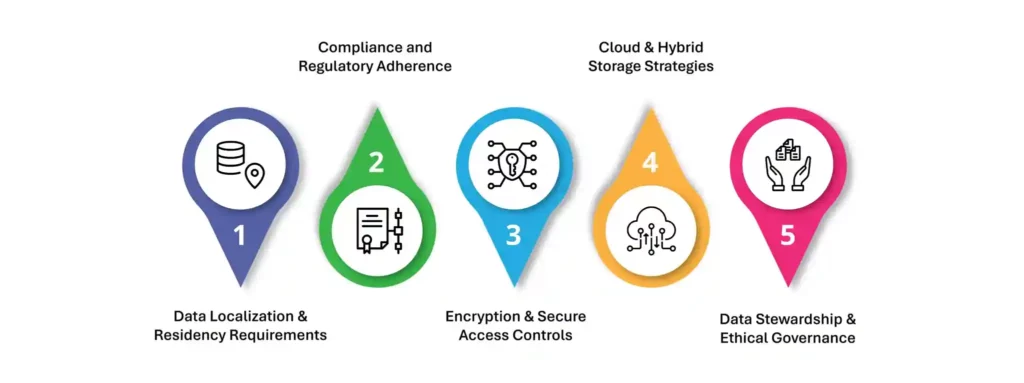
Deepset flags a key concern here. Under the U.S. CLOUD Act, American cloud providers can be compelled to hand over data to U.S. authorities even if that data is stored in another country. True data sovereignty sidesteps this by keeping both compute and data under local jurisdiction.
Data sovereignty means having control over your own data. Countries can share data across borders through G2G agreements while still maintaining data sovereignty.
AI Infrastructure
You cannot build sovereign AI without an AI infrastructure of your own.
NVIDIA calls these setups “AI factories”. These are the data centers where raw data goes in, and intelligence comes out. The physical layer underneath that requires:
- Domestic GPU capacity for training and running models without routing workloads through foreign clouds.
- High-performance compute clusters to handle the parallelism modern AI training demands.
- Network infrastructure with low-latency interconnects between nodes.
- Energy systems are usually the first hard constraint nations hit at scale.
Most countries still depend on AWS, Azure, or Google Cloud for the bulk of their core system. And to fix that, you need to procure domestic hardware, partner with local cloud providers, and fund semiconductor programs to reduce chip dependency.
India’s approach to the 2026 AI Impact Summit is instructive. Just focus on application-layer sovereignty first rather than rebuilding the entire stack.
McKinsey puts the market at $500B to $600B by 2030. The demand is there. The infrastructure is catching up.
AI data centers
AI data centers are where sovereign AI infrastructure gets a physical shape.
These aren’t standard IT data centers. They use specialized AI chips, primarily GPUs, that require massive power capacity and are designed for the computational intensity of training and running large models. Red Hat describes optimization software like vLLM and distributed inference as what makes it financially feasible to run high-performance AI without renting expensive public cloud APIs.
For sovereign AI to work at scale, nations need AI data centers that:
- They are based within the country.
- Use secure, single-tenant infrastructure (not shared hyperscaler resources).
- Can support model training and real-time inference.
- Meet energy efficiency and sustainability standards.
Several countries, including Saudi Arabia, Singapore, Taiwan, and EU member states, are actively building or commissioning sovereign AI data centers. The economic logic is straightforward; if your AI runs on foreign infrastructure, the economic value of your data exports itself every time a query is processed.
Cloud Sovereignty
Cloud sovereignty is specifically about controlling the cloud layer, the platforms where AI workloads run.
Deepset describes this as AI systems running on private cloud, sovereign cloud, or on-premises systems, rather than relying on hyperscalers or foreign-hosted platforms.

Cloud sovereignty involves:
- Sovereign cloud deployments managed by domestic or vetted providers.
- Private cloud configurations where the organization controls the hardware.
- On-premises AI deployments for the most sensitive workloads.
- Contractual and technical controls preventing vendor lock-in.
Cloudera notes that cloud sovereignty matters particularly because geopolitical shifts can cause sudden service denials or trade restrictions on the hardware needed to run AI. A sovereign cloud gives organizations a way to maintain operations even if external conditions change. Sovereign AI basically does not rely on someone else’s power grid.
AI governance and regulation
Owning the infrastructure isn’t enough if you cannot govern what runs on it.
AI governance is the policy and regulatory layer. The rules that define how AI systems should be built, deployed, and operated. Without governance, sovereign AI infrastructure can be misused as easily as foreign-hosted AI.
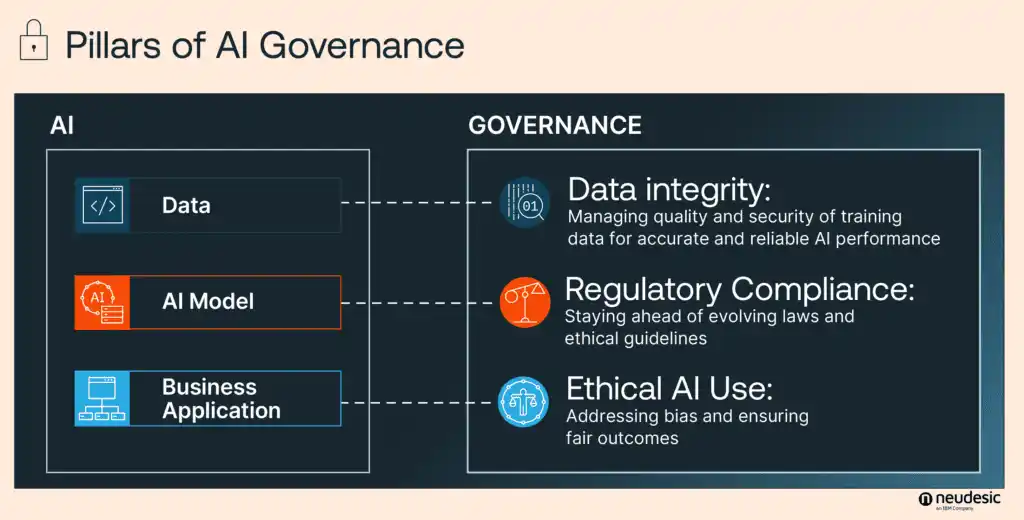
Key elements of AI governance include:
- Legal frameworks, like the EU AI Act, national AI strategies, etc.
- Technical guardrails: monitoring tools, bias-checking, output that logs.
- Auditability requirements so that decisions made by AI systems can be reviewed.
- Clear accountability structures when AI systems fail or cause harm.
Cloudera makes a point I find hard to argue with: you cannot audit what you do not own. Sovereign AI provides the transparency needed to generate the evidence logs that modern regulators require.
AI governance is also the pillar that most countries are still figuring out. The EU is furthest along with the AI Act. Most nations are still building national AI strategies without the regulatory infrastructure to back them up.
Talent and national AI ecosystem development
All of the above is meaningless without people who can build, run, and improve these systems.
Sovereign AI requires a national talent ecosystem: engineers, data scientists, AI safety researchers, policy experts, and domain specialists who can work with AI in legally and strategically sensitive contexts. The WEF emphasizes that initiatives must focus on STEM education and encouraging professionals into AI careers.
This pillar includes:
- University research partnerships and domestic R&D programs.
- Private-sector investment in AI startups.
- Competitive compensation structures to prevent brain drain.
- Cross-border collaboration for knowledge transfer, even among sovereign nations.
The talent challenge is where many nations fall short. Building AI infrastructure is a capital problem. Building an AI talent ecosystem is a generational one.
Challenges in Building Sovereign AI
Sovereign AI sounds compelling in theory. In practice, it runs into some hard constraints:
Cost: Building domestic AI data centers at a large scale is expensive. Most countries can’t replicate the infrastructure investments of major hyperscalers without significant public funding.
Semiconductor dependency: Advanced GPUs are manufactured by a small number of companies, primarily in Taiwan. Full-stack sovereignty is structurally limited by chip supply chains that remain highly concentrated.
Talent scarcity: AI talent is globally mobile and disproportionately concentrated in a few countries. Retaining top researchers locally is a sustained policy challenge.
Balancing openness and control: Countries that push for sovereign AI risk falling behind on developing major models. McKinsey’s research suggests that the most effective strategy is not full isolation but a layered approach. Use global frontier models where feasible, and develop sovereign models where control matters most.
Time horizons: Sovereign AI infrastructure takes years to build. The geopolitical and regulatory pressures driving demand are moving faster than most nations’ ability to respond.
Global Approaches to Sovereign AI
Different countries are taking different bets on where to assert sovereignty:
European Union: The EU AI Act plus GDPR creates the world’s strongest regulatory floor for sovereign AI. Member states are investing in shared European AI data centers and pushing for EU-based cloud providers as alternatives to American hyperscalers.
India: The strategy is application-layer sovereignty. India’s focus on multilingual models, voice interfaces, and AI embedded in Digital Public Infrastructure puts sovereignty at the citizen-state boundary rather than the frontier model layer. The logic: you do not need to build the foundation model from scratch to assert meaningful sovereignty.
Saudi Arabia and the UAE: Heavy capital investment in domestic AI data centers and GPU capacity. Countries with sovereign wealth funds are using them to buy their way into sovereign infrastructure faster than purely organic development would allow.
Singapore and Taiwan: Cultural and linguistic models developing AI infrastructure alongside investments in domestic computing. They focus on becoming regional AI infrastructure hubs rather than fully isolated sovereign systems.
The Future of Sovereign AI
In 2026, sovereign AI is transitioning from a concept to a procurement decision.
Governments are pushing for expertise in sovereign AI. Enterprises in regulated industries are building it into compliance frameworks. Cloud providers are launching sovereign cloud tiers. And the economics are shifting.
A few things I think are worth watching:
- Confidential computing is becoming the technical infrastructure for practical sovereignty. It lets nations and organizations move from hoping their data is safe to knowing it, because the compute itself enforces privacy guarantees.
- Open-source models are a sovereignty enabler. When you can run and inspect the model weights, you do not need to trust a vendor’s security claims.
- AI bills of materials (AIBOMs) will become standard. Just as software supply chain transparency became a regulatory requirement after major breaches, the AI stack will face the same pressure.
The deeper shift is this: for most of history, a country’s power came from controlling physical territory, energy, and military capacity. In the AI era, intelligence infrastructure is becoming the same kind of strategic asset. The countries and companies that figure out sovereign AI early will hold an asymmetric advantage in every domain it touches: defense, healthcare, finance, and governance.
Final Thoughts
Sovereign AI isn’t about nationalism or being in isolation. It’s more about not handing over the OS of your economy to someone you can’t audit, hold accountable, or disconnect from if the relationship turns sour.
The six pillars, data sovereignty, AI infrastructure, AI data centers, cloud sovereignty, AI governance, and talent development, aren’t just some checkboxes. They reinforce each other. You cannot have meaningful AI governance without the infrastructure to enforce it. You cannot build AI data centers without talent. Data sovereignty cannot be exercised if your compute runs on someone else’s cloud.
Most nations and organizations won’t be able to achieve full sovereign AI in the near term. But the ones making smart, incremental bets now on the pillars that matter most to their context will be in a structurally stronger position than those waiting for a complete sovereign stack to appear.
The question is not whether sovereign AI is achievable. It is which layers you need to own, and how fast you can build them.
FAQs
No. Data sovereignty is specifically about where your data lives and who governs it. Sovereign AI goes further. It includes the models trained on that data, the infrastructure running them, and the governance layer above them.
Cloud sovereignty means controlling the cloud platforms where AI workloads run. It is one pillar of sovereign AI. You can have sovereign cloud without achieving full sovereign AI if you do not also control the models, data, and governance above the cloud layer.
Sovereign AI is important because it allows countries and organizations to control their AI infrastructure, data, and models without depending on foreign providers. It improves data security, regulatory compliance, economic resilience, and national competitiveness while reducing the risks of foreign surveillance, vendor lock-in, and geopolitical disruptions.
The six pillars of sovereign AI are data sovereignty, AI infrastructure, AI data centers, cloud sovereignty, AI governance, and talent development. Together, these pillars help countries and enterprises build AI systems that operate under local control, comply with national regulations, and support long-term technological independence.
Several countries are actively investing in sovereign AI, including India, the European Union member states, Saudi Arabia, the UAE, Singapore, and Taiwan. These nations are building domestic AI infrastructure, sovereign cloud systems, local AI models, and AI data centers to strengthen economic competitiveness, regulatory control, and national security.
