


I’ve been following open-source AI models for a while. Most new releases are forgettable, same base model, slightly different tuning, no real behavioral change. GemOpus is different.
When Google released Gemma 4 on April 2, 2026, developers immediately started building on top of it. Within two weeks, a pseudonymous developer named Jackrong released GemOpus: a version of Gemma AI retrained to behave more like Claude Opus, Anthropic’s premium model. The result is a free, locally runnable AI that combines Google’s architecture with Anthropic’s conversational style.
Key Takeaways
- GemOpus is not an official Google product. It is a community-built version of Gemma AI 4.
- It comes in two sizes: a 26B version for desktops and a 4B version for phones and laptops.
- Run it in LM Studio or llama.cpp by downloading one file. No complex setup required.
- Tool calling is currently broken across all Gemma 4 models in local apps. This is a Gemma 4 issue, not GemOpus-specific.
- Gemma AI uses the Apache 2.0 license, free commercial use, no legal gray areas.
- Jackrong himself says GemOpus is not ready for production. His older Qwopus project is more stable if you need reliability today.
What Is Gemma AI?

Gemma AI is Google’s family of open weight AI models built to run locally on your own hardware. No cloud, no subscription, no data leaving your machine. It is the open, self-hosted alternative to Google’s Gemini, and one of the best open source AI models available today under the Apache 2.0 license.
What you need to know:
- It runs on your device: Gemma AI is designed for local deployment unlike Gemini. Download it once, run it forever with no API costs.
- It is fully free to use commercially: The Apache 2.0 license means you can modify it, build products with it, and deploy at scale without usage fees or legal gray areas.
- It is built on the same research as Gemini: You are not getting a dumbed-down model. Gemma is distilled from the same core technology Google uses for its flagship AI.
- It supports images natively: Unlike many open weight AI models that bolt on multimodal support, Gemma 4 understands images out of the box, no extra pipeline required.
- It scales to your hardware: As a lightweight AI model, smaller variants run on a phone or laptop. Larger ones need a GPU or Apple Silicon Mac.
- Gemma 4 is a major leap: Released April 2, 2026, agentic benchmark scores jumped from 6.6% to 86.4% over the previous generation, making it a serious option for AI for developers building local tools.
- It has a massive community: Over 400 million downloads and 100,000+ community variants built since launch, what Google calls the “Gemmaverse.”

What Is GemOpus and How It Improves Gemma AI
GemOpus is a community fine-tune of Google’s Gemma 4, retrained to match Claude Opus’s conversational style and answer quality. It runs entirely on local hardware, costs nothing after setup, and ships as a single GGUF file compatible with LM Studio and llama.cpp.
Think of GemOpus as a personality transplant for Gemma AI. Gemma 4 is powerful, but its default tone can feel stiff and overly formal. Jackrong retrained it on a curated dataset of natural human conversations to make it warmer, more helpful, and more like talking to a person.
GemOpus ships in two versions:
- Gemopus-4-26B-A4B: For users with a dedicated GPU or Apple Silicon Mac
- Gemopus-4-E4B: A small edge model for phones and thin laptops
Both are GGUF files. GGUF is a single-file model format designed to load directly into local inference apps like LM Studio or llama.cpp with no additional configuration. You download one file and you are running.
“There is no need for excessive imagination or superstitious replication of the Claude-style chain of thought.” – Jackrong, model card
Most competing fine-tunes copy Claude’s chain-of-thought text directly into the model. The problem, as Jackrong explains in the documentation, is that copying visible reasoning doesn’t teach better reasoning, it just teaches the style. Answers can sound confident while still being wrong. GemOpus instead focuses on answer quality, clear structure, and natural tone.
A note on Qwopus:
Jackrong’s earlier project, Qwopus 3.5, applies the same Claude-style fine-tuning approach to Qwen’s base model instead of Gemma. It is more stable and better tested than GemOpus right now. If you need something production-ready today, Qwopus 3.5 is the safer starting point. GemOpus is the more exciting experiment, but it is not there yet.
What Changed in Gemma AI After the GemOpus Update
Performance and Efficiency
GemOpus inherits a massive capability jump over the previous generation. Here’s what the benchmarks show:
| Benchmark | Gemma 3 27B | Gemma 4 31B | What It Means |
| AIME 2026 (advanced math) | 20.8% | 89.2% | Solves most competition-level math problems |
| LiveCodeBench v6 (coding) | 29.1% | 80.0% | Handles the majority of real coding tasks reliably |
| GPQA Diamond (graduate science) | 42.4% | 84.3% | Graduate-level science reasoning now viable |
| Agentic tool use | 6.6% | 86.4% | Multi-step task execution went from broken to functional |
The Gemma 4 31B currently ranks #3 among all open models worldwide on Arena AI. GemOpus builds on that foundation.
Model Size and Memory
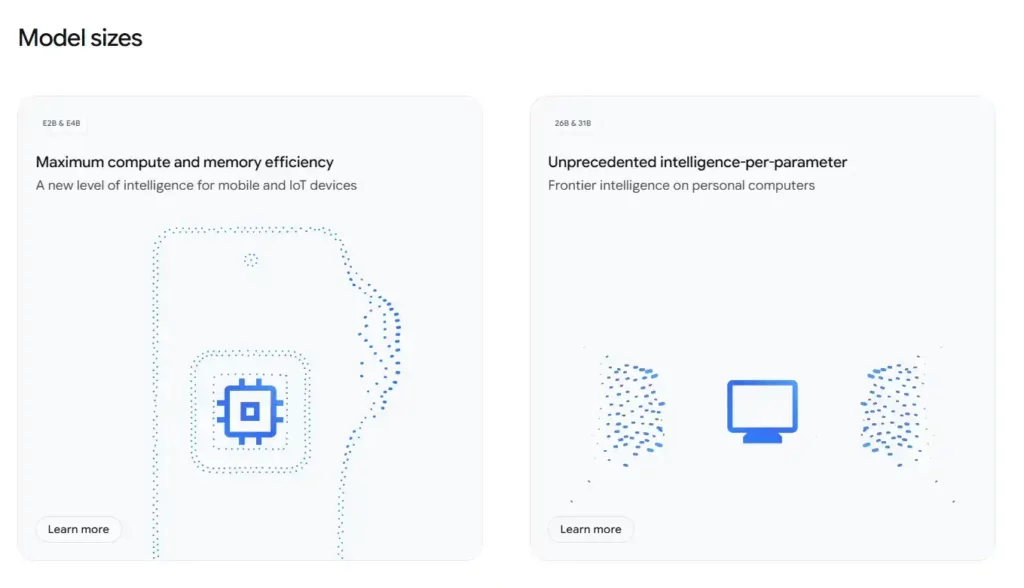
The lightweight AI model design is deliberate. The E4B runs on a phone. The 26B A4B fits on a 16GB MacBook Air.
| Model | Hardware Needed |
| E4B | Thin laptop or older computer |
| 26B A4B | 16GB MacBook Air (Apple Silicon) |
| 31B Dense | High-end gaming GPU |
The 26B A4B uses a Mixture of Experts architecture, activating approximately 3.8 billion parameters per query rather than all 26 billion at once. Only the relevant part of the model runs for each question, which is why it fits on a 16GB MacBook Air. Note: this figure is an approximation based on the MoE routing design, not an official Google number.
One hardware caveat: a single A100 (80GB VRAM) and two RTX 4090s (48GB combined) are not equivalent. The A100 runs the 31B Dense model at full precision. The dual RTX 4090 setup requires reduced quantization to fit.
Tooling
Gemma 4 added built-in function calling, letting the AI interact with outside apps and data sources. The honest caveat: tool calling is currently unreliable in both llama.cpp and LM Studio, failed calls, wrong formats, models getting stuck in loops. For writing, summarizing, and generating code without tool use, it works well.
Where Gemma AI Fits in Google’s AI Ecosystem
Local AI models are machine learning systems that run entirely on your own hardware rather than a remote server. No API calls, no usage fees, no data leaving your machine. Gemma AI is one of the few models in this category capable enough for real development work on consumer hardware.
Gemini vs Gemma: Cloud vs Local AI
Gemini is Google’s cloud-based AI system, accessed through apps, APIs, and web tools. Gemma AI, on the other hand, is built to run locally on your own hardware.
Gemma 4 uses the same underlying research foundations as Gemini-class models. That means you’re not working with a simplified system, you’re running technology built from the same core ideas, optimized for local AI models instead of cloud deployment.
The Gemmaverse and Community Growth
Gemma adoption has grown quickly, with hundreds of millions of downloads and thousands of developer-built variants. Google refers to this expanding ecosystem as the “Gemmaverse.”
The size of this community is part of what makes Gemma AI one of the best open source AI models to build on long term. More developers building on open weight AI models means faster bug fixes, better fine-tunes, and improved tooling support over time. Active ecosystems tend to improve faster than isolated models, making them more reliable for long-term experimentation.
Licensing and Why It Matters for Developers
One of Gemma AI’s biggest advantages is its Apache 2.0 license. Developers can modify, redistribute, and use the model commercially without paying usage fees or dealing with restrictive scaling limits.
Some competing models introduce licensing thresholds that complicate large-scale deployment. Apache 2.0 avoids those barriers, making Gemma easier to integrate into products and internal tools.
Gemma AI vs GPT: Key Differences
GPT models run entirely in the cloud, while Gemma AI is designed to run on local hardware.
Teams working with internal datasets often prefer local deployment because it reduces external data exposure and supports stronger privacy-first AI workflows.
| Feature | GPT Models | Gemma AI |
| Deployment | Cloud-only | Runs locally on user hardware |
| Architecture | Dense neural networks | Mixture of Experts (MoE) |
| Coding Performance | Strong on complex, multi-file workflows | Strong on routine and structured tasks |
| Offline Capability | Not supported | Fully offline operation |
| Cost Model | Pay-per-use API pricing | No per-use cost after setup |
| Custom Training | Limited customization access | Can be fine-tuned on private data |
| Data Handling | Data sent to cloud servers | Data stays on local machine |
| Best Use Case | Large-scale projects and deep reasoning | Private workflows and local development |
Gemma AI vs Claude: Developer Workflow Comparison
| Feature | Claude | Gemma AI |
| Usability | Browser-based, no setup required | Requires downloading model and local setup |
| Setup Time | Instant access | ~20 minutes for developers |
| Reasoning | Strong on complex, multi-step reasoning chains | Reliable for routine development tasks |
| Coding | Handles multi-file debugging well | Handles ~85-90% of standard coding tasks |
| Context Window | Standard context window | 256K token context window |
| Multimodal Support | Supported, but often layered | Native multimodal support |
| Deployment | Cloud-only | Local and edge deployment supported |
| Cost Model | Pay-per-use API pricing | No per-use cost after setup |
| Best Use Case | Complex workflows and large projects | Private tools and local development |
Local deployment is especially useful for teams prioritizing data protection and controlled environments.
Practical Use Cases Where Gemma AI Makes Sense
Gemma is not just a research project. It is a production-capable local AI model that solves real problems for developers, small businesses, and enterprise teams alike. Here is where it actually makes sense to use it.
Local and Edge Deployment
Some data simply cannot leave your building. Gemma is one of the few open weight AI models that makes truly private deployment practical on everyday hardware.
- Prompts with sensitive customer data that cannot touch a third-party server
- Offline apps for field teams, factories, or regions with unreliable internet
- Healthcare, legal, and financial workflows with strict compliance requirements
- Edge hardware and IoT devices where cloud latency is not acceptable
If your team handles regulated data, Gemma removes the legal gray area entirely. You own the hardware, the weights, and the data.
Internal Tools
This is where most teams hit a wall with cloud AI.
Most cloud AI terms of service restrict or outright prohibit processing private company data. Even when they technically allow it, your legal or compliance team likely will not sign off. A locally hosted Gemma model sidesteps this completely.
Common internal tools developers are already building with it:
- Customer support bots trained on internal documentation
- Private database search tools
- Automated code review embedded directly in the development pipeline
- Document summarization for legal and finance teams
Small businesses run into this constantly. Local deployment removes the blocker without requiring a six-figure enterprise AI contract.
Rapid Prototyping
For developers evaluating AI features before committing to a cloud API, local AI models are simply faster and cheaper to test with.
Here is what the workflow looks like with GemOpus:
- Download the GGUF file from Hugging Face
- Drop it into LM Studio
- Start prompting
Total setup time: under an hour. No API keys, no billing account, no usage caps mid-test.
Once it works, swap in a cloud model for production or keep running locally.
Is Gemma AI Among the Best Open Source AI Models Today?
| Model | Best for | License |
| Gemma AI 4 | Efficiency, multimodal, commercial safety | Apache 2.0 |
| Llama 4 Scout | Large context, Meta tools ecosystem | Llama Community License |
| DeepSeek V3.2 | Raw performance, agentic workflows | MIT |
| Qwen 3.5 | Fine-tuning stability, reliable tool use | Apache 2.0 |
Gemma leads on licensing and multimodal support. It trails Qwen on fine-tuning stability, if building a custom version is your goal, Qwen is currently the easier base.
Limitations of Gemma AI
- Coding quality drops when handling complex multi-file projects.
- Tool calling remains unreliable in popular local inference tools.
- Fine-tuning requires careful configuration and testing.
- Raw benchmark performance still trails leading closed models.
- Performance gaps become more noticeable on advanced reasoning tasks.
Getting Started With Gemma AI

Local AI models like Gemma have never been easier to set up.
Setup:
- Download Ollama or LM Studio and install it
- Run ollama pull gemma4:26b or download GemOpus directly from Hugging Face
- Open the app and start chatting, or connect via the local API
Hardware guide:
One of Gemma’s strengths as a lightweight AI model is how little hardware the smaller variants actually need.
| Use Case | Minimum Hardware |
| GemOpus E4B | Modern phone or 8GB laptop |
| GemOpus 26B A4B | 16GB MacBook Air (Apple Silicon) or RTX 4090 |
| Gemma 4 31B | Two RTX 4090s or an A100 GPU |
Best languages: Python and JavaScript get the strongest results. Java, C++, and Rust work reliably for standard patterns. SQL and Go are functional but less consistent.
Conclusion
GemOpus is not production-ready, and Jackrong says so himself. But it represents something that genuinely did not exist before: Google’s open weight architecture, a clean Apache 2.0 license, and Anthropic-style conversational polish, all running on hardware you own.
The Gemma 4 base underneath it is not an incremental update. Agentic benchmarks jumped from 6.6% to 86.4%. Math reasoning went from 20.8% to 89.2%. These are the kinds of numbers that change what a model is actually useful for.
For production work today, Qwopus 3.5 or a cloud Claude API are the safer bets. But if you want to see where local AI models are heading, GemOpus is the most useful experiment you can run right now. The architecture is real, the license is clean, and Gemma AI remains one of the best open source AI models within reach for everyday developers.
FAQs
Yes. Apache 2.0 means free use, modification, and commercial deployment with no per-use fees and no user-count restrictions. You download the model weights and run them on your own hardware indefinitely.
Yes, via Unsloth, Hugging Face, and Keras. GemOpus was built exactly this way. Gemma’s training process is more sensitive than Qwen’s, so careful hyperparameter testing and dataset curation are required. If fine-tuning stability is your top priority, Qwen 3.5 is currently the easier base to work with.
Download Ollama or LM Studio, then pull your preferred model size. The 26B A4B version runs on a 16GB MacBook Air at reduced precision, the MoE design keeps active memory usage low even though the total parameter count is large. GemOpus GGUF files load directly into these apps with no additional configuration.
Python and JavaScript get the strongest results. Java, C++, and Rust work reliably for standard patterns, though complex library usage is less consistent. SQL handles common queries well but struggles with advanced dialect-specific syntax. Complex multi-file tasks are where Gemma falls furthest behind Claude or GPT.
For writing, summarization, and code generation without tool use, yes, it handles everyday tasks reliably. Agentic workflows that depend on tool calling are not ready yet due to the current llama.cpp and LM Studio compatibility issues across all Gemma 4 models.
