


Most AI policy news regarding the AI Executive Order looks like a press release. This one actually has teeth, or at least the outline of them.
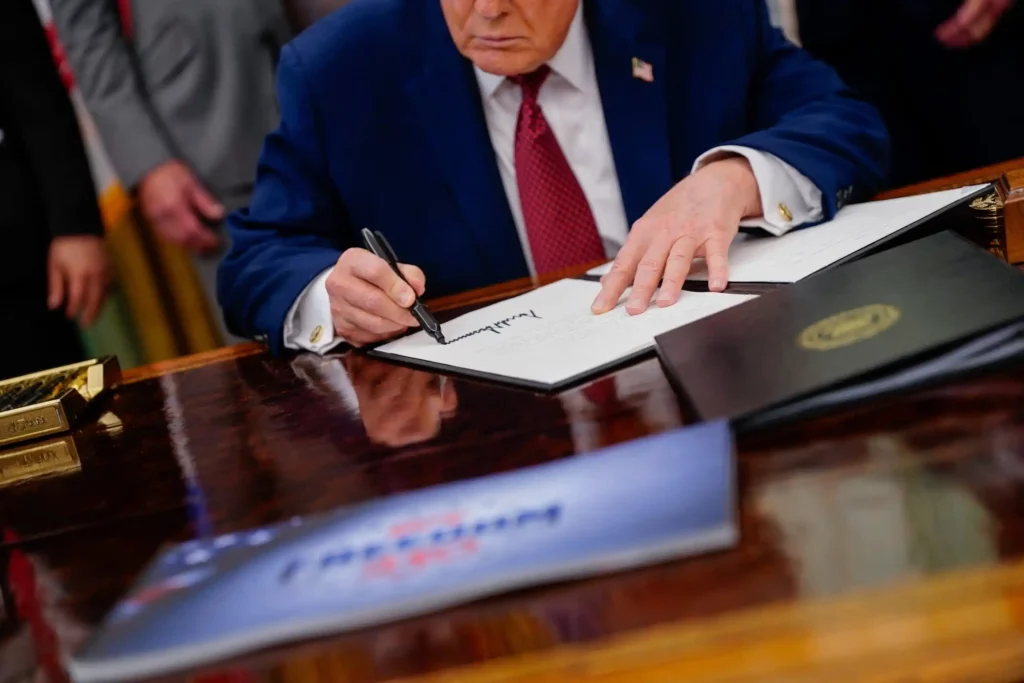
On June 2, 2026, President Trump signed the “Promoting Advanced Artificial Intelligence Innovation and Security” executive order, making it the first meaningful federal AI oversight mechanism his administration has issued. It introduces two core mechanisms. A voluntary 30-day pre-release cybersecurity review for frontier AI models, and a Treasury-led clearinghouse to coordinate vulnerability patching across the private sector. The central tension in both is the word voluntary. Whether this AI executive order actually shapes AI governance in practice depends entirely on cooperation that no law currently enforces.
We’ll look into what the order actually says, where the gaps are, and why the gaps matter more than the headline.
Key Takeaways
- President Trump signed an AI executive order titled “Promoting Advanced Artificial Intelligence Innovation and Security” on June 2, 2026
- The voluntary framework allows developers to give the federal government access to covered frontier models for up to 30 days before releasing them to other trusted partners.
- Covered frontier model designation runs through a classified NSA process, with no public criteria for self-assessment.
- There are no binding mandates or legal penalties for companies that opt out of the review.
- The original draft included a 90-day review window; it was reduced to 30 days over concerns about U.S. competitiveness with China.
What Is Trump’s 2026 AI Executive Order?
The U.S. government released an AI Executive Order titled “Promoting Advanced Artificial Intelligence Innovation and Security.” The order was signed by President Trump on June 2, 2026. The NSA director will determine covered-model designations in consultation with the National Cyber Director, CISA, White House science adviser, and other defence representatives, and the U.S. Treasury will lead the vulnerability coordination clearinghouse.

The stated goal of the policy is to promote AI innovation and security through private sector collaboration. It also aims to harden information systems against external threats, protect American intellectual property from adversary theft, and cultivate advanced AI-enabled capabilities.
But the order doesn’t have any enforceable safety benchmarks, no legal penalties for developers who decline to participate. AI regulation under this framework is fully cooperative by design.
Why was it issued now?
Three specific pressures made the U.S. take this step:
- Claude Mythos capabilities: Concerns have mounted over Anthropic’s Claude Mythos Preview model and its ability to autonomously identify and exploit vulnerabilities in real-world software. That specific risk profile made the AI safety case for pre-release review much harder to dismiss.
- The pulled May draft: An earlier version of this AI executive order was nearly issued in May but was pulled after internal concerns that a 90-day review window would blunt U.S. labs’ ability to compete with China. The signed version cuts that to 30 days.
- Documented adversarial use: Google’s threat intelligence team has documented state-aligned actors already using frontier AI models to automate cyberattacks.
Defining the AI Executive Order Target: What’s a Covered Frontier Model?
The AI executive order comes up with a very critical gap, and the order doesn’t fully solve it.
Frontier AI models are probabilistic, emergent, and opaque, with no fixed capability ceilings. A model that looks unremarkable in a controlled test can become a serious threat when integrated into an autonomous pipeline with real-world infrastructure access.
The order designates AI systems as “covered” based on performance in context to national security. And it includes autonomous operations, cyber operations, and scientific reasoning. CFR analysts argue that the designation should be understood as covering the broader AI system, including integrated models, data pipelines, and deployment architecture, not only the model weights.
The risk here cuts in both directions:
- Too narrow a definition: Genuinely dangerous capabilities ship without any federal review.
- Too broad a definition: The review process exhausts the limited pool of people qualified to do this work, and the whole framework seizes up.
The new classified benchmarking process
The NSA will run a classified process to determine which models qualify as covered frontier models. What the public knows is the designation exists and triggers the 30-day review. But what remains classified is the specific criteria, capability thresholds, and evaluation methodology. And without transparent criteria, mid-tier developers can’t self-assess whether their system qualifies.
Key Provisions of the Executive Order
The order’s architecture works as three interlocking pieces, access, coordination, and deterrence.
The voluntary 30-day early access review
AI companies that develop covered frontier models are asked to voluntarily provide the federal government secure access to those models up to 30 days before their planned release. The review evaluates whether the model can identify and exploit vulnerabilities in real-world software systems.
The keyword is voluntary. There is no legal consequence for opting out. CFR analysts note that labs will likely participate in the testing regime voluntarily, if only to forestall more invasive regulation later. That calculus holds only as long as the regulatory threat remains credible.
The AI cybersecurity clearinghouse
The clearinghouse brings together AI firms, tech companies, and operators of critical infrastructure to find and patch software vulnerabilities before adversaries can exploit them.
But the Treasury leading the process is an unusual choice. More obvious candidates for AI oversight coordination include CISA and the Office of the National Cyber Director. The likely explanation, per CFR’s analysis, is institutional capacity: Treasury is one of the few federal agencies where cybersecurity staffing wasn’t significantly cut over the past 18 months.
Increased criminal penalties for AI-assisted cyberattacks
The order directs the attorney general to prioritise enforcement of existing federal criminal laws against people who use AI to access or damage computer systems unlawfully. The intent is deterrence.
The enforcement problem is attribution. Criminal charges require proving who conducted the attack, and attribution in cybersecurity is one of the hardest problems in the field. State-aligned actors are not reliably deterred by domestic criminal statutes. The provision has more practical impact on domestic bad actors than on the foreign threats driving the AI safety urgency behind the order.
How the AI Executive Order Changes U.S. AI Policy
Before this order, the Trump administration’s posture on AI was deregulation-first, with no pre-release review mechanism and no formal AI-related cybersecurity coordination body. So, this order is a genuine shift. It’s the first time this administration has created institutional infrastructure for AI governance.
“First federal AI oversight framework” and “effective AI regulation” aren’t the same thing. Here is how this order compares:
| Dimension | Trump 2026 EO | Biden 2023 EO | EU AI Act |
| Oversight model | Voluntary federal review | Mandatory reporting for frontier labs | Risk-tiered mandatory compliance |
| Pre-release requirements | 30-day voluntary access window | Safety test results submitted to government | Conformity assessment before deployment |
| Enforcement mechanism | No penalties for noncompliance | Potential regulatory follow-up | Fines up to €35M or 7% of global revenue |
| Private sector obligations | Voluntary cooperation | Mandatory for large labs | Mandatory for all high-risk system providers |
| National security provisions | NSA model designation, Pentagon integration | NIST framework development | Excluded from scope for national security use |
| Cybersecurity coordination body | Treasury-led clearinghouse | CISA coordination | ENISA (EU Cybersecurity Agency) |
| Binding vs. voluntary | Voluntary | Partially binding | Binding |
The gap between this order and the EU AI Act on enforcement is substantial. AI governance under the U.S. framework depends on goodwill and incentive alignment. The EU framework depends on law.
What the AI Executive Order Means for AI Safety and Standards
The order is an evaluation process, not a standard. The 30-day review gives the government a chance to assess the model’s capabilities, constrained by whatever labs choose to show.
The observability problem is structural. A lab that controls the test environment and the prompts shapes what reviewers see. That’s true of any voluntary AI oversight framework.
The Anthropic-Pentagon conflict shows what the order doesn’t resolve. In February 2026, the Pentagon designated Anthropic a supply-chain risk after the company declined to waive restrictions on mass surveillance and fully autonomous weapons.
Recently, the officials credited Palantir’s Maven system, which compressed the military targeting cycle in Iran from days to minutes. It’s the same system that incorporates Claude. Meanwhile, the Pentagon is seeking nearly $30B for its own AI infrastructure. The government wants frontier capabilities. But the labs that build them have safety constraints.
Criticisms and Governance Realities
As per CFR, the order is an important first step, but the administration needs a more comprehensive approach to integrate its cybersecurity goals with national military and economic policy. The gaps are documented. Here is what they look like.
The limits of a voluntary framework
There’s no legal consequence for opting out, which means the review only works if labs choose to participate. And voluntary cooperation is cheaper than binding regulation. It’s not a stable incentive. But if the regulatory threat weakens, or if a lab calculates that 30-day early access creates IP exposure, the participation will fall through.
CFR analysts note that Mythos-style vulnerability reasoning can already be reproduced with open-weight systems. Once open-weight models replicate the capabilities that triggered this AI oversight framework, the 30-day review window loses most of its protective value.
Open-source and enforcement hurdles
Finding a vulnerability and patching it are two separate problems. Two distinct open-source risks are worth separating:
- Patch absorption: Critical infrastructure operators that lack the staff, budget, or update cycles to implement patches quickly, regardless of how well-coordinated the distribution is.
- Capability replication: Open-weight models that can reproduce frontier cyber capabilities outside of any review framework, which means the clearinghouse’s threat model is already eroding.
Federal cybersecurity workforce constraints
A nationwide software hardening campaign requires coordination capacity. The federal government has cut its cybersecurity workforce substantially over the past 18 months, which is part of why the Treasury Department is leading the clearinghouse instead of CISA or the ONCD. Those agencies lost institutional capacity. Treasury retained it.
Is the executive order enough for AI oversight?
No. The order creates a process but not a system. Voluntary participation, open-source replication, and workforce constraints aren’t some minor details of implementation. They are the structural features of the framework. Fixing them would require a binding tier for the highest-risk models, transparent designation criteria, etc.
What the Order Means for the Tech Industry and Businesses
The order’s practical impact splits along a clear line. Both the frontier AI labs and enterprise/critical infrastructure operators face different questions.
Impact on frontier AI labs
For labs like Anthropic, Google DeepMind, and OpenAI, the primary questions are: does their next model qualify as a “covered frontier model”? What does voluntary 30-day government access actually require them to show? And how does the Anthropic supply-chain dispute affect their government relationships going forward?
The $30 billion Pentagon AI infrastructure investment is the context for why these questions matter commercially. Labs that cooperate will be the frontrunner for government contracts. Labs that maintain safety constraints conflicting with government use cases face the friction, just the way Anthropic experienced in February. Without public designation benchmarks, labs also can’t reliably know in advance whether their next model triggers the review requirement.
Impact on enterprise AI adoption and critical infrastructure
For enterprise operators, the clearinghouse leading the process is the most relevant provision. It means:
- Vulnerability disclosures get coordinated through a federal body, with implications for how quickly your systems need to be patched.
- Heightened scrutiny on AI systems integrated into critical infrastructure, especially in energy, water, healthcare, and education.
- No new procurement standards or liability protections for buyers. The order does not tell enterprise customers what AI systems are safe to deploy or shield them from liability for AI-related incidents.
Critical infrastructure operators at the lower end of the resource scale face the steepest gap. They’re in scope for clearinghouse coordination but lack the staff and update infrastructure to respond at speed. And the EO doesn’t fund that gap.
The Future of AI Governance Under the AI Executive Order
Three factors determine whether this AI executive order will stay or leave.
Quality of cooperation: The voluntary access mechanism will work only if both sides treat it as genuine collaboration. If labs grant technically compliant but shallow access and government review capacity can’t push back, the 30-day window becomes a checkbox.
The open-weight timeline: Mythos-style vulnerability reasoning can already be replicated on open-weight systems. Once that capability is widely available outside the frontier lab ecosystem, the logic of reviewing frontier models before release is much harder to sustain. The AI regulation framework does not account for this yet.
The internal conflict: The Trump administration hasn’t resolved its disagreement on what is actually required to compete with China on AI. Deregulation, military control, and risk mitigation pull in different directions. The order reflects all three without choosing between them.
Final Thoughts
The AI executive order in June 2026 is the first federal AI oversight framework under the Trump administration. It’s also structurally voluntary, which means its real-world impact depends on both-side cooperation.
The 30-day review, the Treasury clearinghouse, and the criminal penalties are coherent on paper. But whether they work in practice comes down to whether the observability issue gets fixed, whether patching infrastructure gets funded, and whether the open-weight replication timeline gives the review window enough room to matter. Those are not edge cases. They are the core questions.
If you want to dig deeper into how the EU’s binding AI regulation compares to the voluntary U.S. approach, the AI governance gap between those two frameworks is where most of the policy substance lives right now.
FAQs
It established a voluntary pre-release, 30-day cybersecurity review process for covered frontier AI models, and a clearinghouse for AI-assisted vulnerability patching, led by the Treasury.
President Trump signed the AI executive order on June 2, 2026.
A full AI system, including its data pipelines and deployment architecture, that performs at the state of the art in national security-relevant domains. The exact threshold is classified and set by the NSA.
There are no obligatory binding stipulations. AI companies are encouraged to volunteer to participate. The reason for participation is not legal, but because it gives them the opportunity to avoid more comprehensive regulation of AI in the future.
Biden’s 2023 order required safety test reports for large frontier labs. Trump’s 2026 order is a voluntary action, not an enforceable rule, and introduces a newly mentioned classification process for model designation as well as a clearinghouse for coordination that is under Treasury.
The voluntary framework has no enforcement mechanism, the federal cybersecurity workforce is too depleted to run a nationwide patching campaign, and open-weight models can already replicate the capabilities the order is designed to contain.
