



IPOs get listed every week. Some are oversubscribed, some are undersubscribed, but most of the time it happens is based on the market sentiment and what they’ve built. Interestingly, the Quantinuum IPO is being hyped more for what the company might build.
On June 3, 2026, the Quantinuum IPO was priced at $60 per share on the Nasdaq under the ticker QNT, raising $1.68 billion and landing a market cap of roughly $14 billion. That too against the 2025 earnings of just $30.9 million, which puts the Quantinuum valuation at approximately 453x their revenue. Even the most aggressively priced SaaS companies rarely trade above 30x. But the investors aren’t buying what Quantinuum is today. They’re making a bet on quantum computing becoming commercially useful before anyone else gets there.
Whether that bet holds up depends on things most IPO coverage skips. So, here’s the full picture.
Key Takeaways
- Quantinuum stock (QNT) began trading on Nasdaq on June 4, 2026, after pricing at $60/share.
- The company raised $1.68 billion, making this the largest traditional IPO in quantum computing history.
- 2025 revenue was $30.9M, net loss was $192.6M, and R&D spend was $165.4M, more than 5x revenue.
- RIKEN, a Japanese research institute, accounted for 90% of Quantinuum’s 2025 revenue.
- Q1 2026 revenue dropped 73% year-over-year, from $19.1M to $5.2M.
- Quantinuum’s Helios system delivers 48 logical qubits with 99.921% two-qubit gate fidelity.
- Honeywell holds majority ownership post-IPO; Nvidia NVentures, JPMorgan Chase, and the US Commerce Department have also backed the company.
What Is Quantinuum and Where Did It Come From?
Quantinuum was born in 2021 when Honeywell merged two units. The merger combined its own company, Honeywell Quantum Solutions, which built the physical hardware, and Cambridge Quantum, which developed quantum software and applications. The result is a full-stack quantum computing company covering hardware, software, cloud access, cryptography, and enterprise applications, all under a single roof.
Honeywell remains the majority shareholder after the Quantinuum IPO. This isn’t a standard spinoff where the parent cashes out. Honeywell is treating this as a long-term infrastructure play, which gives Quantinuum financial backing and engineering credibility that early-stage quantum computing companies typically lack. The company is headquartered in Broomfield, Colorado, with operations in the US, UK, Japan, and soon Singapore.
How Quantinuum differs from other quantum computing companies
Most major players in the quantum computing market, including IBM and Google, use superconducting qubits, which require cooling to near absolute zero and operate at very fast gate speeds. Quantinuum uses trapped-ion technology, which suspends charged atoms in electromagnetic fields and manipulates them with lasers.
The only practical difference is that trapped-ion runs slower but produces far more accurate results. Quantinuum’s Helios system achieved a two-qubit gate fidelity of 99.921%. Higher fidelity means fewer errors, which means longer and more complex programs can actually run to completion. That’s the core technical argument for the Quantinuum approach.
Quantinuum IPO Details: Price, Ticker, and Timeline
The Quantinuum IPO was upsized three times before it finally priced, which is itself a demand signal.
IPO pricing timeline:
| Stage | Shares Offered | Price Range | Implied Raise |
| Initial Filing | ~21M shares | $45–$50 | ~$1.05B |
| Upsized (Round 2) | 26.5M shares | $53–$55 | ~$1.46B |
| Final Pricing | 28M shares | $60 (fixed) | $1.68B |
Each upsize reflected stronger-than-expected institutional demand. The company sold 28 million Class A common stock shares, with underwriters holding a 30-day option to purchase 4.2 million additional shares. The final $60 price came in above the already-raised range of $53 to $55, meaning demand was strong enough to push both the share count and the per-share price higher before trading even opened.
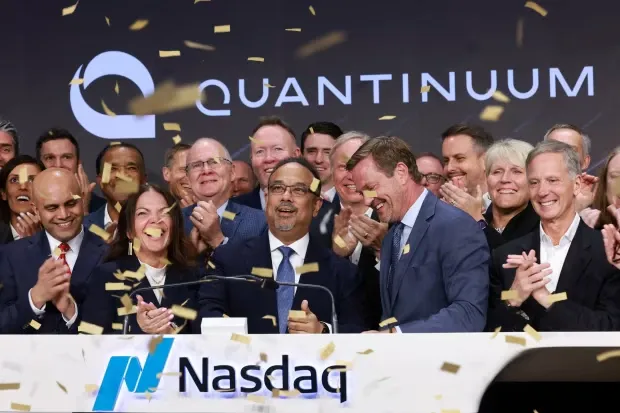
QNT shares began trading on June 4, 2026. This is the first traditional IPO for a full-stack quantum computing company. Previous quantum-adjacent companies, like Rigetti, reached the market through SPACs, which carry lower disclosure requirements and attract a different investor profile. But a traditional IPO demands full compliance and SEC disclosure. And it also tends to draw the interest of institutional investors who do more due diligence before committing capital.
Quantinuum Valuation Analysis: What a $14 Billion Market Cap Means
The Quantinuum valuation is the most contested number in this IPO, and it deserves scrutiny.
$60 per share implies a market cap of roughly $14 billion, or approximately 453x the company’s 2025 revenue of $30.9 million. High-growth SaaS companies at peak enthusiasm rarely trade above 30x. Quantinuum is trading at more than 15 times that ceiling too.
That shows how investors price pre-revenue-scale tech companies when the potential upside is large enough. If quantum computing delivers commercial utility in this decade, Quantinuum’s full-stack positioning could produce strong returns. But if a competing architecture wins, the current valuation has almost no floor.
Quantum computing stock valuation comparison (2026)
| Company | Market Cap | Annual Revenue | Revenue Multiple | Qubit Architecture |
| Quantinuum (QNT) | ~$14B | $30.9M (2025) | ~453x | Trapped-ion |
| IonQ (IONQ) | ~$7B | ~$43M (2024) | ~163x | Trapped-ion |
| Rigetti (RGTI) | ~$3B | ~$12M (2024) | ~250x | Superconducting |
Sources: SEC filings, Nasdaq listings. Market caps reflect approximate figures at the time of Quantinuum IPO pricing.
The entire quantum computing stock sector trades at extreme multiples. Quantinuum is the most expensive by revenue multiple, but it also has arguably the strongest technical credentials of the three.
How Quantinuum’s valuation has changed over time
In January 2024, Quantinuum raised $300 million at a $5 billion pre-money valuation. By September 2025, a $600 million round with Nvidia NVentures, JPMorgan Chase, and Mitsui pushed that figure to $10 billion. And during the IPO, the implied valuation reached around $14.3 billion. That’s nearly a 3x increase in just a couple of years. And this was driven by Helios benchmark milestones and growing institutional confidence in the technology.
Quantinuum Financial Snapshot: Revenue, Losses, and Bookings
The financials aren’t strong by conventional measures. Anyone considering Quantinuum stock needs to sit with that before anything else.
Revenue grew 35% in 2025 to $30.9 million, but the net loss widened to $192.6 million. R&D expense reached $165.4 million, more than 5X of 2025 earnings.
Quantinuum financial summary (SEC S-1 Filing)
| Metric | FY 2024 | FY 2025 | Q1 2026 |
| Total Revenue | $23.0M | $30.9M | $5.2M |
| Net Loss | $144.1M | $192.6M | $136.6M |
| R&D Expense | N/A | $165.4M | N/A |
| Total Bookings | N/A | $79.3M | $1.3M |
Source: Quantinuum SEC S-1 filing
The Q1 2026 numbers are part of this story. Q1 2026 revenue came in at $5.2 million, down 73% YoY from $19.1 million in Q1 2025. The company attributes the drop to a large sales-type lease in Q1 2025 that didn’t repeat. That explanation is plausible. It doesn’t make the underlying lumpiness less real. Q1 2026 bookings were $1.3 million against $79.3 million for all of 2025. The pace is not tracking anywhere near the 2025 full-year figure.
The customer concentration problem
RIKEN, the Japanese research institute, accounted for 90% of Quantinuum’s 2025 revenue. The US government is the only other material customer.
Quantinuum acknowledges this directly in its SEC prospectus as a documented risk factor. A single contract non-renewal from RIKEN wouldn’t produce a bad quarter. It would be an existential revenue event. That is a fact every Quantinuum stock investor needs to hold alongside the $14 billion valuation.
Quantinuum’s Technology: Trapped-Ion Systems, Helios, and the Apollo Roadmap
The technology case is the strongest part of the Quantinuum story, which is why the valuation is not completely without basis.
The Helios system features 98 physical qubits and 48 logical error-corrected qubits. That 2:1 encoding ratio is a meaningful engineering result. Most quantum systems need far more physical qubits per logical qubit, which makes the scaling harder and more expensive.
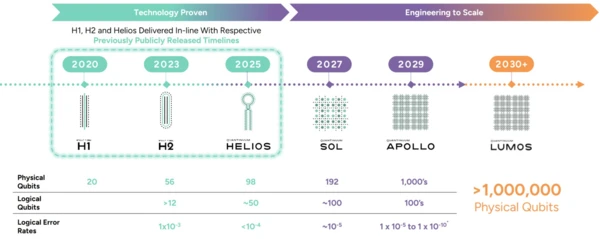
Quantinuum currently operates four commercial systems:
- Three at its Colorado campus.
- One at the RIKEN campus in Japan.
- A fifth system planned for Singapore by late 2026.
The hardware roadmap:
| System | Target Qubits | Timeline | Notes |
| Helios | 98 physical / 48 logical | Live (Nov 2025) | 99.921% gate fidelity |
| SOL | 192 qubits | Unconfirmed | Next generation |
| Apollo | Hundreds of logical qubits | 2029 target | “Ten Nines” fidelity goal |
Apollo’s 2029 date is a prospectus target, not a contractual commitment. IBM has a comparable 2029 target for its Starling fault-tolerant system. Investors are effectively choosing which roadmap they believe more.
Trapped-ion vs. superconducting: The technical trade-off
The trade-off comes down to quality versus speed. Trapped-ion circuits run at millisecond gate times, compared with microsecond speeds for superconducting systems. Quantinuum runs fewer operations per second, which hurts on throughput-heavy workloads. But what it does run, it runs with far less error.
For algorithms that need high fidelity over high volume, such as quantum chemistry and cryptography, trapped-ion holds an advantage today. Those are also the application areas where early enterprise customers are most likely to appear first.
Quantinuum Investors: Honeywell Ownership, Nvidia Backing & CHIPS Act
The investors behind Quantinuum are not speculators. They are strategically motivated capital with specific commercial reasons to want quantum computing to scale.
- Honeywell: The majority shareholder post-Quantinuum IPO and the original builder of Quantinuum’s hardware lineage.
- Nvidia NVentures: Joined the September 2025 $600M round with strategic interest in quantum-classical hybrid workloads.
- JPMorgan Chase: Participated in the $600M round and is active in quantum financial applications research.
- Mitsui, Amgen, QED Investors, Korea Investment Partners: Also part of the September 2025 syndicate.
From the government’s end, the US Department of Commerce signed a $100 million CHIPS Act LoI in May 2026 for photonic interconnect and scaling work. That $100M comes from a $2.013B federal commitment. IBM received the anchor $1 billion allocation from the same program.
That gap tells investors where the US government places the current scale hierarchy. Quantinuum is considered credible. IBM is considered the primary industrial foundation. Quantinuum also has a collaboration with Singapore’s A*STAR, with a Helios system scheduled for the Singapore campus by late 2026.
Quantinuum vs. Competition: How QNT Compares to IonQ, IBM, and Google
Quantinuum currently leads in demonstrated gate fidelity and logical qubit depth. IonQ is its closest architectural peer but hasn’t demonstrated the same depth of logical qubit results in public evidence. What IonQ has that Quantinuum currently lacks is cloud distribution. IonQ systems are available on AWS Braket and Azure Quantum, giving it direct enterprise reach that Quantinuum’s own cloud platform doesn’t match yet. In enterprise sales, a system that is easier to access through an existing cloud contract often wins over a technically superior system that requires a separate procurement relationship.
IBM and Google run superconducting architectures that are faster but more error-prone than trapped-ion at the current stage. IBM’s roadmap calls for a fault-tolerant Starling system by 2029. Google’s Willow chip hit a meaningful error correction milestone in late 2024 and remains a serious competitor. IBM also holds the dominant position in federal quantum investment, having received $1 billion from the CHIPS Act allocation compared with Quantinuum’s $100 million from the same program.
Quantum computing competitor comparison (2026)
| Company | Qubit Architecture | Current Flagship | 2029 Target | Public Status | Cloud Access |
| Quantinuum | Trapped-ion | Helios (48 logical qubits) | Apollo (100s logical qubits) | Public (QNT) | Quantinuum Cloud |
| IonQ | Trapped-ion | Forte Enterprise | Tempo Enterprise (64–256 AQ) | Public (IONQ) | AWS Braket, Azure Quantum |
| IBM Quantum | Superconducting | Eagle/Heron series | Starling (fault-tolerant) | IBM (parent public) | IBM Quantum Platform |
| Google Quantum AI | Superconducting | Willow chip | Fault-tolerant pre-2030 | Google (parent public) | Google Cloud |
Sources: Company roadmap documents, SEC filings, published technical papers.
Quantinuum leads on hardware quality but trails on distribution. In enterprise sales, distribution often wins regardless of hardware quality. And that’s a gap they need to fix ASAP.
Key Risks Every Quantinuum Stock Investor Should Weigh
Constellation Research analyst Larry Dignan described Quantinuum’s S-1 financials as “modest, uneven, and loss-heavy.” That framing holds. Before putting money into any quantum technology stock, including QNT, these six risks matter.
Revenue lumpiness: Quantinuum’s income depends on large individual contracts, not recurring subscription revenue. One big deal produces a spike. No deal produces a gap. The Q1 2026 revenue drop of 73% YoY is a direct example.
Customer concentration: RIKEN accounted for 90% of 2025 revenue. If that relationship changes, so does the income statement. This is a documented SEC prospectus risk factor, not an external critique.
Bookings collapse in Q1 2026. Full-year 2025 bookings were $79.3 million. Q1 2026 bookings were $1.3 million. The company needs to show that 2025 was repeatable, not a one-year anomaly.
The 453x revenue multiple: There is no margin of safety at this valuation. If Apollo slips two years, if a competing architecture hits a breakthrough, or if enterprise adoption takes longer than expected, the multiple compresses fast.
Competitive capital disadvantage: IBM is receiving $1 billion from the same CHIPS Act program that gave Quantinuum $100 million. Google has Alphabet’s balance sheet. Quantinuum’s $1.68 billion raise is meaningful but not comparable to what its largest competitors can deploy.
Apollo’s 2029 timeline is a target, not a commitment: The prospectus uses the word “target.” Investors who treat it as a deadline are misreading the filing.
How to Buy Quantinuum Stock (QNT)
Quantinuum stock trades on the Nasdaq under the ticker symbol QNT. Shares began trading on June 4, 2026, following the June 3 pricing.
Retail investors can access QNT through any standard brokerage with Nasdaq coverage, including Fidelity, Charles Schwab, Interactive Brokers, and most major platforms. No special access requirements apply post Quantinuum IPO. The share price at open will differ from the $60 IPO price depending on where institutional and retail demand settles on day one and beyond.
A few points worth knowing before buying:
- The Quantinuum IPO was priced for institutional investors. Retail buyers participate in the secondary market at open-market prices from June 4 onward.
- Honeywell retains majority ownership, meaning public shareholders do not control Quantinuum’s governance.
- Lock-up periods apply to insider shares and are specified in the final prospectus.
- Quantinuum stock sits firmly in the speculative growth category. It carries a loss rate nearly six times its annual revenue and has no confirmed path to profitability in its own disclosures.
Final Thoughts
The Quantinuum IPO isn’t a normal public offering, and Quantinuum stock isn’t a normal investment.
At $14 billion against $30.9 million in 2025 revenue, this is a long-duration bet on a technology category that has not yet delivered at commercial scale. The technical leadership is real. The backing from Honeywell, Nvidia, and the federal government is real. So is the 90% customer concentration, the 73% Q1 revenue drop, and the loss rate that runs nearly six times annual revenue.
For deeper due diligence, the SEC S-1 prospectus is the right starting point. Quantinuum’s official technology roadmap provides the hardware context. The broader quantum computing market is moving quickly, and Quantinuum IPO is as much a bet on that market’s timeline as it is on Quantinuum’s individual execution.
Disclaimer: This article is for informational purposes only and doesn’t constitute investment advice. Consult a qualified financial advisor before making investment decisions involving quantum technology stocks or any other securities.
FAQs
The stock symbol of Quantinuum is QNT, and its stock exchange is Nasdaq. The company went public on June 4, 202,6 with pricing on June 3, 2026.
The IPO of Quantinuum was priced at $60 on June 3, 2026, and started trading on Nasdaq on June 4, 2026. The company’s IPO raised $1.68 billion, which is the biggest quantum computing IPO ever as a traditional company.
After the IPO, Honeywell will be the majority owner. Other investors to be mentioned include Nvidia NVentures, JPMorgan Chase, Mitsui, and QED Investors, who have invested in the private funding rounds prior to public listing.
Quantinuum develops trapped-ion-based quantum computers and software, cloud tools, and enterprise applications for them. The current flagship hardware is its Helios system, which will be launched in late 2025. Applications include chemistry simulation, cryptography, and machine learning.
In 2025, Quantinuum posted a net loss of $192.6 million, while generating revenue of $30.9 million. R&D expenses have exceeded annual revenues by more than half, at $165.4 million. The company is not expecting to be profitable in the short term.
There are two sources of revenue. In 2025, hardware arrangements generated around $16.5 million primarily through sales-type leases on quantum systems, and cloud platform-related access, research services, and support contracts generated around $14.8 million. Revenue is also highly skewed toward a few big customers, with Japan’s RIKEN accounting for 90% of 2025’s revenue.
