


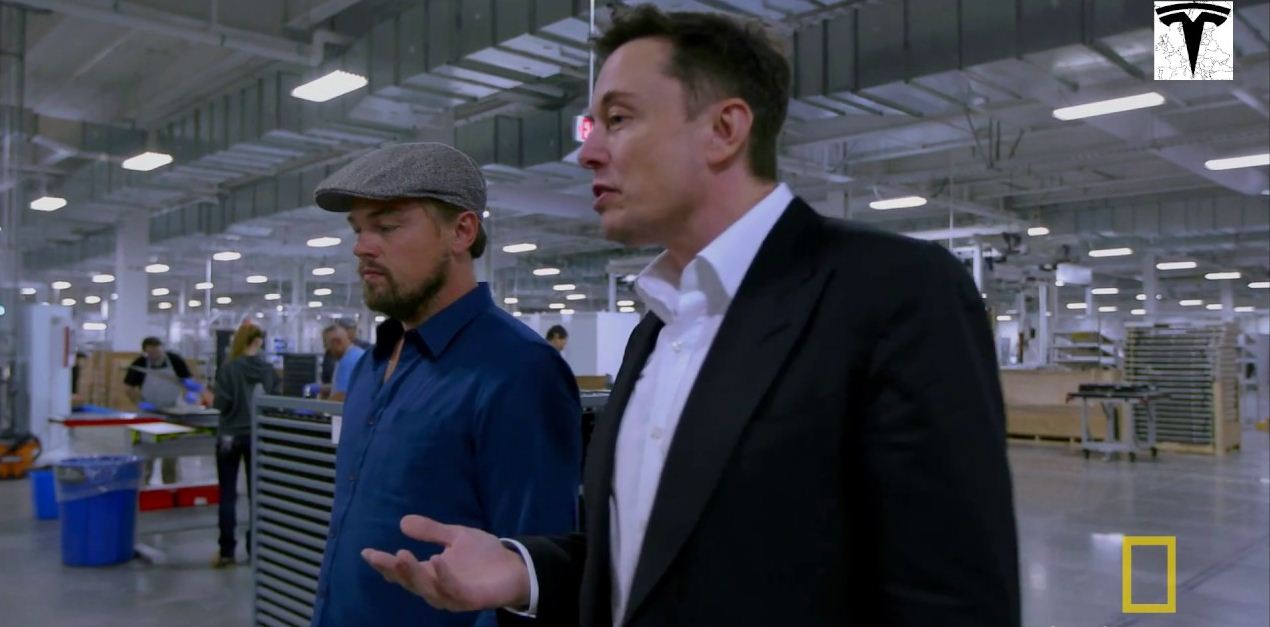
Elon Musk, the CEO of Tesla Motors, provided an interesting insight towards solving the Global Warming and other environmental issues, which are silently strangling our existence on Earth. He summed up the figures to crack the power problem.
The issue came up in an interview in the short film, Before the Flood. Musk seems really confident while he tells Leonardo Dicaprio –
“We actually did the calculations to figure out what it would take to transition the whole world to sustainable energy… and you’d need 100 Gigafactories.”
Also Read: TESLA’S GIGAFACTORY WILL CHANGE HOW THE WORLD CONSUMES ENERGY
The Giga Power Producer
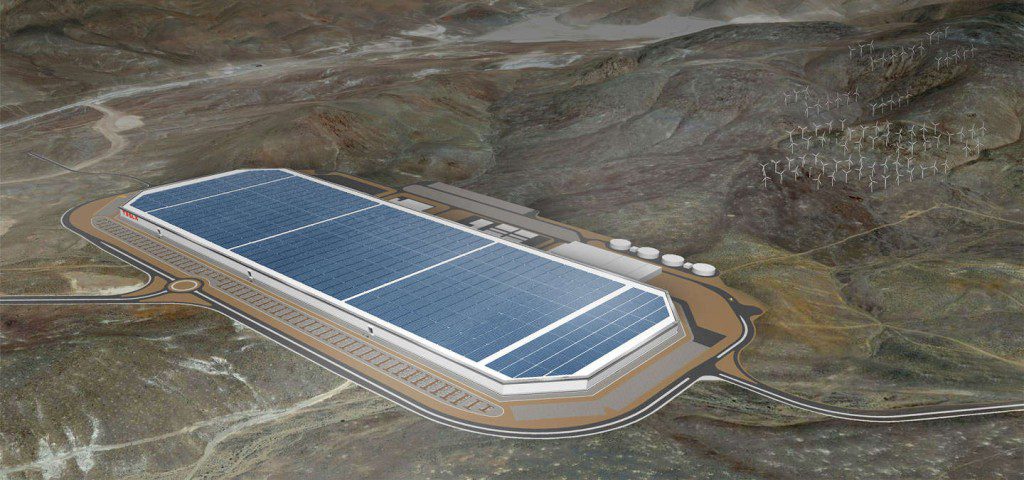
Gigafactory is, in essence, a Lithium-ion battery factory. This is now a vital division for Tesla’s expansion, large-scale efficient production of a battery being its basic target.
The Statistics
According to Musk’s estimate, by the year 2020, the factory will be able to produce an amount of lithium-ion batteries, which would exceed what all the worldwide battery makers were able to produce in 2013. At full capacity, the output is estimate is about 150 gigawatt hours of battery cells. Further, with economies of scale, it is estimated that the price of those batteries should fall by approximately 30%.
Open Sourcing
For utilities and grid operators, the technology enables remote-aggregated control of solar battery systems. Musk has called out for “anyone reading this who is responsible for managing grid operations, and who is interested in procuring capacity, reactive power, or voltage management services deep in the distribution system” to contact them.
Musk also adds that to make this dream come true, big industrial and automotive companies will need to come forward. To quote him, “The thing that’s really going to make a difference is if companies that are much bigger than Tesla do the same thing. If the big industrial companies in China and the U. and Europe, the big car companies, if they also do this, then collectively we an accelerate the transition to sustainable energy.”
Unconventional Power Sources
Musk has claimed that we could entirely avoid building electricity plants in future if we leaned into alternative energy. The climate changes provide us the indication that using up all the fossil fuels can be devastating. As a remarkably efficient example, the Gigafactories have Solar panels all over its roof as a rich component of production. In addition, they have installed wind turbines and Geothermal plants that would have a large share in power procurement too.
Does The Math Work Out?
How credible is Musk’s claim of 100 Gigafactories converting the world into one entirely dependent on sustainable energy? Someone at Reddit did the math:
(100 factories)(150GWh/year)(10 factory-years) = 150,000GWh of storage every day. (Edit: a factory-year is the same type of unit as a man-hour in case that confuses anyone)
In 2012 the world used 22,668TWh of electricity which is 22,668,000GWh/year which is 62,104 GWh/day in electricity demand
Now we need the heating and transportation side of things. EVs are roughly 3.5x more efficient than ICEs which helps a big chunk of the transportation. I’m going to assume heating is another 60,000GWh/day and that leaves 30,000GWh/day for transportation. These numbers are out of my butt, but seem reasonable.
Now what about growth in energy consumption? Well about 20% of current electricity comes from hydro and nuclear and you don’t need to store that which gives us back another 12,400GWh/day. And of course you won’t need to store the electricity that you are consuming as it is generated which really gives back a lot of this storage for future growth. And the factories will of course keep producing more storage every year. So energy demand growth shouldn’t out sprint us.
So lets say Gigafactory 1 is at full power by 2020. GF2 and GF3 at full power by 2025. GF4,5 & 6 by 2030. The rest of the world has the equivalent of GF7-18 by 2030 as well. This gives us roughly 60 GF-years of output by 2030 and adding 18GF-years per year plus whatever else is built. We need to get to 1,000 GF-years. Yeah other companies and Tesla are going to have to be very aggressive at building battery factories. BUT. This is actually doable! I imagine Panasonic, LG Chem, the 9 biggest OEMs, Siemens, GE, and several large Chinese companies could all see the profitability in this eventually and pull a lot of weight. And I am sure many other companies will help out too.
The Possible Impacts
With an alarming depreciation in fossil fuel resources, it’s only a matter of time before we are forced to use alternative energy sources as the only option available. It is of paramount importance that the governments give the idea serious attention.
In conclusion, the prospect of future Gigafactory expansions is relieving, as it provides an answer to the energy crisis situation even if the need of taking extreme measures does not arise.
We can only hope for more power (pun intended) to Musk.
