


Large Language Models (LLMs) in AI have moved from being experimental tools to becoming everyday infrastructure for how we work, learn, and create. Over the past couple of years, I’ve seen how businesses no longer treat AI as a curiosity – they’re building entire workflows around it.
The global LLM market size is projected to grow from $7.7 billion valuation in 2025 to $123+ billion by 2034, with almost 36% annual growth – reflecting how deeply these systems are being adopted across industries. Trained on massive collections of text and code, LLMs can read, reason, and respond in ways that feel increasingly natural.

In our previous blog, we explored what these large language models are and how they function. This time, I’ll focus on how people are using them in the real world – what’s working, where challenges remain, and how issues of safety, trust, and alignment come into play.
If you’ve ever wondered how these models shape what you see or use every day, this piece might help you connect those dots.
Key Learnings
- Large language models (LLMs) use massive text and code datasets to learn how to understand and generate human-like language in a workflow.
- LLMs in AI are increasingly integrated across industries like business, healthcare, research, software development, and creative media, improving productivity and decision-making.
- Many of us have interacted with LLMs directly through tools like ChatGPT, Gemini, and Claude, experiencing their versatility firsthand.
- With multimodal models, agentic systems, smaller language models, and stronger regulation, global jurisdictions are focusing on safe, responsible, and practical deployment.
From Theory to Practice: How LLMs in AI Are Changing the World
So, what is an LLM, really?
Large Language Models, or LLMs in AI, are intelligent systems trained to predict and generate text that feels human-like. These models learn from massive amounts of text and code to recognize patterns in how language is structured. So when you ask a question or start a chat, the model isn’t recalling a stored answer – it’s predicting what should come next based on everything it has learned. That’s the simple answer to how do large language models work.

What started as research experiments a few years ago has now turned into something much bigger. We’re seeing models like GPT-5, Claude Sonnet 4.5, and Gemini 2.5 used across everyday tools – from writing assistants to data analytics and software development platforms.
Once confined to research labs, LLMs now power everything from search engines to drug discovery. As adoption grows, questions of trust, safety, and scalability have become central to how we build and use LLM software responsibly.
Why We’re Seeing More Large Language Models
I’ve noticed that a few key factors are driving the surge in large language models, continuously pushing the field forward:
- Stronger hardware: Modern GPUs and AI chips have made training LLMs faster and more efficient, helping them process larger datasets in less time.
- More digital data to learn from: The internet’s vast collection of text, code, and media gives these models the raw material they need to train and grow smarter.
- Smarter algorithms: Deep learning techniques allow LLMs to identify language patterns, understand context, and predict meaning with impressive accuracy.
Together, these shifts have turned LLMs in AI from research projects into real, usable software shaping our daily tools.
Building Trust and Safety in Large Language Models
AI has its own limitations and challenges. Building trust in LLMs begins long before their use, through careful training, alignment, and deployment.

- Better data quality: Training LLMs on verified, diverse, and domain-specific datasets helps reduce bias and misinformation. Clean data leads to more stable, predictable model behavior.
- Addressing bias and fairness: Teams now run continuous bias audits and fairness tests so large language models don’t reflect harmful stereotypes or misinformation.
- Reducing hallucinations with RAG: Hallucinations are common with LLMs in AI. To tackle this, Retrieval-Augmented Generation (RAG) connects models to trusted external databases, improving factual accuracy in real-time.
- Alignment through human feedback: Methods like Reinforcement Learning from Human Feedback (RLHF) and Constitutional AI guide models help to follow ethical principles and human intent more closely.
- Governance and transparency: Many companies are adopting safety frameworks like the EU AI Act and NIST’s AI Risk Management Framework to bring accountability and traceability into LLM software development.
- Responsible deployment: Continuous monitoring, audit trails, and best practices help detect unsafe outputs and reduce misuse in real-world applications.
Trust in LLMs comes from combining all such sound training practices, transparent governance, and constant human oversight.
Real-World Applications of LLMs
Large language models have moved far beyond labs and research papers – they’re now embedded in how businesses, developers, and creators work every day.
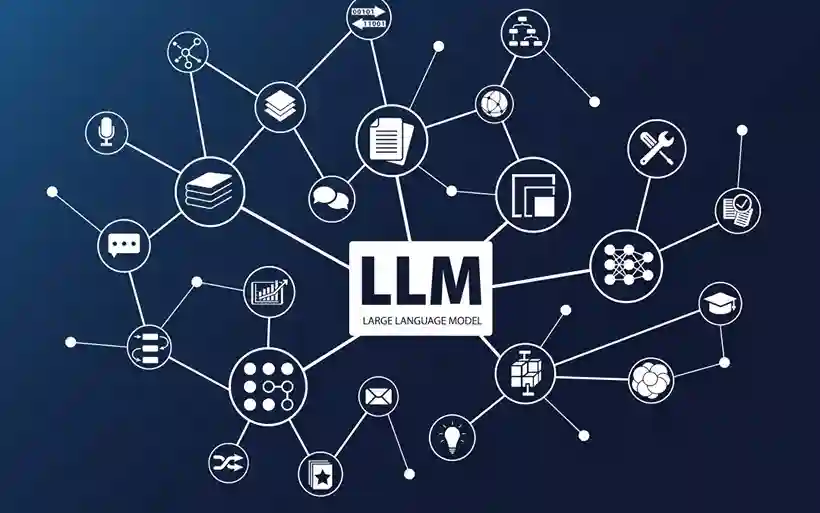
Let’s take a quick look at how major sectors use LLMs:
1. Customer service
- Powering intelligent chatbots and virtual assistants.
- Holding nuanced conversations, understanding context, and answering queries accurately.
- Automating routine tasks, freeing human employees for complex work.
2. Content creation
- Generating creative text for enhancing marketing strategies, social media posts, scripts, and poems.
- Assisting human writers by suggesting ideas or providing creative variations.
3. Scientific research
- Analyzing scientific literature to identify trends and synthesizing information from multiple studies.
- Proposing new hypotheses to accelerate discovery and research.
4. Healthcare and life sciences

- Tools such as Google Med-PaLM assist doctors with clinical summaries and diagnostics.
- AI in healthcare helps researchers process large volumes of medical literature in minutes.
- Developing chatbots to provide patients with 24/7 access to information and support.
5. Software development and engineering
- LLMs like GitHub Copilot and Code Llama suggest code snippets, fix syntax errors, and improve debugging.
- Many teams now use LLM software for technical documentation and version control explanations.
6. AI agents and automation
- Autonomous agents or Agentic AI systems such as AutoGPT or OpenDevin perform multi-step tasks – from scheduling meetings to analyzing data through APIs.
- They act as virtual coworkers capable of reasoning through tasks without constant prompts.
7. Legal, compliance, and policy
- Legal firms use LLMs to draft contracts, summarize cases, and flag compliance risks.
- Policy teams apply them to compare legislation and interpret regulatory updates.
Considerations for Safe and Effective LLM Deployment
Deploying LLMs in AI requires more than just installing software – it involves careful planning, monitoring, and consideration of ethical impacts. Here are the key points you should focus on when putting LLM software into production:
- Technical Integration: Make sure APIs, latency requirements, and privacy settings align with the systems in use. Whether the LLM runs on the cloud or on-premises, it affects performance and data security.
- Cost and resource management: Running large models can be expensive. I’d suggest balancing inference costs, scaling, and computational efficiency without compromising the quality of outputs.
- Monitoring and output control: Continuous observation helps you spot hallucinations, inappropriate responses, or model drift. Logging, feedback loops, and moderation systems are essential to keep LLM outputs reliable.
- Bias and fairness: LLMs in AI can also produce derogatory patterns or results if trained on biased datasets. To avoid this, focus on dataset curation, bias detection, and the implementation of corrective algorithms.
- Legal and ethical considerations: Responsible deployment includes designing for transparency and adhering to regulatory guidelines, like the EU AI Act or NIST AI frameworks.
The Future of LLMs in AI
LLMs in AI are evolving rapidly as the demand increases and innovation continues. The models can interpret complex inputs and produce better outputs. For example, browsers like Comet AI are integrating LLMs directly. This lets you query websites, summarize content, or even interact with multimedia in real time.

Some trends that are likely to take over the market in the next few years are:
- AI reasoning: LLMs are improving in logic and multi-step problem solving, making them more useful in decision support.
- Agentic systems: Autonomous agents like Devin AI are considered the first autonomous software engineers, simplifying workflows in software development without human intervention.
- Smaller Language Models (SLMs): Lightweight models are becoming more popular and efficient for edge devices and private deployments.
- AI regulation and governance: Rules around safety, bias, and transparency will shape how LLMs are trained and deployed in the coming years.
Final Thoughts
Looking ahead, I see large language models continuing to shape how we interact with technology, work, and information. LLMs in AI are becoming more integrated into everyday tools, offering support in creative tasks, research, and decision-making.
As we explore their potential, I find that focusing on responsible training, monitoring, and thoughtful deployment of LLM software is just as important as understanding what is an LLM or how do large language models work.
By balancing practical applications with safety and transparency, we can make LLMs useful, reliable collaborators rather than just AI tools.
Frequently Asked Questions (FAQs)
Popular tools like ChatGPT, Microsoft Copilot, GitHub Copilot, Google Med-PaLM, Claude Sonnet 4.5, Gemini, and an AI browser like Comet AI. All these integrate large language models for better results.
An LLM is any large language model trained on massive text data. While Generative Pre-trained Transformer (GPT) is a specific type of LLM designed by OpenAI for text generation.
Bias, hallucinations, misinformation, deep fakes, privacy issues, and potential misuse in generating harmful content are common risks that require careful monitoring and ethical deployment.
