


Your social media app is about to become your bank.
I’ve been closely following the build-up to X Money for months now, and what is taking shape is one of the most ambitious fintech plays in recent memory. In this piece, I’ll walk you through what X Money actually is, how machine learning is woven into its architecture, how it compares to traditional banking, and what the legitimate concerns are surrounding the April 2026 launch.
Key Takeaways
- X Money launches in April 2026, marking Elon Musk’s most direct move yet into consumer financial services.
- AI is central to the product, with Grok embedded as a native financial assistant rather than a bolt-on feature.
- The yield and rewards on offer materially outperform most traditional bank accounts on paper.
- Regulatory and privacy questions remain the most substantive risks during the rollout.
- Smart Cashtags will allow users to trade stocks and crypto directly from their timeline, with X Money functioning as the integrated wallet behind every transaction.
What is Elon Musk’s X Money App?
X Money is an attempt to turn X into a comprehensive financial platform, one where users handle payments, savings, and transfers without ever leaving the app. The X Money by Elon Musk has been building since acquiring Twitter in 2022 is the clearest expression yet of that everything-app ambition.
The WeChat comparison gets made often, and it holds up. Elon Musk’s super-app vision is built around the idea that a single platform can replace your bank, your payment app, and eventually your financial advisor.
Musk’s interest in payments stretches back to 1999, when he founded an online financial services company called X.com, which later merged into what became PayPal. X Money is, in many ways, the vision he never finished. The X Money by Elon Musk has spent years quietly assembling is not a side feature. It is the central pillar of what he wants X to become.
X Money launch: Availability and current rollout
- X Payments LLC has secured money transmitter licenses in 40+ US states, enabling X to legally store, receive, and send money on behalf of its users.
- Early access rolled out to US Premium+ subscribers starting June 25, 2026, and expanded to broader verified users days later, after the original April target slipped amid regulatory questions.
- Approximately 560 to 570 million monthly active users are already on the platform, giving X Money a distribution advantage most fintech startups cannot replicate.
- New York remains a gap, with the state’s Department of Financial Services yet to grant a license.

Key X Money features: APY, debit card, payments, and Grok AI
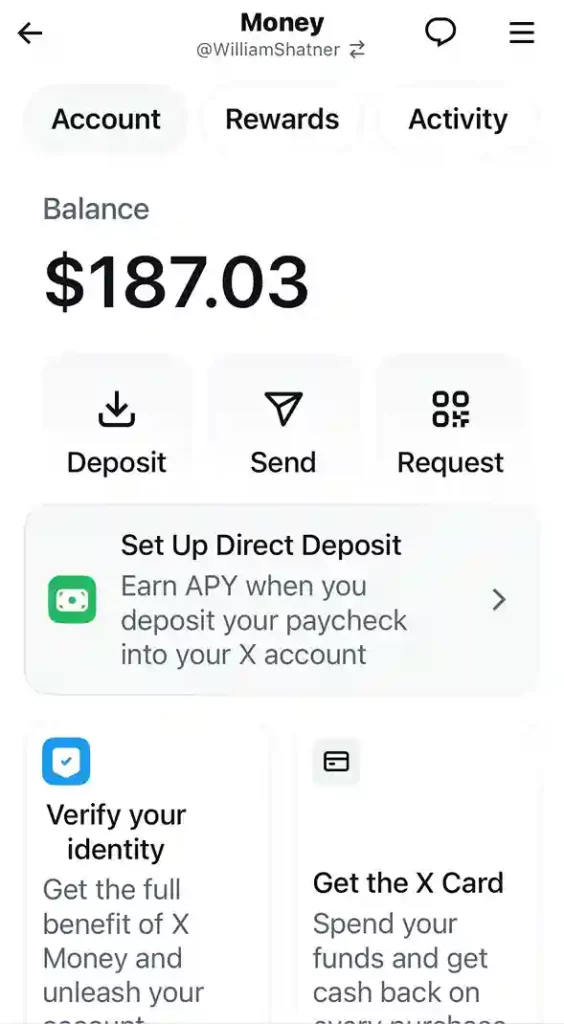
- 6% APY on deposits is offered through Cross River Bank, with balances FDIC insured up to $250,000 per depositor, significantly above the national average for savings accounts.
- A metal Visa debit card comes with 3% cashback on purchases and zero foreign transaction fees, terms that typically require a paid premium card elsewhere.
- Peer-to-peer payments are handled natively inside X through Visa Direct, removing the need for a separate app like Venmo or PayPal.
- No annual fees or credit checks are required to access the full feature set, making the product accessible without the usual conditions attached to competitive rewards cards.
- Grok has been integrated as an AI-native financial assistant from day one, a distinction that separates X Money from most traditional and digital banks that treat AI as an add-on.
- Beta access was initially distributed through an unconventional route. X worked with actor William Shatner to offer 42 invites to those who donated to his charity, with Musk personally sending Shatner $42 via the app as a playful sci-fi reference.
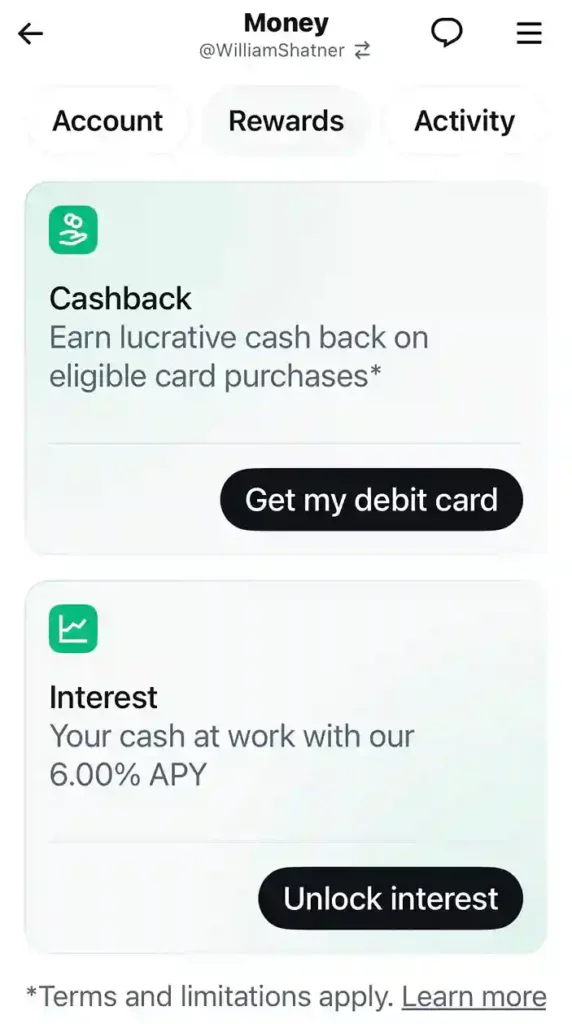
Taken together, the X Money by Elon Musk has represented one of the most fully-formed challenger banking products to enter the US market in recent years.
How X Money Uses AI: Grok, Fraud Detection & Personalization
How Grok AI works inside X Money
X’s corporate structure has shifted rapidly heading into launch. X was first merged into xAI in March 2025. SpaceX then acquired the combined entity in February 2026, creating a $1.25 trillion private company with Grok sitting at its core.
What Grok brings to X Money:
- Natural language financial queries.
- Spending pattern recognition.
- Real-time personalized insights.
All three are powered by one of the most capable large language models currently available to consumers. Musk described the goal during a February 2026 xAI all-hands as making X “the central source of all monetary transactions.”
A Grok-native assistant is central to achieving that. If you are already using Grok as a business and productivity tool, the financial assistant layer is a natural extension of what you already know.
AI-powered fraud detection and risk scoring
At X’s scale, machine learning is not a feature. It is an operational requirement.
How ML fraud detection works inside X Money:
- Models process behavioral signals in real time, cross-referencing device fingerprints, location patterns, and transaction history to flag anomalies before they clear.
- Rule-based systems cannot operate at this speed or accuracy, making machine learning the only viable infrastructure for a platform handling hundreds of millions of transactions.
- X’s existing engagement data gives its models a richer training foundation than most standalone fintech platforms can access.
This is where the AI trends reshaping fintech move from industry talking points to measurable product advantages. A model trained on years of user behavior catches fraud that a traditional bank’s static rule set would miss entirely.
AI-driven financial personalization
This is where AI in fintech creates a gap that legacy banks will struggle to close.
What personalization looks like inside X Money:
- Flagging unfavorable recurring charges based on observed spending patterns, without the user needing to audit their own statements.
- Surfacing savings opportunities tied to actual behavior rather than generic financial advice templates.
- Recommending financial actions in real time, drawing on data that traditional banks hold but lack the architecture to act on quickly.
- Traditional banks have spent decades accumulating customer data. The constraint has never been the data. It has always been the infrastructure required to do something useful with it in real time.
X Money vs. Traditional Banks: Feature Comparison
The AI in fintech column is where the gap between X Money and traditional banks is widest and hardest for incumbents to close quickly.
Here is how the X payments app compares to a standard US bank account across the features that matter most.
| Feature | X Money | Traditional Bank |
| APY on deposits | 6% | 0.39% (national avg) |
| FDIC insurance | Up to $250,000 (via Cross River) | Up to $250,000 |
| Debit card rewards | 3% cashback, metal card | Typically 0% – 1% |
| Foreign transaction fees | None | 1% – 3% |
| AI-native features | Grok-integrated | Limited or bolt-on |
| P2P payments | In-app via Visa Direct | Requires third-party apps |
| Track record | Recently launched with a limited operating history | Decades of institutional trust |
X Money’s 6% yield is already drawing regulatory attention, as it competes directly with bank savings and money market funds. A standard checking account pays a fraction of that.
The debit card math is equally straightforward. Comparable cashback and no foreign transaction fees typically come attached to a premium credit card with an annual fee. X Money offers both with neither condition.
The one column where traditional banks hold a clear edge is trust. A social platform requesting banking credentials is a different proposition than a licensed institution with decades of regulatory history.
X Money Risks: Security, Regulation, and Privacy Concerns
Security risks and fraud protection
The security stakes in fintech are unforgiving. Key risks worth noting:
- The 2025 Bybit hack saw $1.5 billion stolen, serving as a stark industry-wide reminder of what a breach at scale looks like.
- X Money deals in fiat currency, not crypto, but the reputational and financial exposure from a breach is equally severe.
- How X handles its security infrastructure during the rollout phase will be the first real test of the platform’s operational maturity.
Regulatory challenges
Federal-level oversight for a platform at X’s scale remains an open question, and evolving AI regulation in 2026 could directly shape how Grok is permitted to interact with user financial data. Specific regulatory friction points include:
- New York’s Department of Financial Services has expressed concern about licensing, given Musk’s other roles, making it a notable gap in the 41-state footprint.
- The launch timing coincides with Congress debating the CLARITY Act, which would set rules for yield-bearing products and whether non-banks should be permitted to offer deposit-like returns.
- State-by-state licensing gaps mean not all US users currently have access.
Worth noting: X Payments LLC is not itself an FDIC-insured bank. Coverage is pass-through via Cross River Bank, and certain conditions apply before the $250,000 protection kicks in.

Privacy concerns around financial data
X already holds a detailed behavioral profile on each of its users. Additional concerns worth noting:
- Layering financial transaction data on top of existing social and engagement data creates a significantly more comprehensive user profile.
- Users will need to weigh the 6% APY and cashback rewards against that data trade-off based on their own comfort level.
- There is currently no detailed public disclosure on how X Money’s financial data will be used for advertising or AI training purposes.
Platform and operational risks
Elon Musk’s tenure running X has been characterized by rapid and occasionally disruptive decision-making. In financial services, operational stability is not optional:
- How X Money handles disputes and chargebacks at scale is entirely untested.
- Customer support infrastructure for a financial product is materially different from a social platform, and X hasn’t yet demonstrated this capability at scale.
- The platform’s track record of policy changes introduces a layer of uncertainty that established banks do not carry.
Who Should Use X Money?
X designed X Money for many types of users. Based on what the company has announced so far, five groups will likely benefit the most at launch.
1. Active X Users:
Approximately 560 to 570 million monthly active users are already on the platform, and that gives X Money a distribution advantage that no standalone fintech app at launch can match. If you already spend significant time on X, having payments, savings, and social activity in one place removes the friction of switching between apps.
2. People Getting Poor Returns On Their Savings:
29% of US X users report a household income above $100,000, making them exactly the kind of audience that notices the difference between a 0.5% savings rate and a 6% APY. X Money’s yield is accessible without a premium account or annual fee attached.
3. Young Professionals And Digitally Native Users:
Adults aged 25 to 34 make up the largest segment of X’s global user base, accounting for 37.5% of total users. This is the demographic most comfortable managing money through apps rather than branches, and the one most likely to adopt X Money early.
4. Creators And Influencers:
The platform supports immediate, low-cost payouts for subscriptions, tips, and pay-per-content, bypassing the delays that come with traditional banking. Creators building an audience on X can now earn without sending followers to a separate app or checkout page.
5. Crypto And Finance Enthusiasts:
Crypto and finance enthusiasts are a natural fit. Smart Cashtags will allow users to trade stocks and crypto directly from their timeline, with X Money as the backend wallet. Formal crypto integration at launch has not been confirmed, but the direction is clear.
X Money is less likely to appeal to users who place institutional trust and long-term stability above yield and convenience, particularly given that the platform is yet to prove itself in financial services.
Final Thoughts
X Money arrives with stronger fundamentals than most fintech challengers: an existing user base, Grok’s machine learning layer, and Visa’s payment infrastructure. Elon Musk’s super-app vision now has a concrete financial product behind it, an active rollout, and a regulatory footprint across 41 states. The open variables are execution, regulatory tolerance for a 6% yield product, and user willingness to consolidate financial and social data on one platform.
X has also been testing a standalone X Chat app, hinting that X Money could eventually follow with its own dedicated app to compete directly with Venmo and Cash App.
Want to stay ahead of where money and technology are heading? At Yaabot, we cover the latest in AI, fintech, machine learning, and the tech developments reshaping how you work, spend, and invest.
FAQ
Early public access began in April 2026, following Musk’s March 10, 2026 announcement. Access is rolling out across the 41 licensed U.S. states, while New York remains unavailable pending regulatory approval.
No. X Money is built entirely inside the X platform. You will need an active X account to access any of the financial features, including the debit card and deposits.
No. X Payments LLC is a licensed money transmitter, not a chartered bank. This is an important legal distinction. It means X operates more like PayPal or Venmo in structure than like Chase or Bank of America.
Musk has indicated that X Money will eventually support business accounts and creator monetization tools, but the current rollout is focused on individual consumer accounts first.
Based on available information, P2P transfers through Visa Direct are expected to be fee-free for standard transfers. Expedited or cross-border transfer fees have not been confirmed.
No credit check is required to open an X Money account or access the debit card. Eligibility is tied to your X account status and identity verification rather than creditworthiness.
