



I usually track Nvidia GTC to see what new hardware shows up, but the Nvidia GTC 2026 keynote felt less like a chip showcase and more like a roadmap for how AI will actually run in production. What stood out to me was how often Jensen Huang talked about inference, agents, and physical AI, not just bigger models.
A lot of the Nvidia GTC 2026 announcements focused on systems, networking, and AI inference chips, which tells me the industry is shifting from experimentation to deployment.
If you follow AI trends, this felt like a turning point where infrastructure started to matter as much as intelligence. To me, the real shift was simple: AI is moving from models to infrastructure.
Here is what I actually took away.
Key Takeaways
- Nvidia GTC 2026 made it clear that inference, not training, is becoming the biggest driver of AI growth.
- Jensen Huang positioned AI agents as the next major computing shift, moving beyond standalone models.
- Physical AI moved closer to real-world deployment, especially across robotics and autonomous systems.
- AI factories emerged as a central idea, framing computer infrastructure as scalable production systems.
- Next-generation AI inference chips were positioned as the foundation for enterprise-scale AI deployment.
Jensen Huang’s Opening Keynote at Nvidia GTC 2026
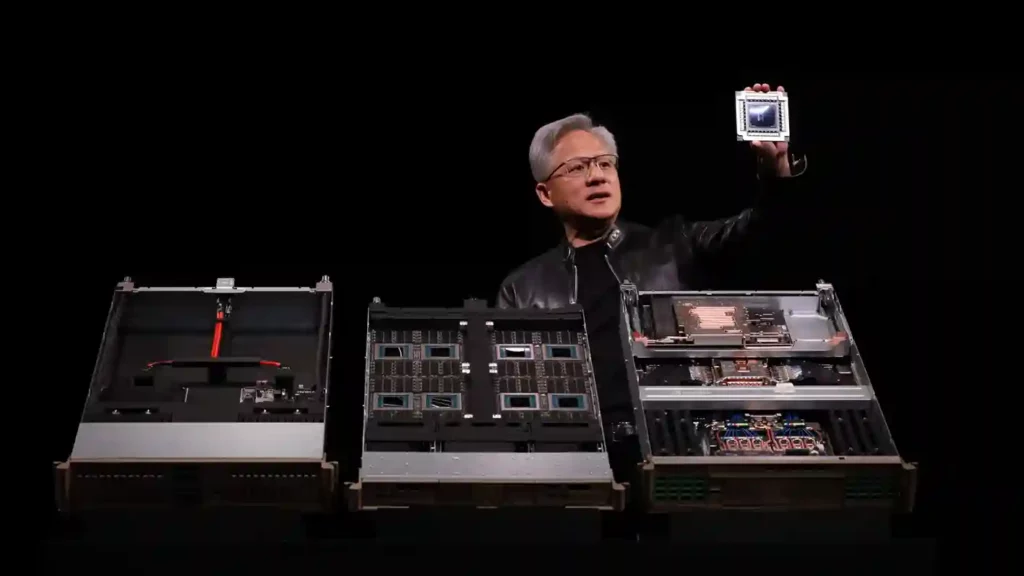
Nvidia GTC 2026 ran from March 16 to 19 at the SAP Center in San Jose. Over 30,000 attendees from 190+ countries showed up, with 1,000 sessions, 2,000 speakers, and 450 sponsors. It’s become one of the biggest tech events on the calendar, and frankly, it shows.
- Jensen Huang opened by framing GTC 2026 around a single idea: the token is the basic unit of modern intelligence.
- He then reminded the audience that Nvidia Compute Unified Device Architecture (CUDA) turned 20 this year, calling it the “flywheel” behind all accelerated computing, the platform supporting every phase of the AI lifecycle.
- Computing requirements for AI have grown by roughly 1 million times over the last few years, a number that sounds absurd until you map it to real data‑center builds.
- Jensen Huang also put a number on demand: he now sees over $1 trillion in AI infrastructure revenue between 2025 and 2027, up from roughly $500 billion through 2026.
Five Major GTC 2026 Announcements and Why They Matter
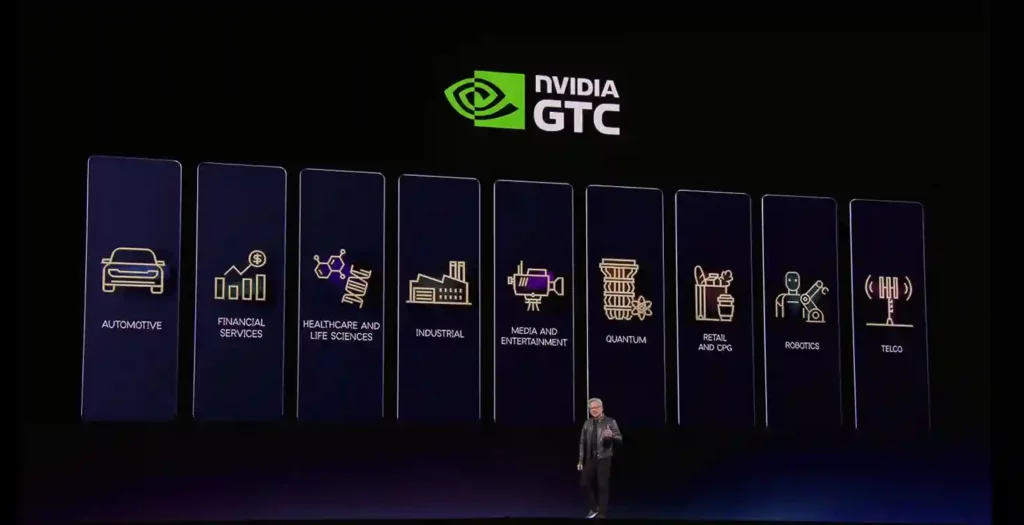
Here’s how I’d compress the major GTC 2026 announcements into a more “insider” view:
1. Vera Rubin AI Platform
- The successor to Blackwell is now in production. Seven co‑designed chips, five rack‑scale systems, built specifically for inference and agentic workloads.
- Vera Rubin delivers roughly 50x more tokens per watt than Blackwell H200 in optimized inference workloads.
- In a 1 GW data‑center envelope, Vera Rubin can produce about 700 million tokens per second, up from around 22 million just two years ago, a ~350x improvement in throughput per watt over that period.
2. Groq 3 LPU
- The first chip from Nvidia’s $20 billion Groq acquisition was completed in December 2025. Shipping Q3 2026.
- Designed for ultra‑low‑latency inference at scale, focusing on the decode phase of token generation.
- When paired with Vera Rubin GPUs, a Vera Rubin + Groq 3 LPX setup can deliver up to 35x higher inference throughput per megawatt and about 10x more revenue for trillion‑parameter, high‑context workloads.
3. OpenClaw and NemoClaw
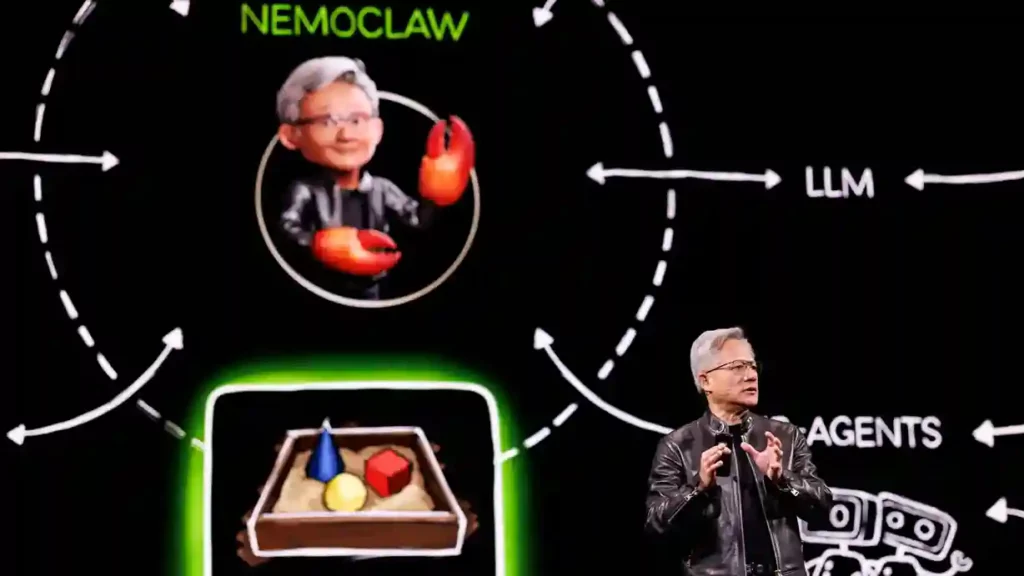
OpenClaw is an open‑source agentic operating system that lets you pull down an agentic OS with a single command and start building agents that use tools and context.
- NemoClaw adds:
- Policy enforcement
- Privacy routing
- Network guardrails
Huang said every company needs an OpenClaw strategy, echoing the way leaders once talked about cloud strategy.
4. Feynman Roadmap
- Nvidia’s 2028 architecture, built on TSMC’s 1.6nm A16 node, with 3D die stacking and custom HBM memory.
- Position Nvidia’s next‑generation AI inference chips and GPU stacks to keep pushing the tokens per watt curve further, targeting NVL1152‑scale racks (eight times the density of Vera Rubin NVL144).
5. Physical AI Partnerships
- BYD, Hyundai, Nissan, and Geely joined the Nvidia DRIVE Hyperion platform for Level 4 autonomous vehicles.
- Uber partnership to bring Nvidia‑powered robotaxis onto its ride‑hailing network, not just a test fleet.
Inside Nvidia’s Next-Generation AI Inference Chips
The clearest signal from GTC 2026 about where the market is going came from how Huang talked about inference, not training.
He referenced an analyst who called Nvidia the “inference king,” and he seemed genuinely pleased about that. It makes sense. The training market has a ceiling. The inference market scales with every API call, every agent loop, every automated workflow.
For AI inference chips, that means:
- Vera Rubin is built around extreme codesign of software and silicon, CPU and GPU in a single system, to compress cost per token.
- Right now, AI inference chips are the bottleneck between what AI can do and what companies can actually afford to run continuously.
- Vera Rubin delivers about 50x more tokens per watt than Blackwell H200.
- In a 1 GW envelope, Vera Rubin produces about 700 million tokens per second, compared to 22 million for the prior generation.
- The next generation, Feynman with LP40, pushes this further: LP40 is specifically designed for language‑processing workloads at scale, and BlueField‑5 handles data movement efficiently.
If you’re thinking about where the AI inference chips market lands in the next two years, the answer from Nvidia GTC 2026 is clear: inside full‑rack systems, not individual GPUs sitting in isolation.
How Nvidia Is Building AI Around Agents, Not Just Models
This was the most underreported angle from GTC 2026.
Jensen Huang did not spend much time on model benchmarks. He spent time on OpenClaw.
OpenClaw is a developer project that lets you pull down an agentic OS with a single command and start building agents that:
- Have memory
- Use tools and context
- Orchestrate multi‑step workflows
A model answers a question. An agent does a job. It has:
- Memory
- Tools
- The ability to call other systems
The infrastructure needed to run agents at scale is fundamentally different from what you need to host a chatbot.
NemoClaw is Nvidia’s answer for enterprise. It handles the things that make agents scary for businesses: who controls what the agent can access, how data stays private, and what happens when an agent tries to do something it should not.
Huang said every company in the world now needs an OpenClaw strategy. That is not hyperbole for the stage. It is the actual product pitch.
The Four AI Trends Jensen Huang Highlighted at GTC 2026
1. Tokens as the atomic unit of value
- AI revenue is fundamentally a token business.
- Jensen Huang sees over $1 trillion in AI infrastructure revenue between 2025 and 2027, up from $500 billion through 2026.
- Every GTC 2026 announcement traces back to producing more tokens, faster, cheaper.
2. Inference displacing training as the primary workload
- Training is expensive but finite. Inference is ongoing.
- Vera Rubin + Groq 3 LPX delivers up to 35x higher throughput per megawatt and about 10x more revenue for trillion‑parameter models compared with Blackwell‑only systems.
3. AI natives driving demand
Huang noted $150 billion in venture investment into AI-native startups in the past year alone. These companies have no legacy infrastructure to defend. They buy full Nvidia stacks from day one.
4. Physical AI as the next computer surface
- Robots, autonomous vehicles, and industrial machines running Nvidia silicon are now a confirmed product category, not a research project.
- At Nvidia GTC 2026, there were over 110 robots on the show floor, including a Disney Olaf robot powered by Nvidia’s Newton simulation engine.
Physical AI and the Rise of AI-Powered Robotics
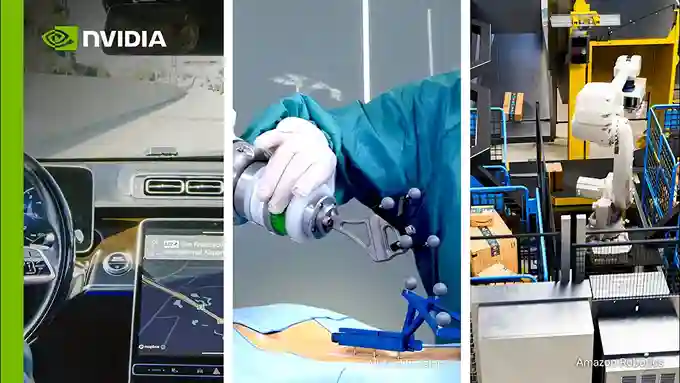
Physical AI was probably the biggest long-term story from GTC 2026, even if it got less immediate attention than the chip announcements.
- Automotive and mobility
- Nvidia extended its DRIVE Hyperion platform to BYD, Hyundai, Nissan, and Geely, positioning them for Level 4 autonomous vehicles.
- The Uber partnership is aimed at integrating Nvidia‑powered robotaxis into a live ride‑hailing network, not just a test fleet.
- Industrial robotics
- Nvidia announced partnerships with ABB, Universal Robots, and KUKA, plus major industrial software vendors, to bring AI into manufacturing and design workflows.
- The Nemotron Coalition’s Isaac GR00T model family is the general‑purpose robotics brain, handling physical reasoning that text‑only models can’t do.
Nvidia vs AMD vs Intel in AI Chips
| Aspect | Nvidia | AMD | Intel |
| Ecosystem | CUDA + CUDA-X, 20-year developer lock | ROCm, smaller adoption | OneAPI, fragmented adoption |
| Developer advantage | Nemotron Coalition, platform for open models | Limited open model ecosystem | Limited open model ecosystem |
| Strategy focus | High switching cost via software + ecosystem | Compete on hardware specs | Compete on hardware specs |
| Benchmark focus | Secondary to ecosystem lock | Hardware performance | Hardware performance |
Nvidia’s competitive strategy from Nvidia GTC 2026 is not to win chip benchmarks. It is to make the ecosystem switching cost too high to justify.
CUDA is the mechanism behind that strategy. Twenty years of CUDA libraries, developer tools, and institutional knowledge do not transfer easily to AMD ROCm or Intel OneAPI. Jensen Huang called CUDA-X the “crown jewels” of the company, which is accurate. It is not just a software layer. It functions as a lock.
The Nemotron Coalition reinforces this advantage. If Nvidia becomes the platform on which the best open models run, AMD and Intel are not just competing on hardware specs. They are competing against a developer ecosystem that took two decades to build.
From AI Models to AI Factories
The framing shift at GTC 2026 that I keep coming back to is the AI factory concept.
Huang stopped talking about models producing answers. He started talking about factories producing tokens.
An AI factory, in Nvidia’s framing, is:
- A full infrastructure layer: compute, memory, storage, networking, and software
- Systems designed to run continuously
- Token-scale output instead of single-query responses
DSX Air is the factory simulation tool, companies simulate AI infrastructure before deploying it, like a fab run yields simulations before a production run.
The revenue forecast, at least 1 trillion dollars between 2025 and 2027, only makes sense in this factory framing. It’s not GPU‑sales money; it’s platform and infrastructure money.
What GTC 2026 Tells Us About the Future of AI Infrastructure
The direction is clear from GTC 2026. AI infrastructure is scaling vertically, not just horizontally.
It is not about buying more GPUs.
It is about building deeper, more integrated stacks where compute, networking, storage, and software are co-designed and co-optimized. Vera Rubin is that stack today. Feynman is what comes next.
Energy demand is the constraint for which no one has announced a solution. Data centers are already straining power grids. Orbit-based computing, teased with Space-1, is a long-horizon answer to that problem.
The AI trends coming out of GTC 2026 point to a world where AI is running continuously, embedded in physical systems, and generating economic value through sheer token volume rather than any single model capability.
Conclusion
Looking back at Nvidia GTC 2026, the biggest shift for me was not a single launch but the direction Jensen Huang kept reinforcing. The focus moved away from chasing larger models and toward scaling real-world systems built on AI inference chips and integrated infrastructure.
What made the GTC 2026 announcements stand out was how clearly they connected physical AI, robotics, and enterprise deployment into one long-term plan. Most AI trends now point toward efficiency and reliability, not just performance.
If this roadmap holds, Nvidia GTC 2026 may be remembered as the moment AI stopped being experimental and started becoming industrial.
Want to stay ahead of where money and technology are heading? At Yaabot, we cover the latest in AI, fintech, machine learning, and the tech developments reshaping how you work, spend, and invest.
Frequently Asked Questions (FAQs)
The biggest GTC 2026 announcements included the Vera Rubin platform, Feynman architecture roadmap, OpenClaw agent system, Nemotron Coalition models, and DSX Air simulation tools for designing large-scale AI factories.
OpenClaw is an open-source agent framework designed to help developers build AI agents that can perform tasks beyond simple prompt-response interactions. Unlike traditional AI models that only generate answers, OpenClaw allows agents to use tools, retain memory, access external systems, and complete multi-step workflows.
AMD is Nvidia’s closest direct competitor in AI inference chips, while Intel competes in data center accelerators. Hyperscalers like Google, Amazon, and Microsoft also build custom AI chips to reduce long-term dependence on Nvidia hardware.
Yes. The Vera Rubin platform, announced at Nvidia GTC 2026, represents Nvidia’s next-generation GPU architecture, designed mainly for large-scale inference and agent workloads rather than traditional model training.
CUDA is Nvidia’s core GPU programming platform. CUDA-X is a broader ecosystem of specialized libraries built on top of CUDA, enabling AI, robotics, simulation, and data science workloads to run efficiently on Nvidia hardware.
