


Here’s something that doesn’t get said enough: the company that made enterprise AI boring, not flashy, not viral, but just reliable, is the one eating OpenAI’s lunch money.
A few years ago, we were using AI, which basically meant we were using ChatGPT. That has changed.
Anthropic now holds 40% of enterprise LLM API spend. OpenAI is at 27%. Two years ago, OpenAI owned 50% of that same market.
I was going through the Ramp AI Index data, Anthropic’s partnership announcements, and third-party tracking to figure out what’s actually behind this Anthropic vs. OpenAI shift. And it’s less about model quality than I expected – I mean, Claude has been way better in my experience.
Key Takeaways
- Anthropic’s enterprise LLM API spend share rose from 24% to 40% while OpenAI dropped from 50% to 27%.
- Close to one in three US businesses now pay for Claude, up from one in 25 a year ago.
- Among first-time enterprise AI buyers, Anthropic wins ~70% of head-to-head comparisons with OpenAI.
- OpenAI still leads in overall business subscriptions: 34.4% vs. 24.4% for Anthropic.
- Claude Code holds over half of the AI coding market.
- 70% of Fortune 100 companies use Claude as of 2025.
Anthropic Hits 40% Spend Share: What the Data Shows
Enterprise LLM spend breakdown
Before running with the Anthropic is winning narrative, the data matters more. The 40% figure is enterprise LLM API spend, not total AI subscriptions or consumer traffic.
And that difference matters a lot. API spend is where production workloads live. It’s the money spent by engineering teams running Claude inside real products, and not employees testing prompts on a Friday afternoon. Enterprise API usage accounts for 70- 75% of Anthropic’s total revenue, which tells you how seriously they’ve optimized for this segment.
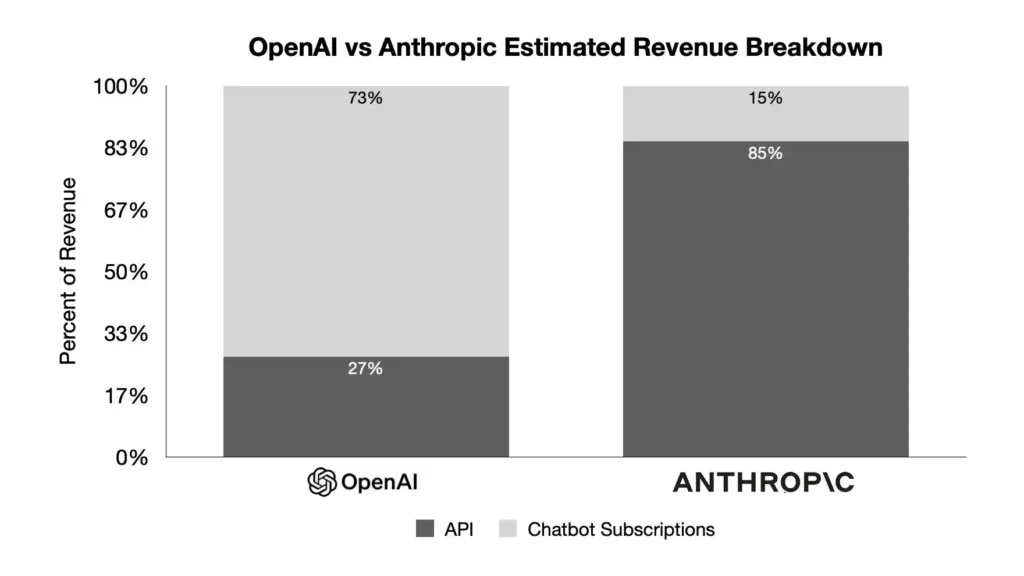
The overall subscription picture is kind of closer. OpenAI is ahead at 34.4% compared to Anthropic’s 24.4%. But Anthropic’s revenue increased by 2.8% in January 2026 alone, while OpenAI’s fell by 0.9% in the same month. It’s the largest single-month decline since tracking began.
| Provider | Enterprise LLM Spend Share (Q1 2026) | Two Years Prior |
| Anthropic (Claude) | ~40% | Much lower (distant second) |
| OpenAI (GPT) | ~27% | ~50% |
| Google (Gemini) | Gaining | Minimal |
| Others | Remainder | Remainder |
Business AI adoption more broadly doubled to an estimated $8.4 billion in six months. The market isn’t zero-sum. Within that growing pool, Anthropic is capturing a disproportionate share of new enterprise dollars.
Anthropic vs. OpenAI market share shift
A year ago, one in 25 businesses on the Ramp platform paid for Anthropic. Today, it’s nearly one in four.
Among companies picking an AI vendor for the first time, Anthropic wins roughly 70% of head-to-head comparisons. That’s a leading indicator. New customers today are renewal contracts and upsell opportunities in 18 months.
Claude’s revenue reflects this. Anthropic went from $1 billion ARR in December 2024 to $14 billion by February 2026, and $30 billion by April 2026, a 114% jump in just 60 days. OpenAI’s ARR is approximately $25 billion. Anthropic passed it this month.
What This Means for Anthropic vs. OpenAI Market Share in 2026
Consumer AI market share still belongs to OpenAI by a wide margin. ChatGPT holds around 60% of global generative AI traffic; Claude sits at around 4.5%. That gap is not closing on the consumer side any time soon.
But enterprise AI adoption is where the margin quality lives. By mid-2025, Anthropic’s enterprise service annualized revenue had already surpassed OpenAI’s.
The Anthropic vs. OpenAI AI market share story is really two separate stories: OpenAI dominates consumer volume, Anthropic is winning enterprise value. Those are different businesses.
Anthropic vs OpenAI: Enterprise vs Consumer AI Comparison
To make the differences clearer, here’s a direct comparison between Anthropic and OpenAI across enterprise and consumer AI use cases:
| Feature | Anthropic (Claude) | OpenAI (GPT) |
| Enterprise AI market share | High (~40%) | Moderate (~27%) |
| Consumer AI usage | Low (~4.5%) | Very high (~60%) |
| Core strength | Reliability, compliance | Ecosystem, brand |
| Best use case | Regulated industries | Creative & general tasks |
Why Anthropic Is Winning Enterprise AI
Safety and alignment as a core differentiator
Anthropic’s Constitutional AI framework isn’t just research; it’s now a procurement criterion.
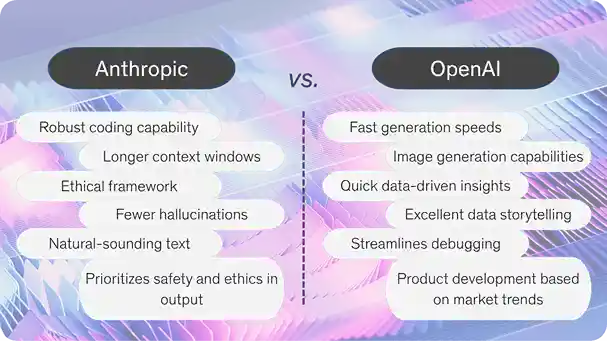
Financial services, healthcare organizations, and law firms evaluating enterprise AI tools all have a common problem. That standard LLM outputs aren’t auditable or compliant by default. A model that confidently hallucinates creates real liability. Claude’s safety architecture and Anthropic’s documented alignment practices make it the lower-risk choice for compliance-heavy buyers.
When I look at AI governance as a buying criterion in sectors like banking and healthcare, Anthropic’s positioning isn’t branding. It’s a product specification requirement for a large share of the market.
Enterprise-first product design
Claude’s large context window is one of its biggest workflow advantages. Processing a full code, or a regulatory filing in a single pass, wasn’t possible at scale on older models. For document-heavy work in legal, financial, and consulting contexts, this matters more than benchmark scores.
Claude Code is the most visible outcome of this enterprise-first approach. It holds over half of the AI coding market and reached $2.5 billion in annualized run-rate revenue by February 2026. VS Code daily install data shows it going from 17.7 million to 29 million installs on an accelerating curve since the start of 2026.
Developers who prefer Claude Code pull their companies into Anthropic’s API orbit. The same pattern built AWS.
Trust, compliance, and risk control
There’s a cultural dimension to the Anthropic vs. OpenAI comparison that doesn’t show up in benchmarks.
OpenAI’s decision to pursue Department of Defense contracts, combined with Sam Altman’s acknowledgment that OpenAI handled the situation “poorly,” created an opening. Data shows only 11% overlap between OpenAI and Anthropic’s app ecosystems. OpenAI is building a consumer super-app with premium integrations like Spotify and Uber. But Anthropic is being embedded into financial terminals and developer tooling. The bets are different, but the objective is to get their value.
For a compliance officer evaluating enterprise AI tools, these differences carry different weights. When your model is handling customer financial data, “safety first AI” isn’t just a tagline.
Strategic partnerships and distribution
The scale of Anthropic’s recent partnership announcements is worth naming directly:
- Deloitte: Claude deployed to 470,000 Deloitte employees. It’s Anthropic’s largest enterprise deployment at the time.
- Accenture: 30,000 Accenture professionals trained on Claude, designated as a premier Claude Code partner.
- Large enterprise accounts (greater than $100K ARR) grew nearly 7x in the prior year.
- Over 1,000 customers now spend $1 million or more annually on Claude.
Accenture’s and Deloitte’s networks reach 2000 global companies directly. And when those firms standardize on Claude for client deployments, Anthropic gets distribution leverage that would take a direct sales team years to replicate.
Where OpenAI Still Holds an Edge
This is where I want to push back on any reading of the Anthropic vs. OpenAI story as a clean win.
OpenAI still leads in aggregate business subscriptions at 34.4% vs. Anthropic’s 24.4%. Consumer brand recognition isn’t nothing. When a non-technical executive says “let’s use AI,” they still default to ChatGPT more often than Claude.
OpenAI’s developer ecosystem is also larger and older. Tooling, libraries, prompt templates, and institutional knowledge built around the OpenAI API represent real switching costs.
The raw infrastructure numbers are real, too. OpenAI’s Codex now has 3 million weekly users, up from 2 million the prior month. The company processes more than 15 billion tokens per minute across its APIs. That’s infrastructure scale that took years to build.
OpenAI is also pivoting towards enterprise and developer markets. It’s the exact segments Anthropic has been winning. Marketing, advertising, real estate, and business consulting verticals still skew toward OpenAI.
Anthropic’s current lead in enterprise AI adoption isn’t permanent if OpenAI executes a credible product pivot.
Enterprise AI Adoption Trends Driving This Shift
From experimentation to production
The most important enterprise AI trend of 2026 is the shift from pilots to production. Organizations aren’t asking “should we try AI?” anymore. They’re asking, ” Which enterprise AI tools perform reliably enough to run business-critical workflows?”
The question that changes the evaluation criteria is when the demo model is so impressive, but it’s hallucinating when in production. It’s useless when it’s running a thousand automated tasks per day. And at that rate, even a 5% failure rate means 50 broken workflows daily.
Claude’s three-agent framework reduced failure rates significantly for companies building production agent systems. That architectural difference is why consistency beats brilliance.
Rising importance of AI governance
Procurement teams in financial services and healthcare now require documentation on model training, safety evaluations, and bias testing before signing contracts.
This is Anthropic’s natural terrain. Published safety research, model cards, and transparency commitments give procurement teams the documentation they need to pass internal compliance reviews. Anthropic’s identity as a safety-first lab gives it structural credibility here that OpenAI is actively trying to catch up to.
Vendor consolidation and spend optimization.
Enterprise AI adoption in 2024 was fragmented. Different teams ran different models, overlapping their usage and with no oversight. Now, finance teams want fewer vendors and a clearer RoI.
Claude’s expanded portfolio analysis, Claude Code for development, and Cowork for non-technical workflows cover more of the enterprise surface area than they did two years ago. That breadth makes Anthropic a more defensible single vendor choice for companies looking to simplify.
What Enterprises Actually Want From AI in 2026
After looking at enterprise AI spending data across multiple sources, the buyer priorities are consistent:
- Reliability at volume: Predictable outputs across thousands of tasks.
- Compliance-ready documentation: Model cards, usage policies, and audit trails for legal and risk teams.
- Long-context capability: Processing full documents or codebases without chunking workarounds.
- Measurable developer productivity: ROI that CFOs can defend in quarterly reviews.
- Cost predictability: Pricing structures that don’t produce budget surprises at scale.
Claude hits more of these boxes for more enterprise buyer profiles than it did two years ago. That’s the underlying reason for the LLM market share shift — not vibes, not brand, and not any single benchmark.
Risks and Limitations of Anthropic’s Lead
Anthropic’s 40% enterprise LLM spend share has caveats worth naming.
The data comes primarily from Ramp and similar payment-tracking sources, covering US corporate card and invoice spending from approximately 50,000 companies. That’s meaningful but not comprehensive. The global picture likely looks different.
The spend lead may also partly reflect pricing dynamics. If its per-token pricing is more competitive for high-volume cases, companies might route more API volume through Claude.
Google’s Gemini 3.1 Pro matches Claude on reasoning benchmarks and has Google’s cloud infrastructure as its distribution mechanism. That’s not a competitor to dismiss.
And Anthropic’s projected positive free cash flow by 2027, compared to OpenAI’s projected $14 billion in losses for 2026, assumes the current growth rate holds.
Anthropic vs. OpenAI: Who Wins Long-Term?
Neither definitively.
The best-case scenario is a two-player enterprise AI market where Anthropic dominates regulated industries, and OpenAI holds consumer AI. The market is already consolidating around these two companies, with Meta and Google distant despite massive capex commitments.
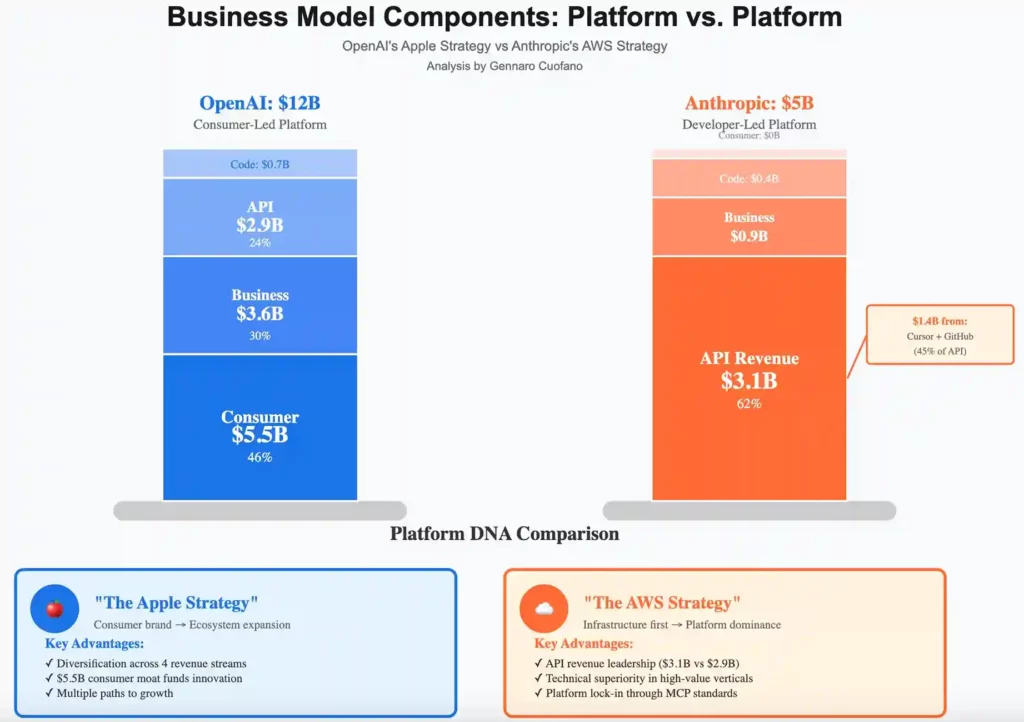
For enterprise buyers, the real risk is assuming either company’s current position is fixed. The companies that handled the last 24 months of AI market share movement best were the ones with provider-agnostic infrastructure. The ability to route workloads across models and switch when one vendor raises prices or underperforms.
What This Means for the Future of Enterprise AI
Multi-model strategies will become standard.
The Anthropic vs. OpenAI binary is dissolving. Enterprises are increasingly routing different workloads to different models. Claude for compliance-sensitive legal analysis, GPT-4o for creative and marketing copy, and Gemini for Google Workspace workflows. LLM orchestration, managing that routing intelligently, is becoming its own product category.
Rise of specialized enterprise AI tools
Claude Code’s success points to a broader pattern. Vertical AI tools with measurable productivity RoI are outperforming regular chatbots. A software engineer in the US costs $200,000-$400,000 annually; conservative 20-30% productivity gains translate to $40,000–$90,000 in annual value per developer.
The enterprise AI tools market will keep segmenting around specific professional functions. Starting from law, financial analysis, to engineering productivity.
Shifting AI market share dynamics
Enterprise AI market share is moving faster than any previous software market shift I can recall. The Anthropic vs. OpenAI gap that looks significant today could narrow or widen considerably by 2027, depending on a small number of factors: OpenAI’s enterprise pivot execution, Anthropic’s ability to maintain model consistency at scale, and which provider Google and Microsoft push through their cloud distribution.
Final Thoughts
What I take from this data is Anthropic’s rise to 40% of enterprise LLM API spend, and it’s driven by legitimate product advantages. Reliability in agent workloads, compliance-ready AI governance, and strategic enterprise partnerships have enabled them to reach 2000 global companies. The shift from one in 25 to one in four businesses paying for Claude in a single year is not noise.
But the story isn’t about “Anthropic winning.” Enterprise AI adoption has matured enough that buyers now evaluate AI providers like any other enterprise software. Anthropic happens to score better on the criteria that matter most right now for buyers with the largest contracts.
OpenAI still has the ecosystem, the consumer brand, and a real enterprise customer base. Its response to losing AI market share in the enterprise will determine whether Anthropic’s lead compounds or plateaus.
For any enterprise evaluating the Anthropic vs. OpenAI decision today: the actual answer is probably both, routed intelligently.
FAQs
Consistency in agent workloads, compliance-ready documentation, and Claude Code’s developer productivity gains.
Claude holds an estimated 29% enterprise AI market share. Anthropic’s enterprise revenue surpassed OpenAI’s by mid-2025, despite Claude holding just 4.5% of the broader consumer AI chatbot market.
Possibly. OpenAI’s existing developer ecosystem and enterprise relationships give it real recovery potential. The most likely outcome is a sustained two-player market rather than a single clear winner.
