



NVIDIA made its most powerful move in China with the introduction of the Vera CPU, and it doesn’t have a single GPU in it.
Nvidia’s Vera CPU is already taking orders from Chinese data center operators, with first deliveries expected as early as August 2026. The reason this works where H20S and Blackwells failed comes down to one technical fact: Vera is a CPU, not a GPU. That single classification keeps it outside the strictest layers of the China chip ban. And Nvidia knows exactly what it’s doing.
Key Takeaways
- The NVIDIA Vera CPU is an 88-core Arm-based processor designed for agentic AI workloads. It’s not the GPU-class training compute that triggered U.S. export restrictions.
- Nvidia began taking orders from Chinese cloud providers in mid-2026, with initial deliveries expected by August.
- U.S. export controls target GPUs above defined FLOPS thresholds. CPUs are classified as “general-purpose” processors and face far fewer licensing requirements under current BIS rules.
- The H20 ban hit Nvidia with a $4.5 billion inventory charge and $2.5 billion in lost Q1 FY2026 revenue. Vera is partly how Nvidia rebuilds from that.
- Intel has sold Xeon CPUs into China for years without GPU-level restrictions. Nvidia is now copying that playbook.
- Chinese domestic competitors, including Cambricon and Huawei’s Ascend line, grew dramatically during the GPU ban.
- With 37 analysts rating NVDA a “Strong Buy” and a $272.08 consensus price target, any confirmed China revenue changes the model Wall Street is working from.
What Is the Vera CPU?
Nvidia built its entire AI-era identity on GPUs. The Vera CPU is very different from that.
Announced as part of the Vera Rubin platform in March 2026, the NVIDIA Vera is a purpose-built Arm v9 processor with 88 custom Olympus cores. It’s specifically designed to run the infrastructure that GPU clusters depend on, like task orchestration, analytics pipelines, and runtime engines.
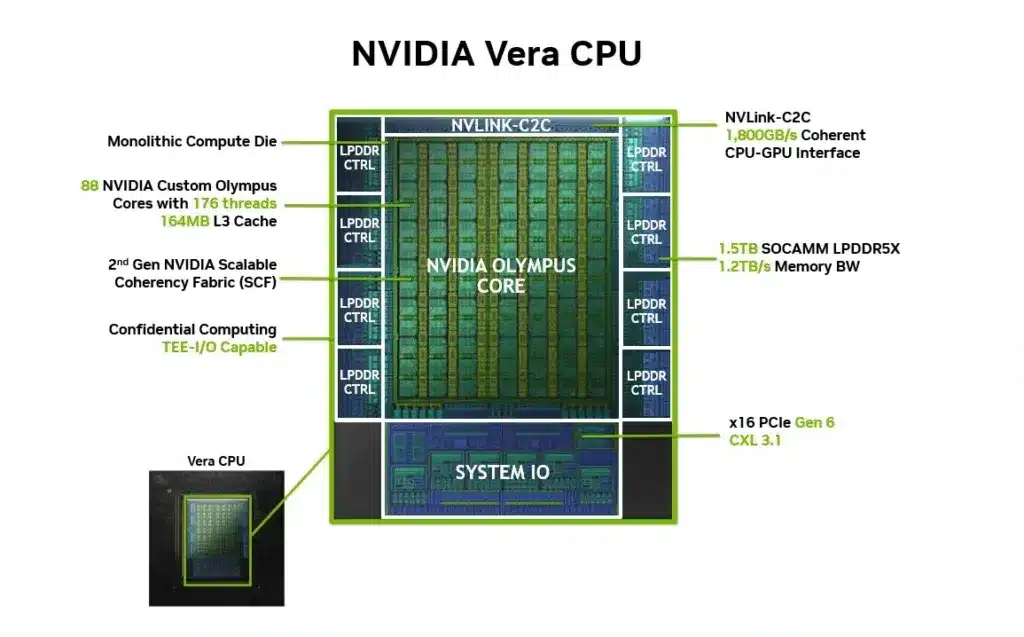
Specs per Nvidia’s announcement:
- 88 Olympus cores built on a second-generation coherent mesh fabric.
- 10-wide decode engine that fetches and processes more instructions per cycle than comparable x86 designs.
- 40% lower peak memory latency versus x86 competitors, cutting bottlenecks for data-intensive pipelines.
- Monolithic mesh interconnect enabling roughly 50% faster core-to-core communication.
- Arm v9 ISA with extensions for low-precision AI inference.
Think of the Vera CPU as the general manager of a GPU rack. The Rubin GPUs do the matrix math. Vera handles everything else.
This difference is also a legal distinction.
How the Vera CPU Differs from the Grace CPU
Nvidia’s previous Arm-based processor is the Grace CPU, part of the Hopper architecture generation and designed mainly for HPC workloads alongside the H100 GPU. Vera is an upgrade, but it’s also a different product for a totally different job.
| Feature | Grace CPU | Vera CPU |
| Core count | 72 Neoverse V2 cores | 88 custom Olympus cores |
| Architecture gen | Hopper era | Vera Rubin era |
| Primary workload | HPC, scientific compute | Agentic AI, data center orchestration |
| Memory latency | Standard Arm baseline | 40% lower than x86 competitors |
| AI-specific ISA | Limited | Arm v9 with low-precision inference support |
| China export status | Restricted under GPU-adjacent rules | Currently unrestricted as general-purpose CPU |
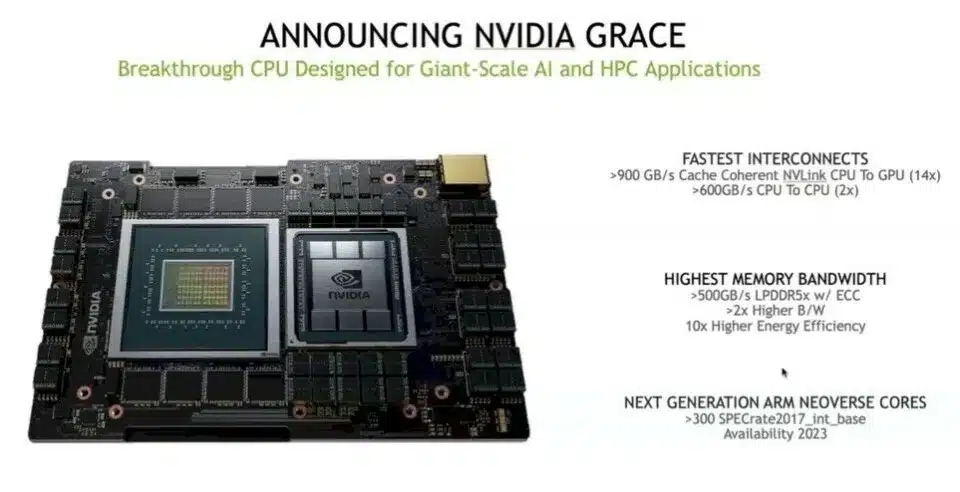
Grace was Nvidia proving it could build a competitive CPU. Vera is the product Nvidia is actually trying to sell at scale. And unlike Grace, which was bundled closely with the H100 in the Grace Hopper Superchip, Vera can be sold as a standalone server component. That standalone capability is what makes the China strategy viable.
What the Vera CPU Means for NVIDIA Stock
NVIDIA stock analysis in mid-2026 has one major variable: China. Vera is the first concrete signal of how Nvidia plans to change that.
The damage from the China chip ban is well-documented in Nvidia’s own filings:
- Q1 FY2026: $4.5 billion inventory charge on H20S that could no longer ship, plus $2.5 billion in blocked H20 revenue.
- Q2 FY2026 outlook: Additional $8 billion revenue loss attributed directly to H20 export restrictions.
- Nvidia’s current guidance explicitly excludes China revenue. Any recovery forces upward model revisions from a zero baseline. Source
As of May 2026, 37 analysts rate NVDA a “Strong Buy” with a consensus 12-month price target of $272.08, roughly 23% above recent prices. The core bull case is about Blackwell GPU ramp globally. China is a bonus.
But the math matters. One analyst estimate puts a partial China recovery at 50% of the previous H20 run rate at $3.5 to $4 billion in additional annual revenue. Against current guidance, that’s a 4-5% top-line upside. And for a company trading at high earnings multiples, that increment isn’t that big.
The Vera CPU probably won’t recover the $8 billion. But stabilizing NVIDIA China revenue at any positive number, through a compliant hardware category, changes how analysts perceive long-term China exposure.
The downside scenario to watch is that, if the U.S. reclassifies high-core-count CPUs under BIS dual-use rules, or Taiwan enacts its own draft AI chip export controls (under discussion as of June 2026), Vera’s clean export status disappears before getting started.
Why a CPU Specifically Gets NVIDIA Back Into China
U.S. export controls on AI chips don’t target hardware categories. They target performance thresholds.
The BIS framework works like this; chips that cross defined FLOPS ceilings for AI training are classified as dual-use items. That classification triggers case-by-case export licensing, volume caps, and, since January 2026, a 15% revenue fee payable to the U.S. government on approved H200 sales. The H20 triggered these rules. So did every Blackwell variant. So does the H200.
The Vera CPU doesn’t. As a general-purpose processor, it sits under the compute ceilings that activate dual-use classification:
- No individual export license required for most Chinese commercial buyers.
- No 15% revenue share payable to the U.S. government.
- No shipment volume caps equivalent to GPU-tier restrictions.
Nvidia isn’t ignoring the China chip ban. It’s just bypassing the ban.
The Compliance Math Nvidia Is Betting On
The updated BIS rule (January 15, 2026) created a narrow but real opening for GPU sales alongside clear limits:
- H200-class GPU exports capped at roughly 850,000 units total, limited to 50% of cumulative U.S. sales.
- Chinese buyers placed orders for over 2 million H200 chips following the December 2025 announcement.
- China conditionally approved just 400,000 GPUs for ByteDance, Alibaba, and Tencent combined, less than one-fifth of total orders.
- The State Department then stalled all shipments pending further review. Source
The Vera CPU touches none of those constraints. Reuters reported a major Chinese cloud operator placing orders for over 300 servers, each housing two Vera CPUs, with August 2026 delivery targets. If those ships, it marks the first confirmed Nvidia hardware delivery into China’s commercial AI market since the April 2025 H20 ban.
How China Is Likely to Respond to the Vera CPU
Most people assume that as NVIDIA’s returning, the Chinese are eager to get their hands on it. That’s not how it looks from Beijing’s PoV.
- Domestic preference is policy, not just sentiment: China’s government actively directed state-linked companies to prioritize domestic chip alternatives during the GPU ban. And the result was stark. Cambricon’s revenue jumped roughly 4,300% in the first half of 2025, reaching around $402.7 million. That growth wasn’t market-driven. It was policy-driven, and that doesn’t change the moment a foreign CPU becomes available.
- Beijing has a legal lever it hasn’t fully used yet: China’s State Administration for Market Regulation announced in September 2025 that NVIDIA had violated conditions from its 2020 antitrust review. That gives Beijing the ability to restrict NVIDIA purchases by state entities on regulatory grounds, entirely separate from the U.S. export control picture.
- The CPU alone doesn’t complete the stack: The Vera CPU is designed to orchestrate AI workloads, but you still need GPUs to run the models. A data center operator buying Vera without Rubin GPUs is just buying a part of a solution.
Private Chinese cloud operators, less subject to state procurement directives, are the realistic near-term buyers. Assuming broad Chinese demand for NVIDIA Vera because it’s technically exportable is the wrong read.
Nvidia vs AMD vs Intel in the China Market
| Company | Current China Access | Strategy | GPU Export Exposure |
| Nvidia | GPUs blocked; Vera CPU currently unrestricted | CPU entry via regulatory classification gap | High on GPU side; low for CPU |
| AMD | Instinct MI300X GPUs restricted; EPYC CPUs unrestricted | No equivalent China CPU push announced | Moderate; same GPU-tier restrictions as Nvidia |
| Intel | Xeon CPUs fully available; Gaudi AI GPUs restricted | Established CPU presence; limited AI GPU share | Low overall; Gaudi commercially marginal |
| Huawei (Ascend) | No U.S. export limits; domestic-only | Full domestic AI stack; direct state support | None; outside U.S. regulatory jurisdiction |
Intel has had exactly the playbook Nvidia is now running, for years. Xeon CPUs flow into China without GPU-level friction because they’ve always been classified as general-purpose. Nvidia is doing the same thing with Vera, just with a much higher-performance CPU and a clearer AI infrastructure use case.

The “Nvidia vs. AMD” dynamic here is interesting. AMD has the same GPU restrictions on its Instinct line but hasn’t announced an equivalent CPU push into China. That probably gives NVIDIA a window.
What This Means for the Broader Chip War
The Vera CPU move matters beyond NVIDIA as a template.
If a GPU maker can route around export restrictions by reclassifying its data center footprint around general-purpose CPUs, other chipmakers will try the same approach. The chip war’s next phase isn’t only about who builds the fastest GPU. It’s about who builds the most legally flexible hardware stack.
A few structural points that outlast this specific product:
- CPU architecture is now a geopolitical category: Arm-based designs occupy a different regulatory tier than x86 alternatives. As that distinction becomes commercially relevant in China, regulators will pay more attention to it.
- The “general-purpose” classification is under active pressure: If Vera CPUs start to manage agentic AI deployments in Chinese data centers, BIS may revisit the regulations.
- The longer the GPU ban holds, the harder re-entry gets: Stacy Rasgon at Bernstein Research said it plainly; banning H20 chips effectively handed the Chinese AI training market to Huawei and Cambricon. The more entrenched domestic alternatives become, the higher the bar for any foreign chip, even a legally compliant one, to displace them.
The chip war doesn’t turn on the Vera CPU. But NVIDIA’s willingness to reshape its product strategy around export policy shows how deeply semiconductor geopolitics has changed the business.
Reasons to Be Skeptical of the “Re-Entry” Framing
This is now a very common story as NVIDIA’s returning to China. But it comes with some specific problems:
- The actual volumes are small: One cloud operator, roughly 300 servers, deliveries not yet confirmed. That’s a pilot, not a market re-entry. Calling it a return to NVIDIA China overstates what has actually happened.
- The Vera CPU needs the GPU to finish the job: Without Rubin GPUs, Vera is a high-end orchestration chip without the accelerators it’s meant to orchestrate. The China chip ban still blocks the hardware that makes Vera’s full value proposition work.
- Regulatory reversal risk is real and near-term: Taiwan’s Ministry of Economic Affairs was drafting controls in June 2026 that could extend export restrictions to CPUs above performance thresholds. That could potentially pull Vera under the same regulatory umbrella.
- Beijing’s procurement policies create friction even where no legal barrier exists: The antitrust proceedings against Nvidia in China, and ongoing pressure on state-linked companies to buy domestically, mean legal availability doesn’t automatically translate to actual sales.
To be precise, NVIDIA identified a real regulatory gap and is testing it responsibly. Whether Vera becomes a meaningful revenue line depends almost entirely on factors outside Nvidia’s control.
Final Thoughts
The Vera CPU is a real regulatory move. NVIDIA found a legitimate gap in the China chip ban and is testing it with a product that sits cleanly outside GPU-specific export controls.
Whether that gap stays open depends on U.S. and Taiwanese regulators. Whether Chinese buyers actually choose Vera over domestic alternatives depends on Beijing. NVIDIA controls neither of those variables.
FAQs
Orders opened in mid-2026. First deliveries are targeted for August 2026. No confirmed large-scale shipments have been publicly verified as of this writing.
No. The H20 ban targets GPUs above specific compute thresholds. The Vera CPU is classified as a general-purpose processor and currently sits outside those restrictions.
Vera shows how chipmakers are adapting product strategy to export policy. If it works, expect AMD and others to pursue similar CPU-first China strategies.
Nvidia absorbed a $4.5 billion inventory charge in Q1 FY2026, lost $2.5 billion in blocked H20 shipments, and projected an $8 billion Q2 shortfall, all from the April 2025 export restrictions.
