


Remember hearing a commercial flight – drinks cart, real boarding pass – crossed the Atlantic in under three and a half hours?
That was the Concorde. It got retired before most of today’s flyers ever boarded one, and supersonic travel spent the next twenty years looking like a gorgeous, expensive dead end: physics proven, business case dead.
Now someone’s trying again.
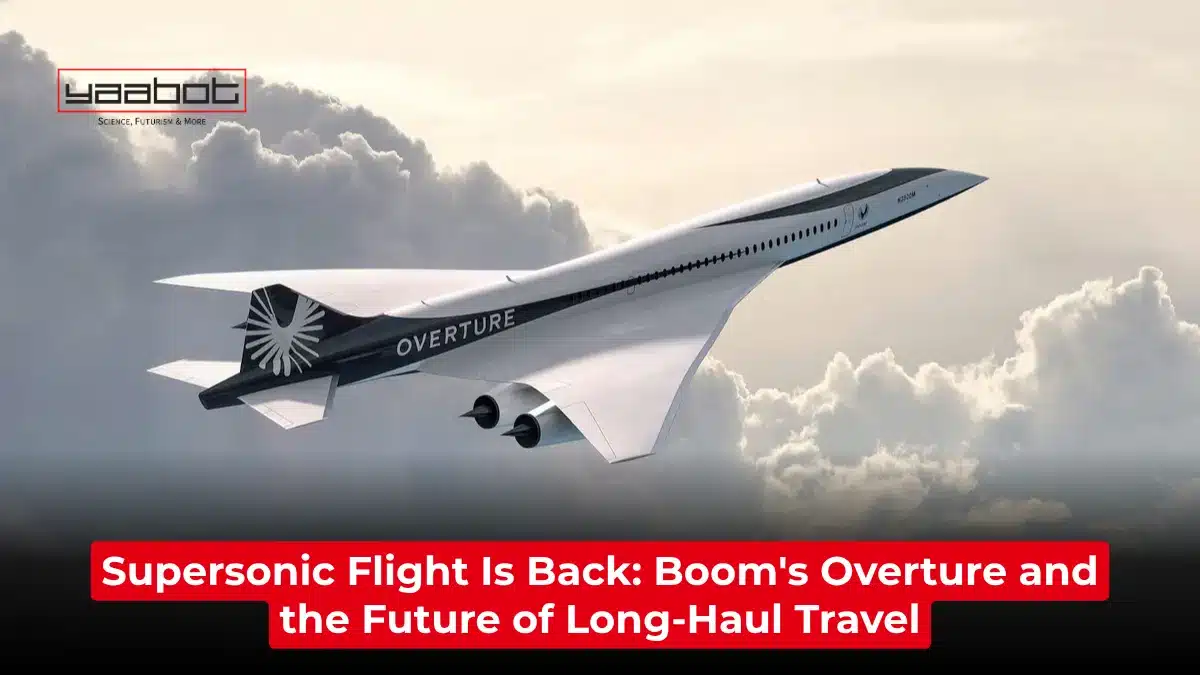
Boom Supersonic’s Overture is the leading attempt – its demonstrator already broke the sound barrier over the Mojave. Whether Overture actually flies passengers on Boom’s timeline is still up in the air, and that gap between promise and remaining engineering work is the real story here.
Key Takeaways
- Supersonic flight means traveling faster than the speed of sound, which is roughly Mach 1. And Boom’s Overture is designed to cruise at Mach 1.7.
- Overture’s demonstrator, XB-1, broke the sound barrier on January 28, 2025.
- Boom targets 2029 for commercial service, but independent analysts expect the timeline could slip into the early 2030s.
- American Airlines, United Airlines, and Japan Airlines have placed conditional orders, but Delta has publicly passed.
- The biggest open risk is certifying a brand-new engine and a brand-new airframe at the same time, on the same schedule.
What Is Supersonic Flight?
Supersonic flight simply means moving faster than sound travels through the air, crossing the speed threshold of Mach 1. At cruising altitude, that works out to roughly 660 miles per hour, though the exact number differs with temperature and altitude.
Anything at Mach 5 or beyond gets its own label, hypersonic. That’s the home ground for missiles, and commercial aviation has never operated there. To date, only two passenger jets have ever flown supersonically commercially; one was the French-made Concorde and the other was the Russian-made Tu-144. No other aircraft has repeated that feat since it retired.

A few basics worth knowing before the rest of this piece:
- Mach 1 isn’t a fixed speed in miles per hour. It changes with air temperature and altitude, which is why the same aircraft needs a slightly different speed to go supersonic at sea level versus at 40,000 feet.
- Breaking the sound barrier produces a sonic boom, a shockwave that reaches the ground as a loud crack, sometimes strong enough to rattle windows for miles.
- Commercial supersonic flight has always meant flying above oceans, since most countries ban sonic booms over populated land.
That overland restriction is the thread connecting Concorde’s commercial failure to Overture’s biggest current obstacle.
The Rise and Fall of Commercial Supersonic Flight
Concorde entered scheduled service in January 1976, jointly operated by British Airways and Air France. It could cross the Atlantic in about 3.5 hours, cutting a 7-8 hour subsonic flight roughly in half. More than 2.5 million passengers flew supersonic on the type before it stopped flying in 2003. That was the beginning of commercial supersonic flights.
Only 20 Concorde airframes were ever built, and just 14 entered commercial service. That small number tells you most of what you need to know about why it failed. A round-trip ticket between New York and London cost around $7,574 in 1996, which works out to roughly $12,460 in today’s money. At that price, seats regularly flew half empty, filled out by airline staff and upgraded passengers rather than full-fare customers.

The plane was also brutally fuel-hungry, and the July 2000 crash of Air France Flight 4590 accelerated a decline that economics had already set in motion.
Noise was a separate, permanent problem. Concorde’s sonic boom got it banned from flying supersonic over populated land almost everywhere, which is why its route map never grew past a short list of ocean-spanning city pairs like London to New York and Paris to Washington. Concorde was never really a transportation product. It was a luxury experience with a transportation shape.
Boom Overture: The Aircraft Bringing Commercial Supersonic Flights Back
Overture is designed to carry 64 to 80 passengers at a cruise speed of Mach 1.7, all in a single premium cabin, and to run on up to 100% sustainable aviation fuel. That’s roughly 1,300 miles per hour, well below Concorde’s Mach 2.04 top speed, but Boom’s bet is that Concorde’s economics needed fixing far more than its speed did.
The aircraft itself hasn’t flown yet. What has flown is XB-1, a scaled demonstrator that reached Mach 1.122 over the Mojave Desert on January 28, 2025, becoming the world’s first independently developed supersonic aircraft to break the sound barrier.
That flight validated pieces of the aerodynamic and materials approach Overture depends on, but a one-third-scale demonstrator faces a very different certification problem than an 80-seat commercial airliner does.
Overture vs. Concorde: Specs at a glance
| Concorde | Overture | |
| Cruise speed | Mach 2.04 (~1,354 mph) | Mach 1.7 (~1,300 mph) |
| Passenger capacity | ~100, single class | 64 to 80, single class |
| Fuel | Standard jet fuel, heavy consumption | Up to 100% sustainable aviation fuel |
| NYC-London round trip fare | ~$12,460 in 2020 dollars | Not yet published; Boom has said it is targeting business-class-range fares, not Concorde-level luxury pricing |
| Aircraft built | 20 built, 14 entered service | 0 flown; first flight targeted 2027 |
| Status | Retired 2003 | In development; demonstrator supersonic since Jan 2025 |
The Symphony engine and why Boom builds its own
Boom originally planned to buy an engine from an established manufacturer. None of them agreed to build one, so Boom is now developing its own, called Symphony. It’s a medium-bypass turbofan built to run supersonic without afterburners, the fuel-hungry, ear-splitting boost system that Concorde relied on and that contributed heavily to its noise problem.
That decision cuts both ways.
It removes Boom’s dependence on a supplier’s roadmap, but it also means the company is certifying a clean-sheet airframe and a clean-sheet engine at the same time, something no aerospace company of any size has done on a three-year timeline. That decision alone accounts for most of the certification risk facing the whole program.
The Aviation Technology Behind Boomless Supersonic Flight
The new engineering in Overture is the attempt to fly supersonic over land without anyone on the ground hearing a boom, a harder problem than top speed alone.
Boom calls this Mach cutoff, a phenomenon where a shockwave refracts through layers of the atmosphere and dissipates before it reaches the surface, letting an aircraft fly supersonic overland at reduced speed without a sonic boom reaching the ground. XB-1 has already demonstrated boomless supersonic flight using this effect.
That single technical trick is what could reopen thousands of overland routes that have been closed to supersonic jets since the 1970s.
Two other pieces round out the aviation technology story:
- Sustainable aviation fuel: Overture is designed to run on up to 100% SAF, a deliberate answer to the emissions criticism that dogged Concorde and every supersonic concept since.
- Camera-based vision systems: Because the fuselage shape limits forward visibility on landing, Overture uses external cameras and sensors to give pilots an augmented view during takeoff and approach, a system Concorde solved with a mechanically drooping nose instead.
- High-altitude cruise: Overture’s own published specifications put its cruising altitude around 60,000 feet, well above where subsonic airliners fly, which is part of how it manages drag and fuel burn at Mach 1.7.
What Supersonic Flight Means for Long-Haul Air Travel
The practical case for supersonic air travel is straightforward. It turns full travel days into half travel days. A flight that eats an entire waking day today could become something you do before lunch and are done with by dinner, and that changes the kind of trips people are willing to take, not just how comfortable the trip feels once they are on board.
Boom’s own route modeling gives a sense of scale. According to IEEE Spectrum’s coverage of the XB-1 test flight, Boom is targeting several long-haul corridors where the time savings are largest, mostly ocean-spanning routes where the overland boom restriction doesn’t apply.
Route time comparisons: Today vs. Overture
| Route | Current flight time | Projected Overture time |
| New York to London | ~6.5 hours | ~3.5 hours |
| Tokyo to Seattle | ~8.5 hours | ~4.5 hours |
| Los Angeles to Sydney | ~14.5 hours | ~8.5 hours |
Every route on that list is oceanic, and that’s not an accident. Overland supersonic flight in the United States has been banned since 1973, and until that changes at scale, Overture’s real-world value will stay concentrated on transatlantic and transpacific corridors instead of domestic ones.

How the Airline Industry Is Betting on a Supersonic Aircraft
Three major carriers have put money behind Overture. American Airlines has ordered 20 aircraft, United Airlines 15, and Japan Airlines has also signed on, together accounting for up to 130 aircraft in orders and options. That is a real signal of interest. But these are largely conditional commitments tied to Overture actually achieving certification, not firm, non-cancelable purchases.
Not every airline is convinced. Delta passed on ordering Overture, and CEO Ed Bastian said in 2022 he had more questions than answers about the program. One airline previously linked to Overture has since dropped out entirely. That split in the airline industry, three carriers in and at least one prominent holdout, shows the actual state of confidence more than the headline order numbers suggest.
Boom’s pitch to airlines centers on scale. The company has said Overture could eventually serve more than 600 profitable routes worldwide, betting that international travel demand has grown large enough since the 1970s to support supersonic service as a mainstream premium product. Whether that demand forecast holds up is itself unproven, since it depends on ticket prices that have not been set yet.
The Real Challenges Facing the Return of Supersonic Flight
This is the section that separates a marketing timeline from an engineering one.
- Simultaneous certification: Overture requires FAA and EASA sign-off on both a new airframe and the Symphony engine at the same time. Established manufacturers routinely spend a decade or more certifying a single new engine program. Boom is attempting both at once, on a schedule that assumes 2029 commercial service.
- The overland ban: In June 2025, an executive order directed the FAA to begin lifting restrictions on supersonic flight within US airspace, contingent on manufacturers proving noise mitigation. That’s a huge policy shift, but it’s just a directive to update rules, not a full-fledged change.
- Independent analyst skepticism: Forecast International, an aerospace research firm, has stated plainly that Boom’s 2029 to 2030 target is speculative, and that entry into service will likely slip into the 2030s given the scope of what remains to be certified.
- Fuel supply: Overture’s 100 percent SAF design depends on a fuel that is still expensive and hard to source at commercial scale, and the wider airline industry is still lobbying governments for the incentives needed to grow production. Overture’s economics are tied to a supply chain that does not fully exist yet.
- Economics that still have to prove out: Boom hasn’t released a ticket price. Its public positioning points toward business-class-range fares instead of Concorde-level luxury pricing, but that’s more of a stated ambition. Fuel costs, SAF availability, and per-seat economics on an 80-seat cabin will decide whether that promise holds.
These aren’t reasons to dismiss the program. They’re reasons to treat 2029 as a target Boom is chasing, not as a fact.
The Future of Aviation Technology: Is Supersonic Aircraft Here to Stay?
What makes this attempt different from Concorde is the structure built around it: an order book spread across three carriers instead of two national flag airlines footing the entire bill, a sustainable fuel strategy built in from day one instead of bolted on later, and an overland regulatory path that did not exist when Concorde was flying.
But none of that guarantees success.
A grounded fleet with strong marketing is still a grounded fleet. The honest way to think about the future of aviation technology here is that the ingredients for a durable supersonic product exist for the first time since 1976. Assembling those ingredients correctly is now purely an engineering and certification problem, and problems like that get solved with time, money, and flight-test data.
Final Thoughts
The time between 2029 and 2023 is worth watching, because that gap is where marketing promises meet the reality of certifying an engine and an airframe from scratch, all at the same time.
I would rather see Boom slip a year and deliver a working aircraft than hit 2029 and cut corners to get there. Getting an airline to trust Overture with paying passengers, on a schedule regulators actually approve, is the hard part of this whole project, harder than the airframe and harder than the Mach number on the spec sheet.
For more info on AI and tech, visit Yaabot.
FAQs
Supersonic flight refers to speeds beyond Mach 1, the speed of sound, and is defined as a speed greater than 660 mph at cruising altitude. Boom Overture hopes to be the second such commercial aircraft to do so, as Concorde did.
Boom targets 2029, but independent analysts at Forecast International expect the timeline could slip into the early 2030s, given that Overture and its engine both still need certification.
Overture is designed to cruise at Mach 1.7, about 1,300 mph, roughly twice the speed of a typical subsonic airliner and slightly slower than Concorde’s Mach 2.04.
Boom hasn’t published fares. The company has said it is targeting prices closer to today’s business class than Concorde’s roughly $12,000 round-trip fare, but this remains unconfirmed.
American Airlines (20), United Airlines (15), and Japan Airlines have reserved up to 130 aircraft pending certification. Delta has NOT ordered.
Not fully. A June 2025 executive order directed the FAA to begin lifting the overland ban, contingent on noise mitigation, but updated rules haven’t yet been finalized.
