


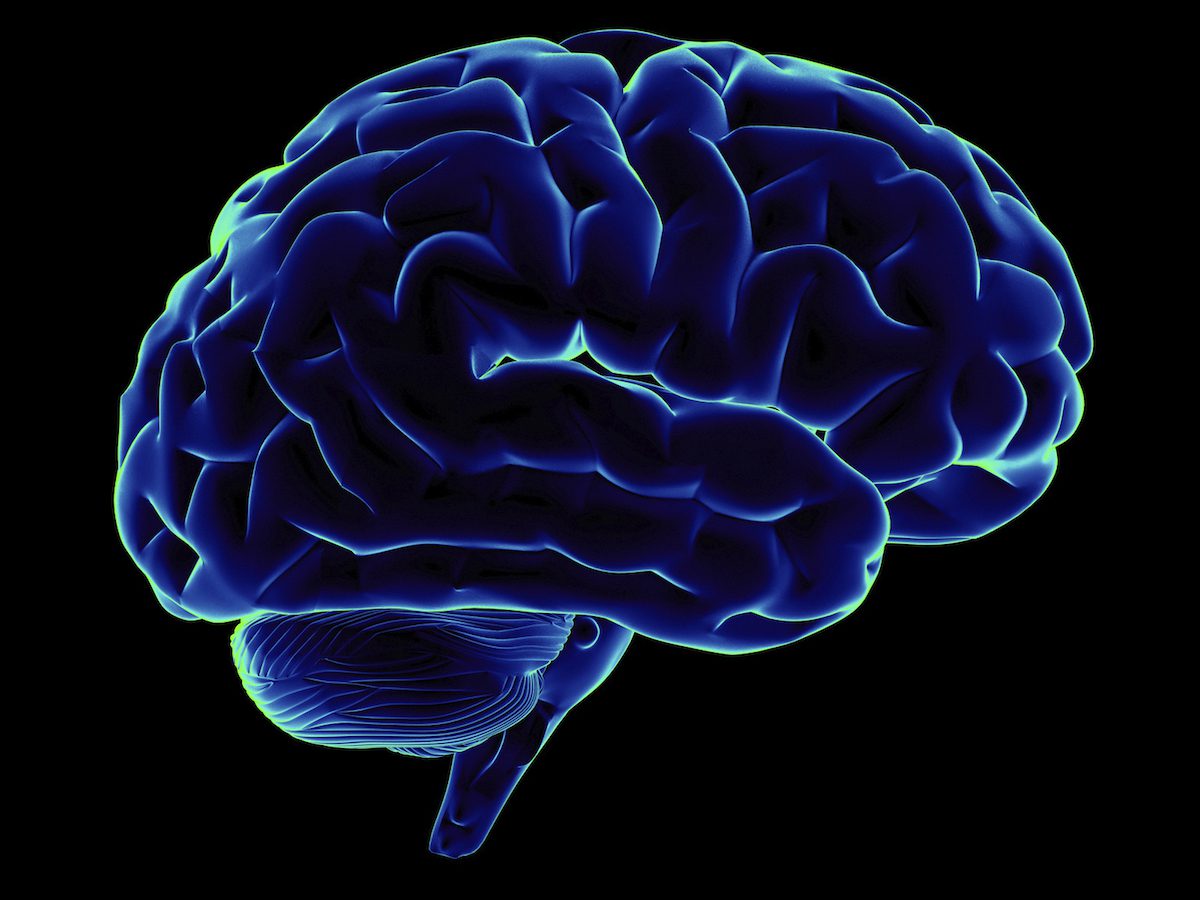
As the self-proclaimed ‘superior’ species on planet Earth, we’ve always been quick to point that our brain, with its amazing thinking prowess, has given us our edge over other species. Our brain has not only provided us with the ability to ‘sense’ our environment but to think and plan. Anticipation and execution of tasks, movement, growth and even each of our measured breaths have their designated ‘control rooms’ in the brainy office. It is the seat of our consciousness and awareness.
Simultaneously, the brain is also the least understood organ of our body. In fact the whole process of neural functioning and thought formation and the quirks in our brains, like dreams and hallucinations, are unanswered questions.
Also Read: The Science Behind Sleep
Our traits as a species exist today due to natural selection. Over the course of our evolution, favorable traits managed to stick around, and this applies to our brain too.
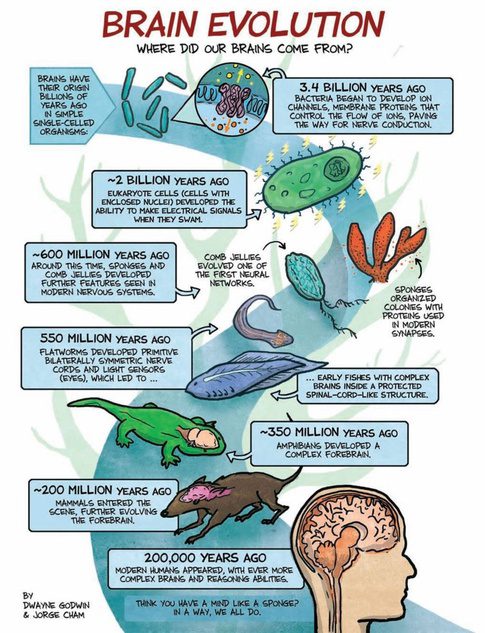
The elaborate process of information conduction in our organs, has its roots in the development of ion channels in bacteria that existed nearly three and a half billion years ago. The fundamental function of synapses, wherein information travels from one neuron to another, utilizes several proteins. Some of these proteins can be traced to the sponges which use them to form colonies, thus establishing connections. With the appearance of fish came the rudimentary spinal cords and simpler brains. The forebrain (a part of our brains) can be seen in amphibians and mammals. Our brain as an organ has been evolving with life for billions of years.
When it comes to human evolution in detail, our understanding of it is an incomplete story. We’ve figured out the milestones but several dots still require manual connection.
The Human Brain has Grown
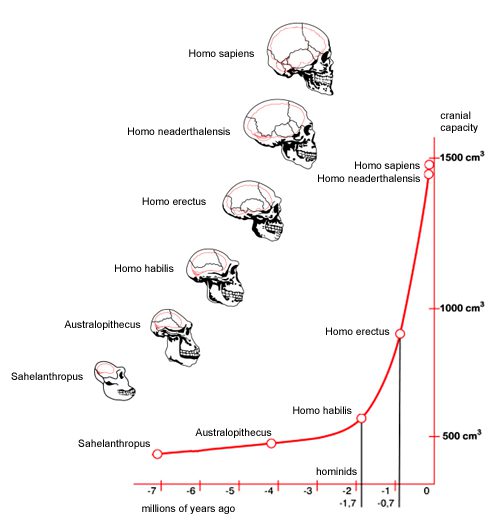
Fossils are our windows to the past. And in the human evolutionary trail, the skull, the house of our brain, helps us to better understand the changes that have occurred in our brain as we have evolved. A general trend that one observes is that the early hominids had a smaller brain capacity and it has increased with each step. As a result, the brain of early Hominids weighed around 400 grams, and today, our brains weigh 1500 grams on average.
It is believed that our intelligence developed and was enhanced due to this increase in brain size. Is this trend going to continue? It is a common notion that a bigger brain equals higher intelligence. This idea has transcended into science fiction works. One of the popular alien figures has been of a form with enormous heads. Many people imagine that even we are on a path to a large head with huge brains with increased abilities. But is an enlarged brain on card in our future?
Related: What’s next in human evolution?
Size = Intelligence?
Is the adage ‘the bigger the better’ true when it comes to brains too?
Only if brain size were the only parameter for intelligence. The whale has a brain weighing 6 kilograms. Does that imply that it is more complex in its thoughts and behavior than humans? On the other end of the spectrum, even ‘bird brains’ are capable of amazing feats like migration over large distances, elaborate nest formations and elaborate mating behaviors.
Comparable physiology helps us out of this conundrum. While larger brains are indicative of complex behavior, it is the size of brain with respect to the body mass that is more indicative of the animal’s intelligence. The 6 kg brain of a whale is only 0.01% of the gigantic 60,000 kg whale!! On the other hand, our brain accounts for 1.9% our body mass.
The Genes behind Intelligence
To better understand the genetic basis of the evolution of human brain, scientists look at cases where the brain size is smaller than the expected. Genes that are at work here can be said to play a role in brain size determination. One such gene that has come up is ASPM – which results in brain size anomalies when mutated. APMS is present in other mammals too. Its evolution, though, has happened at a greater pace in primates than say, in rodents. Microcephalin is another gene said to be involved in brain size determination. But these are not only determining genes when it comes to the brain size. But these are the few that are recognized and prone to scrutiny.
Related: The evolution of human morality
According to a fresh study, a new allele for microcephalin emerged over 35,000 years ago and a new one for ASPM emerged nearly 6,000 thousand years ago. This was deduced by calculating the frequency of these genes in various populations. While about 70% of individuals from Europe and East Asia studied had the allele for microcephalin; 50% of Middle Easterners and Europeans had the ASPM allele (Africans and East Asians had it in much less frequency). According to Dr. Bruce Lahn of University of Chicago, who helmed this study, this is evidence of natural selection at work; and proof that human brain is still evolving.
More evolution to come?
On the other hand, a lot many theorists believe that our brains today are at the pinnacle of evolution. Our utilisation of our mental abilities may not be optimum, but physically; it does not get better than this. Researchers have created models to make this point. Importantly, if we believe that the brains were going to get bigger, we must remember that it doesn’t work alone. Our brain, accounting for less than 2% of our body, already consumes a fifth (20%) of our oxygen supply!
A bigger skull will be needed to accommodate a bigger brain; a need for improved heart function, increased circulatory network will arise leading to an increased demand on all organs– thus a larger body on the whole. But due to its obvious dangers during childbirth, larger skulls are naturally selected against! Already, our large skulls result in more painful childbirths than in other primates.
Moreover, a larger brain means longer distances for the information to cover which place a huge energy demands. A lot of brain development occurs in our infancy, after our birth, and a lot of people suffer due to an unequal availability of nutrients. Larger brains would have higher nutritional demands in an already malnourished world.
Besides, any organ doesn’t pop out of nothing; we rely on changes in underlying structures. The present structures in our brain impose some restrictions on these gigantic brain prospects.
Though not properly backed, a popular theory is that our brain may not need to grow in our intelligent future. They believe that we are utilizing our brains inadequately and that learning how to do use it properly will lead us into a clever route.
Genetically engineered changes may be a possibility to enhance brain function and even remove all possible mental health issues. But genetically modifying ourselves is a divisive, and as of now, a scary prospect.
Related: The Social Impact of Genetic Manipulation
But we intelligent creatures love to argue and ponder. And that has led to another idea of brain evolution – it considers that our natural brain capacity is at its peak and may even decline due to our increased dependence on technology.
Language is considered one of the most vital gifts that our brains have given us. But isn’t this form of communication already the decline (or at the very least modified) by our dependence on electronic devices? Aren’t we already using artificial systems to store information and data?
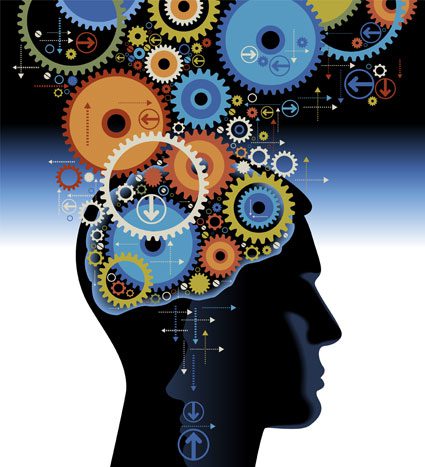
On a brighter note, aren’t we already using implants and the likes for regaining lost functions like impaired hearing and defective hearts?
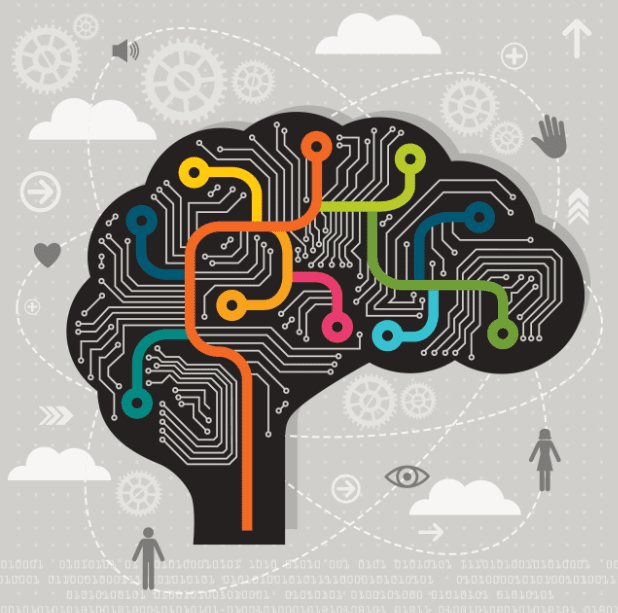
Futurists believe that one day it will be possible for us to exchange our electrical impulses with computers, enhancing our memories. Maybe, even save ones’ ‘consciousness’ outside the body. As for the mechanic reliance, it doesn’t sit well with people who believe that it will be the death of our species if we were to form this alliance.
This artificial, man-directed evolution is distinct from the conditions in which our brains developed. Our shift to bipedalism (using two limbs for movement) triggered a multitude of reactions, maybe, even our brain’s development due to the rearrangement that happened in our bones and form. It seems unlikely that now any ‘organic’ or natural reason will be able to steer us into an upgraded brain. But maybe we, ourselves, would tamper with it and create something new and formidable.
