



NASA is expected to launch the James Webb Space Telescope on March 30, 2021. Also referred to as the successor to the 1990 Hubble Space Telescope, the James Webb Telescope is a big deal. With its goal of “complementing and expanding” the observations of its predecessor, many claim the JWST to be a replacement to the Hubble Space Telescope, primarily because the JWST is planned to further look into the areas suggested by the Hubble Telescope. Because this new telescope is going to unlock access to areas of the universe that Hubble couldn’t, we can expect to find extraordinary discoveries about the youngest objects in the universe. But how does it compare with Hubble?
The James Webb Space telescope is said to be the most powerful and capable telescope created by mankind so far. Although there are several larger terrestrial telescopes, the JWST boasts some of the most advanced scientific equipment that are capable of applying different principles of optics in looking at the universe. Because there are so many inherent differences, but so little clarity to the layman, it is important to understand the amazing endeavour of the James Webb Space Telescope, and see how it compares on James Webb vs Hubble Telescope comparison.
The JWST Is Our Most Powerful Telescope Yet

While all space telescopes are our eyes in the sky, there is a reason why the JWST is referred to as one of the biggest and most ambitious scientific projects of all time – its sheer size.
- According to the official Webb telescope website, The James Webb Space Telescope is not only more powerful in terms of the aperture of the primary mirror, but also the capacity of the telescope in terms of the wavelength. Webb would have a main mirror with a diameter of 6.5 meters, which will allow it a significantly greater focus area than the mirrors found on our current range of space telescopes.
- Hubble’s mirror is 2.4 meters in diameter, which is somewhat smaller with an equivalent reflection size of 4.5 m², giving Webb about 6.25 times more reflection area.
“To go to the earliest galaxies, we needed a bigger mirror, and that bigger mirror had to look at a bigger frequency of light,” astrophysicist Blake Bullock told MSN. Bullock is also director at Northrop Grumman Aerospace Systems.
What’s more, is that the James Webb telescope shall orbit the sun about 1.5 million kilometers away from Earth, located at the L2 – the 2nd Langrange point of the Sun-Earth system. This would lend it a superior viewing field, allowing it to see see further back in time. Its larger size also means that the new telescope can detect the faintest amounts of radiation from the farthest reaches of the universe.
James Webb Telescope vs Hubble: Different Wavelengths

Webb will observe mainly in the infrared and will have four research instruments to record celestial source photographs and spectra. The Hubble detectors can detect a limited portion of the infrared spectrum from 0.8 to 2.5 microns, but the primary ranges are 0.1 to 0.8 microns in the ultra-violet and visible portions of the spectrum. The JWST, on the other hand, provides a 0.6 micron to 28 micron wavelength range. The advantage here is that viewing in the near-infrared spectrum can make smaller objects visible and helps us look farther into the universe. Since the wavelength of IR is much larger than the visible area of the spectrum, IR light waves simply travel through small particles like space dust and gases, making generally hidden extraterrestrial objects visible.
One of the primary goals of the James Webb telescope is to look for Earth-like planets, and with its capability to observe through gases, we might have a chance at studying numerous other planetary properties.
James Webb vs Hubble: Can Look Further Into The Past
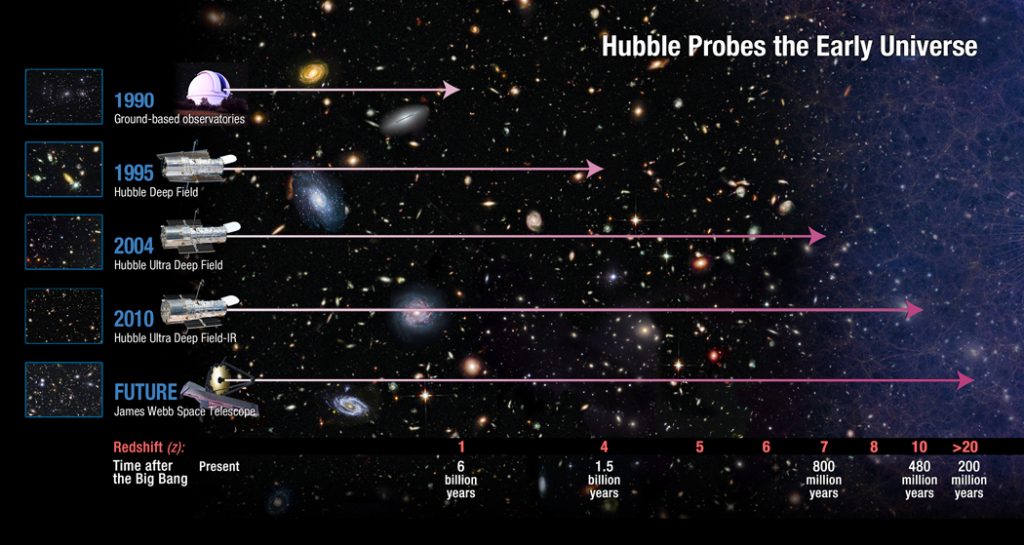
Because of the cosmic speed limit, we are always looking at the past form of any celestial object. The farther an object is, the farther back in time we are looking.
- The Hubble Space Telescope can see until the point right after the first galaxies were formed, or in other words, teen galaxies.
- The James Webb Telescope, on the other hand, can go as far as toddler galaxies to even the birth of the galaxies shortly after The Big Bang. This should end up offering us more information on the Dark Ages, which ended around 0.3 billion years after The Big Bang.
Not only can the JWST view the earliest objects formed at the beginning of the universe, but due to its wavelength spectra, we can also look at exoplanets orbiting around their stars and their constituent elements.
Due to its wider viewing capabilities, the results from the JWST, when applied to the study of atomic spectra, can unlock a lot more information that has so far been impossible to obtain. The implications in astronomy, and even in the search for extraterrestrial intelligence, are significant. The James Webb Telescope also packs in a Near-Infrared spectrograph (NIRSpec), which will offer three different spectroscopic capabilities, assisting scientists in helping us map the universe and navigate its depths
The excitement surrounding this mission is understandably peaking, with the scientific community eagerly waiting for the launch of this new feat in engineering. Scientists will be able to access the telescope and study the early universe collaboratively, globally. In a previous post, we noted how James Webb will transform our view of the cosmos. “It is the biggest, most powerful telescope ever to be put in space. There are big telescopes on the ground but nothing of this nature and complexity in space. Hands down, it’s the most powerful thing out there,” Bullock added.
