



I remember the first time someone told me 5G would “change everything.” That was around 2019. And it did change some things. But for most people, it just made their phones load Instagram faster.
6G is being sold the same way, and I think that framing is going to cause people to miss what’s actually interesting about it. This isn’t about downloading a movie in just a couple of seconds. The real story is what happens when a network becomes less of a pipe and more of a platform.
By 2030, the global 6G market is projected to generate over $50 billion in its first five years of rollout. That’s an infrastructure-level upgrade.
Key Takeaways
- 6G is not just a faster 5G. It introduces AI natively into the network architecture itself, not as an add-on.
- Target specs include up to 1 Tbps speeds and sub-0.1ms latency. That’s the kind of numbers that unlock real-time holographic communication and remote surgery.
- Commercial launch is expected around 2030, with trials possibly beginning in 2028–2029.
- Industries like healthcare, manufacturing, and smart cities stand to gain the most, not individual consumers.
What Is 6G?
6G technology is the sixth generation of wireless technology, expected to deliver speeds up to 1 Tbps, ultra-low latency below 0.1 milliseconds, and AI-native network architecture. It will operate on terahertz (THz) frequencies and is projected to launch commercially around 2030.
It operates in terahertz (THz) frequency bands above the millimeter-wave spectrum that 5G uses. These higher frequencies enable massive bandwidth but also introduce significant engineering challenges, particularly around signal propagation and coverage.
The International Telecommunication Union (ITU) is coordinating 6G development under its IMT-2030 framework. The first full technical specifications are expected to be finalized by late 2028.
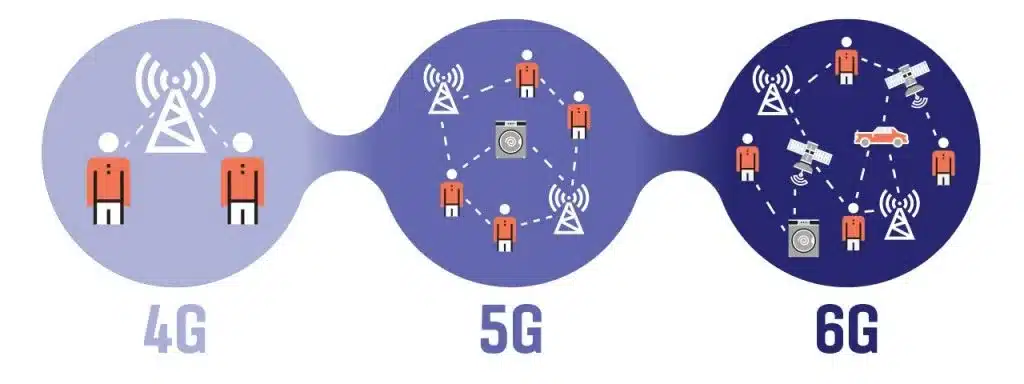
Why 6G Is Not Just About Speed
But here’s what often gets overlooked: 6G’s defining characteristic isn’t speed—it’s the AI that’s built directly into the network. That represents a fundamentally different architecture from anything we’ve seen before.
Unlike previous generations, where the network simply transported data, it introduces intelligence at the infrastructure level. This allows the network to optimize itself, adapt in real time, and support complex systems like autonomous machines and digital environments without constant human control.
Key Capabilities of 6G
- Peak data speeds: up to 1 Tbps (compared to 10 Gbps for 5G).
- Latency: under 0.1ms (5G targets 1ms).
- Frequency range: 0.1–1 THz.
- Use cases: holographic communication, autonomous systems, advanced AR/VR, digital twins, smart city infrastructure.
- AI-native architecture: built-in intelligence that enables the network to self-optimize, adapt, and make real-time decisions
6G vs. 5G: What Actually Changes?
The narrative of it being X times faster undermines the actual differences. Speed is just a part of it, but it’s not the part that matters most.
Key differences at a glance
| Feature | 5G | 6G (Estimated) |
| Peak Data Rate | 10 Gbps | 1 Tbps |
| Latency | ~1 ms | < 0.1 ms |
| Frequency Range | 30–300 GHz | 0.1–1 THz |
| AI Integration | Overlay/add-on | Native architecture |
| Primary Use Cases | Mobile broadband, IoT | Holographic comms, autonomous systems, XR |
| Energy Efficiency | Baseline | Target: 10–100x improvement per bit |
| Network Design | Human-managed | Self-optimizing, self-healing |
The latency difference is more important than the speed difference for most industrial applications. At under 0.1ms, you’re operating in a regime where a robotic arm can receive corrections faster than a human nerve signal. That’s a manufacturing and surgical capability.
Why 6G Is About More Than Faster Internet
The speed narrative is a distraction. Here’s what actually changes.
From connectivity to intelligence
Every network generation up to 5G was fundamentally a channel for moving data between endpoints. The endpoints are used to do the thinking. And the network used to get transported.
6G breaks that model. In an AI-native network, the infrastructure itself does most of the things and reroutes traffic without human intervention. The network doesn’t just carry data, it participates in decisions about how that data gets used.
This is important because the bottleneck in smart systems isn’t usually the bandwidth. It’s the latency and compute overhead of sending data to a central system, processing it, and sending instructions back. It collapses that loop.
Beyond smartphones
Most coverage of 5G and 6G anchors the story in smartphones. But the smartphone users won’t be the biggest beneficiaries of 6G technology. They’ll be:
- Autonomous vehicle fleets that need sub-ms coordination across a city grid
- Industrial sensors in factories require real-time feedback loops.
- Medical devices performing remote procedures, where a slight latency could mean death.
The IMT-2030 framework explicitly envisions 6G as connectivity for intelligent entities, which includes robots, autonomous systems, and digital twins.
How 6G Could Enable Holographic Communication
Holographic communication is one of the most over-hyped and under-explained concepts in the 6G conversation. Let’s actually unpack it.
What holographic communication actually means
In the 6G context, holographic communication doesn’t mean some top-notch graphical projections from a device. It refers to volumetric video communication, streaming a 3D representation of a person or environment in real time. This would allow the remote participant to be spatially present.

The technical requirements to pull this off are extreme. Telepresence requires between 1 and 10 Gbps of sustained throughput per stream. Factor in multiple participants, real-time rendering, and haptic feedback layers.
Why 5G falls short
5G’s theoretical maximum is 10 Gbps. But real-world performance is far lower, typically ranging between 100 and 500 Mbps for consumer applications. But even if you set aside throughput, 5G’s 1ms latency target is just barely adequate for basic remote activity.
The Role of AI in 6G Networks
This is the part I find genuinely interesting, and it’s the least-discussed angle in most 6G coverage.
AI-native network architecture
In current networks, AI is used for specific tasks on top of the network: traffic analysis, anomaly detection, and capacity planning. The network itself runs on static protocols.
In a 6G network designed around AI-native architecture, the protocols are the AI. Spectrum allocation, beamforming, routing, etc., happen through learned models. The network trains on its own operational data and updates its behavior continuously.
6G’s self-healing systems
6G networks are designed to detect and fix around failures autonomously. A tower going down won’t need a human to fix it. The surrounding infrastructure redistributes load, and the system self-heals within milliseconds. And for telecom operators, this means dramatically lower operational costs over time.
How 6G Could Transform Industries
Healthcare
Healthcare is the most high-stakes application. Remote robotic surgery is technically feasible today in controlled settings. But it can’t be deployed at scale because the current networks don’t guarantee the required latency. A surgeon operating remotely needs a feedback loop under 1ms and needs that guarantee.
6G’s combination of sub-0.1ms latency and network-level reliability changes the network dynamics. Beyond surgery, real-time remote patient monitoring, AI-driven diagnostics at the edge, and personalized treatment systems all become more viable when the network itself can process and act on data locally.
Manufacturing
Smart factories are already deploying 5G for connected robotics and predictive maintenance. The only limitation is coordination, that too at a large scale. A factory floor with hundreds of autonomous robots needs precise sub-ms coordination to prevent collisions and optimize workflows. And that’s something 5G’s latency and reliability limits make difficult at full density.
6G technology closes that gap. It also enables digital twins and real-time virtual replicas of physical manufacturing environments, which require continuous, high-bandwidth synchronization between the physical and digital layers.
Smart cities
Smart city infrastructure is the application area where 6G’s sensor integration and AI-native processing matter the most. From traffic systems to energy grids, all generate enormous data volumes that need to be processed at the edge, not shipped to a central data center.
6G’s design, distributed intelligence, and massive device density perfectly fit the smart city model.
The Biggest Challenges Facing 6G
I want to be honest here: 6G faces serious unsolved problems, and the hype cycle tends to paper over them.
Spectrum and infrastructure limits
THz frequencies can carry enormous data volumes, but have terrible propagation characteristics. THz signals are either absorbed by water vapor or blocked by walls, and can’t travel more than a few hundred meters without degradation.
This means a 6G network will need a fundamentally denser base station infrastructure than 5G. The cost implications are significant. 6G components are unlikely to be compatible with the existing 5G infrastructure. So, essentially, an entirely new network has to be built, which changes the economics considerably.
Energy consumption
There’s a painful irony in the 6G energy story. The density of infrastructure required for THz coverage is dramatically higher than total energy consumption.
With more base stations, more edge computing nodes, and more AI inference at the network level, the per-bit efficiency gains may not offset the absolute energy increase. This is an area where the sustainability narrative around 6G deserves more scrutiny than it typically gets.
Privacy and security risks
An AI-native network that processes its environment and location data, and also integrates with the physical infrastructure, is also an extraordinary surveillance system. The same tech that enables holographic communication and remote surgery can aggregate behavioral patterns and movement data at scale.
This isn’t a reason not to build 6G. But it’s a reason to be serious about governance frameworks before deployment, and not after. The geopolitical dimension increases the risk. China is developing its own 6G ecosystem largely independent of the global standards. This risks a fragmented global 6G landscape with incompatible privacy norms.
Which Countries and Companies Are Leading the 6G Race?
Countries leading 6G research
The 6G race looks a lot like the 5G race with the same geopolitical fault lines, but higher stakes.
- China holds the largest number of 6G patent filings globally and conducted the first 6G test satellite launches between 2020 and 2024. China’s IMT-2030 Promotion Group, established by the Ministry of Industry and Information Technology in 2019, coordinates industry-academic-government 6G R&D.
- South Korea was the first nation to deploy 5G commercially,with Samsung and LG actively leading 6G research. South Korea aims for a 2028 pre-commercial launch.
- Japan allocated ¥66.2 billion (~$440M) in 2023 specifically for 6G research, targeting a 2030 commercial launch with a focus on AI-native architecture.
- The United States is pursuing 6G through the NTIA and private-sector investment, with plans to demonstrate 6G technology at the 2028 Los Angeles Summer Olympics.
- The EU is funding 6G through the Smart Networks and Services (SNS) Joint Undertaking, with Germany’s 6G-ANNA project among the most active research programs.
Key companies investing in 6G
- Nokia are committed to their commercial deployment targets of 6G by late 2029, with first release of specifications targeted for Q4 2028.
- Ericsson is actively involved in 6G standards work through 3GPP and O-RAN.
- Huawei / ZTE are the leading patent holders, though their participation in Western markets remains politically complicated.
- Samsung / LG are particularly active in hardware research (antennas, THz transceivers).
- Companies like Apple, NTT Docomo, Airtel, Jio have announced 6G programs, though at different levels of maturity.
When Will 6G Launch?
Expected timeline
| Year | Milestone |
| 2025 | 3GPP Release 19 study items begin; standardization phase kicks off. |
| 2026–2027 | 3GPP Release 20 studies technical consensus building; spectrum decisions at WRC. |
| 2028 | 3GPP Release 21 specifications finalized; early trials begin; US 6G demos at LA Olympics. |
| 2029 | Pre-commercial 6G networks in early-adopter markets. |
| 2030 | First commercial 6G deployments in major markets. |
| 2035 | Broad global 6G availability. |
Current development stage
As of 2026, 6G is squarely in the standardization and early research phase. Nokia’s official 6G roadmap states that while trials could begin as early as 2028, the first commercial networks are expected in late 2029, followed by wider deployment in 2030. Consumer devices, like smartphones, tablets will likely lag network deployment by 12–18 months, as they did with 5G.
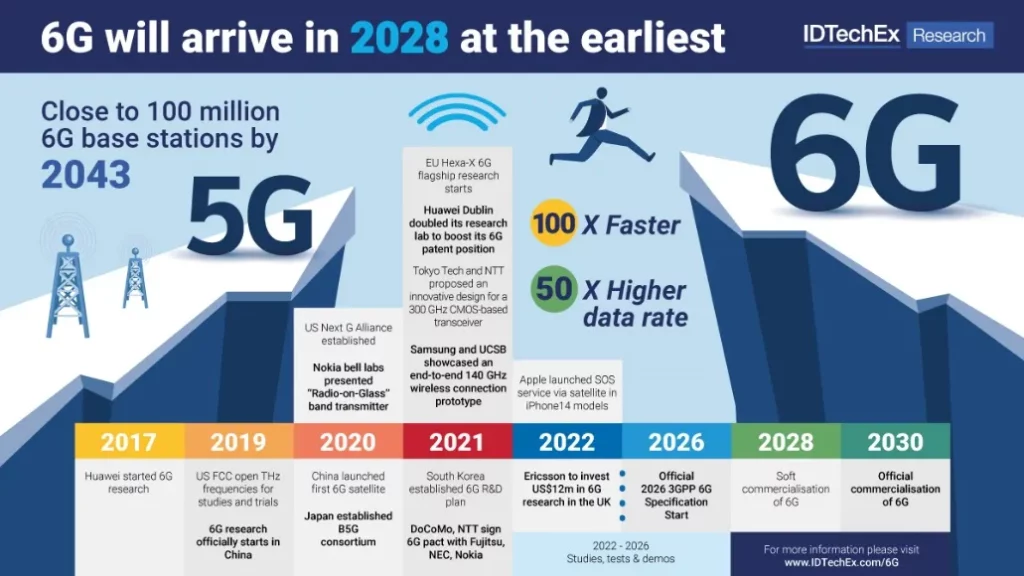
It’s worth noting that the 5G revenue growth has been slower than analysts predicted, which has introduced some caution around the pace of 6G investment. The industry isn’t in a rush to repeat the “overbuild and wait” dynamic of early 5G deployment.
Should Businesses Care About 6G Right Now?
Short answer, yes.
But you shouldn’t be making 6G-specific infrastructure purchases today. The standards aren’t final, the hardware doesn’t exist at a commercial scale, and the deployment timeline in most markets is still 4–5 years out.
But there are things businesses should be doing now:
- Auditing their 5G readiness. 6G builds on 5G Advanced infrastructure. If you’re not on 5G for relevant operations yet, that’s the actual gap to close.
- Watching the AI-native architecture shift. The move toward self-optimizing networks changes how enterprise telecom contracts will work.
- Monitoring spectrum policy. For industries heavily dependent on IoT and smart connectivity. Manufacturing, logistics, healthcare, the regulatory decisions happening at WRC-27 around spectrum allocation will have direct operational implications.
- Taking the security governance conversation seriously. If 6G networks integrate into your critical infrastructure, the privacy and security architecture decisions being made now will be very hard to reverse later.
The businesses that will get the most out of 6G are the ones that treat the next four years as a preparation period, not a waiting period.
Final Thoughts
6G isn’t coming to make your phone faster. It’s coming to make the infrastructure around you smarter. And in some cases, to blur the line between the physical and digital environment in ways we haven’t fully worked out the implications of yet.
The technical specifications are impressive. 1 Tbps theoretical speeds, sub-0.1ms latency, and AI baked into every layer of the network. The network has real potential for healthcare, factories, and cities with integration of autonomous technology.
But the challenges are also real. THz propagation limits, infrastructure costs, and geopolitical scenarios could fracture the global 6G standards. It’s a technology that’s still being defined by engineers, regulators, and governments, all at the same time.
One of the things to keep in mind is that the generations of wireless technology that changed the most weren’t the ones that delivered the fastest speeds. They were the ones who changed what you could do that wasn’t possible before. If 6G delivers on its AI-native, ultra-low-latency promise, it won’t just be a faster network. It’ll be a different kind of infrastructure entirely.
FAQs
When will 6G be available?
Commercial 6G deployments are expected around 2029–2030 in markets like South Korea, Japan, and China. Global availability is projected around 2035.
What’s the difference between 6G vs. 5G?
The key differences are speed, latency, and architecture. 6G is AI-native, meaning AI is embedded in the network itself, not added on top.
Which country will launch 6G first?
South Korea and China are the leading candidates for the first commercial 6G deployment, based on current R&D and stated timelines. Both are targeting a 2030 launch, with pre-commercial trials possible in 2028–2029.
