



Most generative AI tools are designed to answer a question, create an image, or suggest a piece of code. AlphaEvolve goes further. It generates algorithms, tests them, compares the results, and repeatedly improves the strongest solutions.
Developed by Google DeepMind in 2025 as a Gemini-powered coding agent, AlphaEvolve is a generative AI coding agent that creates algorithms, tests them, and keeps improving the strongest results. It has already been used across AI training, data-centre scheduling, databases, chip design, and scientific research.
Key Takeaways
- AlphaEvolve is a generative AI coding agent from Google DeepMind that autonomously discovers and optimizes algorithms through an evolutionary loop.
- It broke Strassen’s 56-year-old math record by finding a 4×4 complex matrix-multiplication algorithm using just 48 scalar operations.
- Unlike static generative AI models, AlphaEvolve develops its solutions through repeated generation, evaluation, selection, and automated verification.
- It has officially moved into hardware design, with an arithmetic-circuit optimization proposed by AlphaEvolve integrated into the silicon of a next-generation Google TPU.
What Is AlphaEvolve?
AlphaEvolve is an evolutionary coding agent developed by Google DeepMind. It combines Gemini large language models with automated evaluators and an evolutionary framework to discover new algorithms or improve existing ones.
I find it easiest to understand AlphaEvolve as an automated laboratory for code. Gemini proposes possible solutions. Evaluators run and score them. AlphaEvolve keeps the strongest candidates and uses them as the starting point for another round of ideas.
Unlike a normal coding assistant, it doesn’t stop after generating one response. It can explore many variations and gradually improve the result according to measurable goals like accuracy, speed, memory use, energy consumption, or operation count.
How Does AlphaEvolve Work?
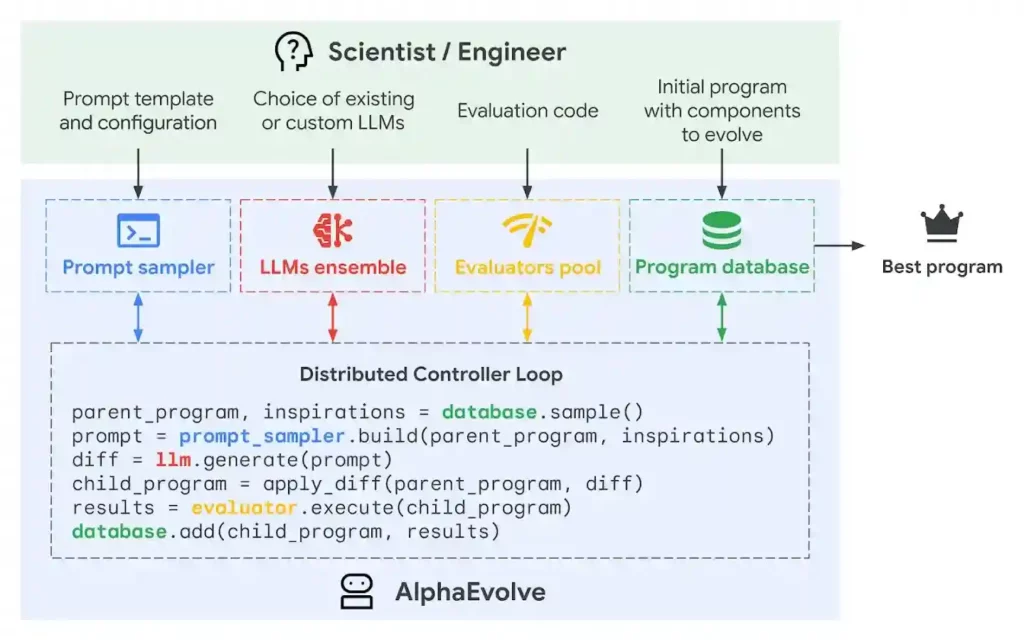
The AlphaEvolve architecture has three main components working in a continuous loop.
Step 1: Generate: AlphaEvolve uses an ensemble of Gemini models to propose modifications to a program. Gemini Flash is used to explore a broad range of ideas quickly, while a more capable Gemini model contributes deeper and more deliberate suggestions. The models produce candidate solutions as runnable code rather than only natural-language explanations.
Step 2: Evaluate: Every proposed program is run through one or more automated evaluators. These evaluators measure whether the program is correct and how well it performs against the selected objectives.
This stage reduces one of the biggest weaknesses of ordinary generative AI: code that sounds convincing but doesn’t actually work. AlphaEvolve’s solutions must produce measurable results rather than merely look plausible.
Step 3: Evolve: The best-performing programs are stored in a program database. AlphaEvolve selects promising candidates, modifies or combines them, and sends the new generation back through the evaluator.
The cycle then begins again.
This is what makes AlphaEvolve different from a model that simply receives a more detailed prompt. The system is not relying on one attempt. It uses feedback from actual execution to decide which ideas deserve further development.
The 56-Year-Old Math Record AlphaEvolve Broke
In 1969, German mathematician Volker Strassen showed that two 2×2 matrices could be multiplied using seven scalar multiplications instead of eight. Applied recursively, his method multiplied 4×4 matrices in 49 operations instead of 64.
That record stood for 56 years until AlphaEvolve found a valid 48-operation method – the first improvement in this setting since 1969.
The gain may seem small, but matrix multiplication powers scientific computing, graphics, engineering, machine learning, and AI training. While this discovery will not speed up every matrix calculation, it shows that AI-guided search can uncover solutions human researchers missed.
How AlphaEvolve found a better solution
- AlphaEvolve received a basic code structure and the objective of reducing the number of scalar multiplications.
- It generated numerous candidate algorithms representing different ways of decomposing the matrix operation.
- Each candidate was tested for mathematical correctness and computational efficiency.
- The highest-scoring programs were retained, modified, and combined to create a new generation.
- After repeated rounds of evaluation, AlphaEvolve produced a correct method requiring 48 scalar multiplications.
Researchers then verified the result. That final step matters. AlphaEvolve can dramatically accelerate the search for a solution, but new mathematical claims still require formal checking and expert scrutiny.
AlphaEvolve vs. Traditional AI Models
| Feature | Standard Generative AI | AlphaEvolve |
| Output type | Text or code suggestions | Verified, runnable algorithms |
| Verification | None by default; hallucinations are possible | Formal automated evaluators |
| Improvement mechanism | Usually produces a response using static model weights | Evolutionary loop with continuous feedback |
| Problem scope | General-purpose responses | Targeted algorithm optimization |
| Deployment | Commonly used through a user-facing chat or coding interface | Used in scientific research and production infrastructure |
| Self-referential capability | Does not independently optimize the systems on which it runs | Can optimize parts of the infrastructure used to train its underlying models |
| Lineage and predecessors | Built on foundational Transformer architectures such as GPT, Claude, or Gemini | Extends the algorithm-discovery direction demonstrated by AlphaTensor from matrix mathematics to broader code and infrastructure optimization |
The Role of Generative AI in AlphaEvolve
AlphaEvolve is more than an evolutionary algorithm with a chatbot attached. Its gen AI layer makes the search smarter.
Traditional evolutionary systems rely heavily on random mutations. Gemini instead uses its knowledge of code and computational patterns to suggest meaningful changes, such as simplifying calculations, removing redundant steps, or restructuring functions.
I think of Gemini as AlphaEvolve’s hypothesis generator: it proposes ideas, while the evaluator tests whether they work.
This combination helped AlphaEvolve improve an already optimized FlashAttention kernel by 32.5%. That matters because finding gains in mature, heavily engineered systems is far harder than improving weak code.
Why AlphaEvolve Matters for Scientific Computing
The applications Google has documented are no longer limited to research demonstrations.
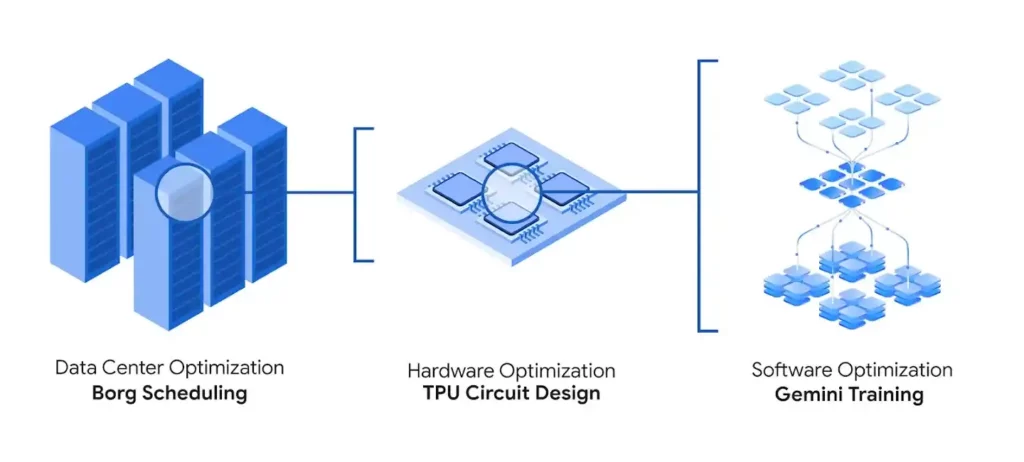
- Data centres: AlphaEvolve developed a scheduling heuristic for Google’s Borg workload-management system. The algorithm has been used in production and continuously recovers an average of 0.7% of Google’s worldwide computing resources.
- AI training: It improved a matrix-multiplication kernel in Gemini’s architecture by 23%. That kernel-level improvement resulted in an overall 1% reduction in Gemini’s training time.
- Mathematics: Across a later collection of 67 mathematical problems, AlphaEvolve matched or improved many of the strongest known human solutions. Its work extended beyond matrix multiplication into combinatorics, geometry, analysis, and number theory.
- Physical silicon integration: AlphaEvolve proposed a Verilog rewrite that removed unnecessary bits from a heavily optimized arithmetic circuit. After hardware verification, Google integrated the proposal into an upcoming Tensor Processing Unit.
- Google Spanner databases: AlphaEvolve optimized compaction heuristics for Spanner’s log-structured storage systems, reducing write amplification by 20%. It also contributed to software optimizations that reduced the storage footprint by approximately 9%.
These percentages can appear modest when viewed individually. At Google’s scale, however, an improvement can be repeated across enormous numbers of workloads, machines, and training operations.
Potential applications across industries
When the AlphaEvolve architecture generalizes beyond Google’s internal systems, the list of potential applications in AI problem-solving becomes broad.
- Drug discovery: Optimize molecular-simulation algorithms so that researchers can model protein behaviour and drug interactions faster and with greater accuracy.
- Chip design: Automate circuit simplification and hardware optimization in an industry where testing every possible design manually is impractical.
- Robotics: Discover more efficient control and motion-planning algorithms, particularly for robots that must operate in real time with limited computing resources.
- Logistics and operations research: Develop scheduling and routing methods for warehouses, fleets, supply chains, and delivery networks.
- Climate modelling: Improve numerical solvers used in atmospheric and ocean simulations, lowering the computational cost of detailed climate projections.
- Genomics: AlphaEvolve optimized DeepConsensus, a model used to correct DNA-sequencing errors. The changes reduced variant-detection errors by 30% and are helping PacBio researchers analyse genetic data more accurately and at a lower cost.
- Quantum computing: It suggested circuits for molecular simulations on Google’s Willow quantum processor that produced ten times lower error than conventionally optimized baselines.
- Green-energy infrastructure: AlphaEvolve optimized a Graph Neural Network used for the AC Optimal Power Flow problem. The model’s ability to find feasible power-routing solutions increased from 14% to more than 88%.
Could AI start solving problems humans struggle with?
It already has, but only for certain types of problems.
AlphaEvolve performs best when the task is clearly defined and an evaluator can score the output objectively. Matrix multiplication is a good example. The evaluator can test whether the answer is mathematically correct and count exactly how many multiplications it uses.
Many real-world questions are less precise.
In areas such as healthcare policy, education, economics, and environmental planning, people may disagree about the ideal result. Improving one measurement may also worsen another. AlphaEvolve cannot independently decide which goals society should prioritize. It relies on humans to define the problem, select the metrics, establish the constraints, and judge whether the final output is appropriate.
The system can explore possible solutions at remarkable speed. Humans must still decide what is worth optimizing.
Concerns and Limitations Around AlphaEvolve
AlphaEvolve has produced impressive results, but several limitations should shape how we interpret them.
- Computational cost: AlphaEvolve may need to generate, execute, and compare a large number of candidate programs. Complex optimization projects can therefore require significant computing power.
- Evaluator dependency: The system is only as reliable as the evaluator used to score its work. If the scoring function overlooks an important requirement, AlphaEvolve may optimize the numerical result without solving the actual problem.
- Transparency: A program discovered through repeated evolutionary search may be correct without being immediately intuitive to human engineers or researchers. Understanding why it works may require additional analysis.
- Problem scope: AlphaEvolve is general-purpose within computational optimization, but that does not mean it can solve every type of problem. The task must be expressible through code and measurable through a dependable evaluator.
- Deployment risk: A candidate can perform well in a controlled benchmark and still encounter unexpected conditions in the real world. Production use requires testing beyond the original scoring environment.
Why human validation still matters
Google’s teams do not automatically deploy every AlphaEvolve result simply because it earns a high score. Hardware engineers verify circuit changes. Researchers check mathematical constructions. Infrastructure teams test reliability and compatibility before introducing optimized algorithms into production.
This creates a sensible division of responsibility.
AlphaEvolve handles the large-scale exploration. Human experts handle interpretation, validation, and final approval. AI may examine far more possibilities than an engineering team could test manually. However, the people deploying the result remain responsible for its safety and real-world impact.
How AlphaEvolve Fits Into Google DeepMind’s Bigger AI Strategy

Google DeepMind has repeatedly developed AI systems that combine machine learning with structured search, testing, or scientific verification.
- AlphaGo (2016): Demonstrated that AI could outperform elite human players in the complex strategy game Go.
- AlphaFold (2020): Transformed protein-structure prediction and made predicted structures available for more than 200 million proteins.
- AlphaTensor (2022): Used AI to discover new matrix-multiplication algorithms, creating an important foundation for automated algorithm discovery.
- AlphaDev (2023): Discovered faster sorting and hashing algorithms, some of which were later included in widely used software libraries.
- AlphaEvolve (2025): Expanded algorithm discovery across mathematics, infrastructure, hardware, science, and commercial optimization.
The pattern is clear.
Instead of using AI only to produce content or predictions, DeepMind builds systems that operate inside a defined experimental process. The AI proposes a solution, the environment tests it, and the results guide the next attempt.
AlphaEvolve is the broadest version of this strategy because it is not restricted to one scientific field. It can potentially work on any problem that can be represented through code and evaluated objectively.
What AlphaEvolve Could Mean for the Future of AI Problem Solving
One of the most interesting parts of AlphaEvolve is that it can improve some of the infrastructure used to develop AI itself. AlphaEvolve optimized the Gemini training kernel, and Gemini models power AlphaEvolve’s code-generation capabilities.
That creates the potential for a compounding cycle.
Better optimization tools can improve AI infrastructure. More efficient infrastructure can support the training of stronger models. Those models may then make the next generation of optimization tools more capable. This is not autonomous or uncontrolled self-improvement. Engineers still define, verify, and deploy the changes.
However, it does show how AI can contribute to the technical process used to build future AI systems. Several developments will be worth watching:
- Whether OpenAI, Anthropic, Meta, and other AI companies introduce similar closed-loop optimization systems.
- Whether repeated improvements to Google’s computing infrastructure produce visible reductions in AI-training or cloud-computing costs.
- Whether independent researchers using OpenEvolve discover meaningful new algorithms outside Google.
- Whether businesses can reproduce AlphaEvolve’s reported gains across logistics, forecasting, manufacturing, financial services, and semiconductor design.
- Whether researchers develop reliable evaluators for scientific problems that are currently too open-ended for automated evolutionary search.
Google has already moved AlphaEvolve beyond an internal research project. On July 9, 2026, it became generally available through the Gemini Enterprise Agent Platform on Google Cloud. Google says it has been tested in logistics, semiconductors, genomics, high-performance computing, financial services, and other industries.
Early commercial examples include a 10.4% warehouse-routing improvement at FM Logistic, forecasting improvements at Coolblue, and performance improvements in JetBrains development tools.
These cases suggest that AlphaEvolve’s value may not be limited to rare mathematical breakthroughs. Its broader commercial role may be improving mature algorithms that businesses already use.
The Bottomline
AlphaEvolve’s 56-year-old maths breakthrough makes a strong headline, but its real value lies in its wider use across AI training, databases, chip design, genomics, and scientific computing.
What stands out to me is its ability to test and improve its own ideas instead of simply generating code. Human experts still define the problem and verify the results, but AlphaEvolve can explore far more possibilities than any team could test manually.
That makes it less like a chatbot and more like an automated research partner.
For more info on tech and AI, visit Yaabot.
FAQs
AlphaEvolve is a Google DeepMind AI coding agent that automatically generates, tests, and improves algorithms. It combines Gemini models, automated evaluators, and an evolutionary framework to search for stronger computational solutions.
AlphaEvolve found a way to multiply two 4×4 complex-valued matrices using 48 scalar operations. The previous best-known result required 49 and had remained unbeaten in this setting for 56 years after Strassen’s 1969 work.
A conventional chatbot usually generates a single response or code suggestion. AlphaEvolve generates multiple candidate programs, executes and scores them, retains the strongest results, and repeatedly improves them through an evolutionary loop.
Yes. AlphaEvolve moved from private preview to general availability on Google Cloud’s Gemini Enterprise Agent Platform on July 9, 2026.
No. Humans are still required to identify the problem, design a reliable evaluator, establish constraints, inspect the results, and verify important discoveries. AlphaEvolve automates much of the search process, but scientific judgement and accountability remain human responsibilities.
