



The most honest thing any tech executive said this year was just four words. Salesforce CEO Marc Benioff, explaining a 4,000-person AI layoff, reportedly put it as ‘I need fewer heads.’ Nothing except the math.
But here’s a very important pattern, the same companies firing people are the ones spending the most money in tech history. Amazon cut roughly 16,000 corporate roles while its cloud unit posted its fastest growth in three years. That’s a company making a conscious choice.
If you work in tech, invest in it, or are trying to break into it, that choice affects you directly. So it is worth getting clear on what is actually driving the AI layoff trend and who is cutting.
Key Takeaways
- Spending and cutting are one decision, not two. Tech giants are trimming payroll to help fund record AI budgets.
- The scale is accelerating. Roughly 81,747 tech jobs went in Q1 2026 alone, close to half of all of 2025’s cuts in a single quarter.
- Oracle is the clearest case. It cut ~21,000 roles, about 13% of staff, to free cash for a data center buildout its own filing admits AI drove.
- The money dwarfs the savings. The four biggest spenders plan ~$725 billion in AI capex in 2026, up 77%, which is what the cuts help pay for.
- It’s a reshuffle. Around 275,000 AI roles sit open while laid-off workers lack the skills to fill them, splitting the AI workforce into winners and losers.
- Not every “AI layoff” is about AI. Some cuts are ordinary cost-cutting wearing a smarter label, because the AI story reads better to investors.
What Is Causing the Modern AI Layoff Wave and Tech Layoffs?
Tech layoffs are just cutting jobs to help pay for AI, and using AI to justify the cuts. Increasing AI spending and firing aren’t two very different things. They’re pretty similar decisions; just viewed from two sides of the balance sheet.

Here are the numbers for this year. Roughly 81,747 tech workers lost their jobs in just Q1 of 2026, the highest quarterly figure the industry has seen in years. Meanwhile, the 4 biggest spenders are pouring hundreds of billions into AI infrastructure.
The payroll and the capex budget are connected. When a company commits to spending like never before, the cash has to come from somewhere, and reducing headcount is the fastest lever to pull. That’s the engine behind the tech layoffs of 2026.
How Big Is the AI Layoff Wave in 2026? Tech Layoffs by the Numbers
Big, and getting bigger. The Q1 figure alone is close to half of what the entire sector shed last year. For context, 112,732 tech jobs were cut by 218 companies in 2025. With AI layoff moving at this speed, we are on pace to blow past that.
A quick honesty note on the numbers. Different trackers track different things. The 81,747 figure was cuts announced by named companies. But some other trackers, counting more events, put the 2026 total closer to 95,878 by early May, running at hundreds of people per day.
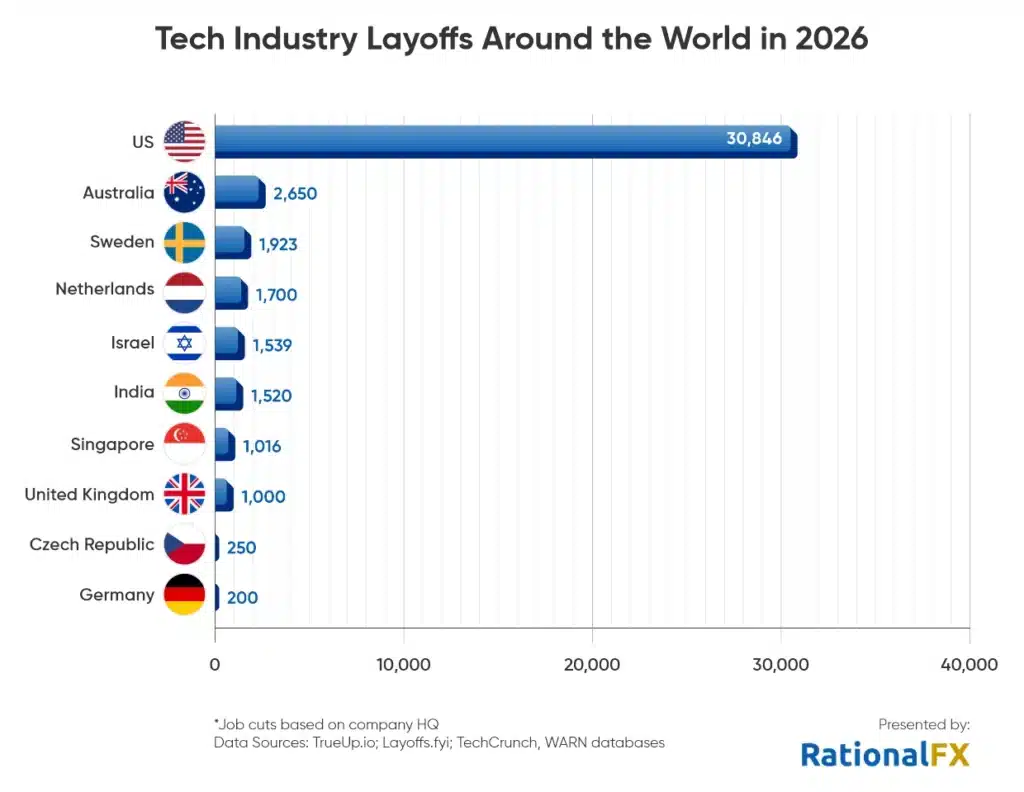
Here’s how the biggest names stack up.
| Company | Roles cut | Share of workforce | Timing | AI capex context |
| Oracle | ~21,000 | ~13% | Over the past year | Capex up 162% to $55.7B |
| Amazon | ~30,000 | ~10% (corporate/tech) | Since October | Part of ~$700B+ Big Four spend |
| Meta | ~8,000 | ~10% | Effective May 20 | Capex still ramping hard |
| Microsoft | ~8,750 buyouts | ~7% (US) | From April | Record data center spend |
| Salesforce | ~4,000 | Support roles | September | Heavy AI product push |
And this reaches well past the five names above. Microsoft offered voluntary buyouts for the first time in its half-century history. Snap cut about 1,000 staff, citing AI efficiencies directly. Intel confirmed it would shed roughly 24,000 roles, and IBM trimmed thousands more. Pull the lens back to 2025, and AI was blamed for over 50,000 layoffs in the US alone. This is not five companies having a bad quarter. It’s the industry rethinking its manpower.
The pattern isn’t subtle. The companies spending the most are cutting the most, and they’re doing it in the same quarters they report the spend.
Why AI Investment Is Forcing Cost Cutting
The AI layoffs aren’t happening because these companies are failing. They’re happening because AI investment is expensive, and the money has to be freed up from somewhere.
Think of it like a transaction. A company decides to spend record amounts on AI. To protect its margins while doing that, it trims the payroll. The savings from the cuts help fund the buildout.
Why payroll specifically? Because it’s the fastest and the easiest lever a public company can pull. Building a data center takes years. Renegotiating chip contracts is slow. But headcount can be cut this quarter, and the savings show up on the next earnings report, right when investors are nervous about the size of the AI bill. Wall Street rewards the move, which makes it almost irresistible.
Oracle is the clearest case I have found, because its own filing does the math for you:
- Free cash flow last fiscal year came in at negative $23.7 billion, with capital spending up 162% to $55.7 billion.
- Restructuring cost the company about $1.8 billion in severance and exit costs, up from $374 million the year before.
- Analysts estimate the cuts could save Oracle as much as $10 billion a year.
Source | Tech Research Online
Read those three lines together, and the logic snaps into focus. Oracle is burning cash on AI, so it is squeezing $10 billion out of its own workforce to keep the capex commitments on track.
There’s also a second force here: the tools themselves. As AI coding assistants get better, smaller engineering teams can ship what used to take larger ones, which quietly lowers the headcount a company thinks it needs.
Where the Billions Go: AI Infrastructure Behind the AI Layoff Wave
So where’s all this money going?
Mainly into the data centers, chips, power, and the accelerators that run AI models. This is the AI infrastructure layer.
The collective figure is staggering. Google, Amazon, Microsoft, and Meta plan to spend about $725 billion on capital expenditures in 2026, up 77% from last year’s $410 billion. That isn’t a typo. In just a year, the four of them nearly doubled an already record budget.
Oracle shows how this pressure turns into AI layoffs. To fund its share, the company:
- Partnered with OpenAI on the Stargate project to secure up to 4.5 gigawatts of compute capacity, and announced plans to raise $50 billion in debt and equity.
- Faced real investor pressure over how much debt it is taking on for the buildout, with its stock sliding as those concerns grew.
When you borrow $50 billion, and your cash flow is deep in the red, the payroll starts to look like a source of funds. That is the through-line from a data center announcement to a layoff email.
But there’s also a real risk in all of this. These companies are paying for the infrastructure now, on the bet that AI productivity will justify it later. But if those gains take longer to arrive than promised, they will have cut staff and taken on debt ahead of returns that haven’t shown up yet. That’s a margin problem waiting to happen, and it’s the scenario investors are quietly pricing in when these stocks wobble.
The most contrasting part is that on one axis, capex is climbing at 77% a year. On the other, headcount is falling by 10% or more at the biggest names. Same companies, same period.
Company Breakdown: Oracle, Meta, and Amazon Layoffs
Numbers in a table are tidy, but each of these three tells a slightly different story about how AI investment shows up as job cuts. Here’s what stands out about each.
Oracle Layoffs: The AI Infrastructure and Data Center Gamble
Oracle is the most extreme example on this list. The company shed about 21,000 jobs, roughly 13% of its workforce, dropping from 162,000 to 141,000 employees over the past year.
What makes Oracle layoffs notable is that it said the quiet part in a regulatory filing. The company acknowledged that deploying AI across its operations had led to workforce reductions and might lead to more. The cuts hit legacy database administrators and on-premises support teams hardest, the parts of the business most exposed to the shift toward AI-driven cloud tools. Its stock has been punished all year as investors weigh the debt against the payoff.
Meta layoffs: 8,000 jobs and Zuckerberg’s efficiency bet
Meta’s cut was smaller in raw terms but just as pointed. The company laid off about 8,000 people, 10% of its workforce, effective May 20, and dropped plans to fill thousands of open roles.
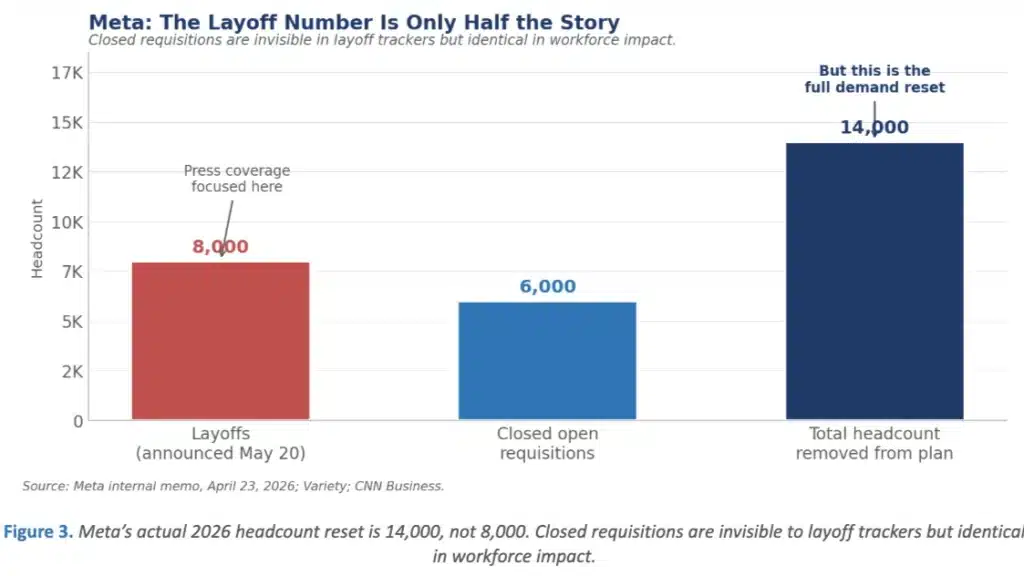
Recruiting and HR got the biggest hits. And it’s normal because if you’re hiring less, you need fewer recruiters, right? Zuckerberg said something that stuck with me, telling staff that success isn’t a given in the age of AI. If translated, nobody’s role is safe just because the company is profitable. Meanwhile, Meta’s AI capex keeps ramping, which is the whole paradox in one company.
Amazon layoffs: AI infrastructure and major job cuts
Amazon layoffs are the largest by volume. The company has eliminated roughly 30,000 corporate and tech roles since October, about 10% of that workforce, with around 16,000 of those landing in the first quarter alone.
The detail that gets me is the timing. Amazon made these cuts while its cloud business, AWS, posted growth of 24%, its fastest in more than 3 years. A company doesn’t slash 30,000 jobs because it is struggling when its core engine is accelerating. It does it because it has decided AI efficiency is worth more than the headcount, and it is redirecting the savings toward infrastructure.
The AI Workforce Paradox: 275,000 Open Jobs, Thousands Cut
But here’s the twist. This isn’t a simple story of AI eliminating work. It is a story of AI reshuffling it, badly.
Even as tens of thousands lose jobs, around 275,000 AI-related roles sit open, unfilled. The jobs exist. The problem is that a laid-off database administrator can’t instantly become a machine learning engineer. You can’t transfer your skill overnight.
The hiring data backs this up:
- AI adoption is slowing hiring for entry-level and generalized IT roles, the exact rungs people used to climb into tech on.
- Tech salaries are mostly flat compared with last year, with one loud exception: specialized roles like AI engineers, where demand is intense.
So the AI workforce is splitting into two tiers. If your skills point at building AI, you’re in the best market of your career. If they point at the work AI is starting to absorb, you are on the wrong side of a widening gap. That divide, more than the raw layoff count, is the thing worth watching.
The quiet casualty here is the entry-level job. A lot of the tasks that used to be handed to juniors are exactly what the AI handles well now. That removes the rung people used to climb into tech on. If you’re early in your career, the line learn to code is no longer enough on its own. The market is paying for judgment about AI, not just familiarity with it.
Is Every AI Layoff Really About the Technology or Just Cost Cutting?
Now the part I think most articles are too polite to raise. Not every “AI layoff” is actually about AI. Some of it’s ordinary cost-cutting wearing a smarter costume.
Think about the incentives. We are restructuring because demand softened makes a CEO look reactive. But saying we’re cutting because AI makes us more efficient makes the same CEO look visionary, and often nudges the stock up. Same layoff, but a different narrative. Reporting this year has noted that some of the most AI-forward layoff headlines deserve a skeptical read.
A few things are worth separating out honestly:
- Confirmed: Oracle stated in a filing that AI deployment drove workforce reductions. That’s on the record.
- Confirmed: The capex-to-payroll math at companies like Oracle is real and documented.
- Murkier: When cuts get framed around raising the bar on performance reviews, that can be routine belt-tightening dressed in AI language.
One executive coach quoted in the coverage called this a fundamental structural shift rather than a temporary market correction, and I think that’s closer to the truth. The change is very real. But the framing around it is sometimes marketing.
I’m not saying that the AI story is fake. The Wall Street Journal has laid out in detail how the AI splurge is genuinely costing big tech its workforce. Some analysts call this a fundamental structural shift, not a blip. What I’m saying is that “AI” has become a convenient headline, and a smart reader should ask which cuts are driven by the technology and which are just using it as cover because both are happening at the same time.
Final Thoughts
Strip away the drama and what’s left is a trade. Tech giants decided that AI infrastructure was worth more than a “slice of their workforce,” and they acted on it with unusual speed. And we’re talking about 90,000-plus jobs.
The honest answer to this permanent or a correction? is that we don’t know yet. Q2 numbers aren’t fully counted. Meta’s cuts only just took effect. Oracle’s restructuring is ongoing. The number will likely climb before it settles, and the real test is whether the AI jobs being created can absorb the people the old roles are shedding. So far, the skills gap says no.
So, if you want a signal to watch, skip the layoff headlines and listen to the earnings calls. When executives talk about capex guidance, they are telling you how much more payroll pressure is coming. The spend forecasts predict the cuts.
FAQs
Oracle cut ~21,000 roles, Amazon ~30,000, Meta ~8,000, Microsoft ~8,750 buyouts, and Salesforce ~4,000. Intel confirmed roughly 24,000 cuts as the wave spread across the sector.
They are cutting payroll to help fund record AI spending. The savings protect margins while capex climbs, so the AI layoffs and the investment are one financial decision, not two.
AI was blamed for 50,000-plus AI layoffs in 2025 in the US, and roughly 81,747 tech jobs went in Q1 2026 alone. Trackers vary, so treat these as directional.
Unclear. Some analysts call it a fundamental structural shift; others see a cost-cutting cycle that eases once AI productivity gains actually arrive. Q2 data is still incomplete.
