



Two years ago, the most embarrassing position in tech was being with Intel. The company was losing customers, bleeding engineers, and burning cash on a manufacturing strategy that wasn’t working. Today, Intel is up over 240% year-to-date, lapping NVIDIA on a stock chart. The move is part of a broader shift unfolding across the AI chips industry.
That is the setup for the strangest trade in AI chips and semiconductor stocks right now. NVIDIA still controls over 80% of the global AI accelerator market. Its revenues are still record-breaking. But AMD is up 112% YTD, Intel is up 240%, Micron has crossed an $800 billion market cap, and NVIDIA itself is sitting at a comparatively modest +15% for the year.
The Philadelphia Semiconductor Index is up 66% YTD. NVIDIA is underperforming in its own backyard. That divergence is the story.
Key Takeaways
- The AI chips trade is no longer a single stock. Wall Street’s 2026 bet is on an ecosystem of CPUs, memory, and inference hardware, not just GPUs.
- Inference is now as commercially important as training. Running AI at scale favors CPUs and high-bandwidth memory, not just the GPUs that trained the model.
- AMD and Intel have actual earnings behind these moves. AMD hit record data center revenue; Intel beat guidance by $1.4B.
- The correction risk is not hypothetical. The Philly Semi Index is up 66% YTD. BTIG is warning of a 25-30% pullback.
What Is the “Changing of the Guard” in AI Chips Everyone Is Talking About?
Mizuho analyst Jordan Klein coined the phrase, and it captures something specific, Wall Street’s AI chips thesis has stopped being a one-stock trade. For two years, every dollar flowing into AI infrastructure traced back to GPU demand, and NVIDIA made the best GPUs. That logic held until it started to crack.

AI infrastructure is maturing. Hyperscalers have already built out massive GPU capacity. The next phase is to deploy AI applications at scale in enterprise environments, which requires different hardware. CPUs for inference, high-bandwidth memory for model serving, etc.
NVIDIA’s Dominance in AI Chips Is Real. So, Why Is Wall Street Looking Elsewhere?
NVIDIA still controls over 80% of the AI accelerator market. Its H100 and Blackwell GPU architectures are the default choice for frontier model training. Its revenues are record-breaking. None of that changed in 2026.
What changed is the valuation numbers. Investors looking for asymmetric returns in AI chips have to go somewhere else. Not because NVIDIA’s business is weak, but because markets work on expected vs. actual outcomes.
The other factor is architectural. NVIDIA is purpose-built for the GPU-heavy, training-intensive layer of the AI stack. Enterprise customers are now deploying inference workloads and AI agents that don’t need the same compute profile as training a frontier model. That creates legitimate space for competitors in the AI computing landscape.
NVIDIA’s 2026 stock performance vs. the semiconductor sector
| Stock / Index | 2026 YTD Gain |
| NVIDIA (NVDA) | +15% |
| AMD | +112% |
| Intel | +240% |
| Philadelphia Semiconductor Index | +66% |
NVIDIA is positive. It’s just that the entire semiconductor sector has lapped it. For investors who hold NVIDIA as their primary AI infrastructure bet, that relative underperformance is hard to ignore.
AMD’s Explosive Q1 2026 Numbers That Caught Wall Street Off Guard
AMD’s Q1 2026 earnings were not a sentiment story. They had numbers behind them:
- Total revenue: $10.3 billion, up 38% year-over-year.
- Data center revenue: a record $5.8 billion, up 57% YoY.
- Free cash flow: $2.6 billion, roughly triple the prior year’s figure.
The data center segment now drives over half of AMD’s total revenue. AMD’s EPYC server CPUs and Instinct AI accelerators are gaining serious traction with cloud providers and enterprises expanding their AI computing capacity.
The story that gets missed is AMD’s position in the AI chips rotation. It’s not primarily about GPU competition with NVIDIA, but about the CPUs. As enterprises move from training to inference workloads, EPYC processors offer a cost-efficient path for running AI models in production, where power consumption and cost of ownership are more important than throughput.
AMD CEO Lisa Su’s bold $120 Billion server CPU prediction
AMD CEO Lisa Su projected the server CPU market growing at over 35% annually, potentially reaching $120 billion or more by 2030. It’s nearly double the company’s prior estimate of 18% annual growth for the segment, revised upward in just six months.
Bank of America put the data center CPU market at $27 billion in 2025, growing to $60 billion by 2030. Su’s estimate goes significantly further. The exact number is uncertain, but both forecasts point in the same direction. CPUs are coming back to the center of the AI computing story, and the market is larger than most analysts assumed a year ago.
Intel’s Unlikely Comeback: The Most Surprising AI Chips Story of 2026
If AMD’s quarter was better-than-expected, Intel’s entire 2026 is harder to categorize. Nobody had Intel on their 2026 watchlist at the start of the year.
Intel posted Q1 2026 revenue of $13.6 billion, beating its own expectations by $1.4 billion. Their Data Center and AI (DCAI) segment grew 22% YoY. Then the deal flow started:
- Google signed a supply agreement with Intel for Xeon processors.
- Apple entered negotiations with Intel (alongside Samsung) for chipmaking partnerships.
- Confirmation of the Apple agreement drove a 14% single-day stock gain.
- Intel shares climbed 33% in early May alone, on two separate double-digit surges.
The Intel story isn’t about GPU competition. Intel isn’t going to out-GPU NVIDIA. What Intel is betting on is the inference layer, where Xeon CPUs have a cost and power efficiency advantage for certain workloads over GPU-based solutions.
Why Intel’s Xeon CPUs Are Suddenly in Short Supply for AI Inference Micron has crossed an $800
Intel CEO Lip-Bu Tan made an observation that explains the supply crunch directly. The CPU-to-GPU ratio in AI data centers is shifting.
During AI training, data centers historically ran roughly one CPU for every eight GPUs. That ratio made sense. Training is GPU-intensive. But as AI moves toward inference and agentic workloads, the ratio is moving toward near parity. Running AI agents at scale requires far more CPU capacity than training a model does, because you are handling millions of user requests simultaneously rather than one giant parallel computation.
Intel’s Xeon processors sit directly in that demand pocket. The supply shortage is a consequence of how quickly that shift is happening across enterprise AI deployments.
GPU vs. CPU for AI: Why the Shift from Training to Inference Changes Everything
AI training builds a model. It is massively parallel, runs for weeks on GPU clusters, and requires the raw floating-point throughput that NVIDIA GPUs were designed for. That is why NVIDIA became dominant.
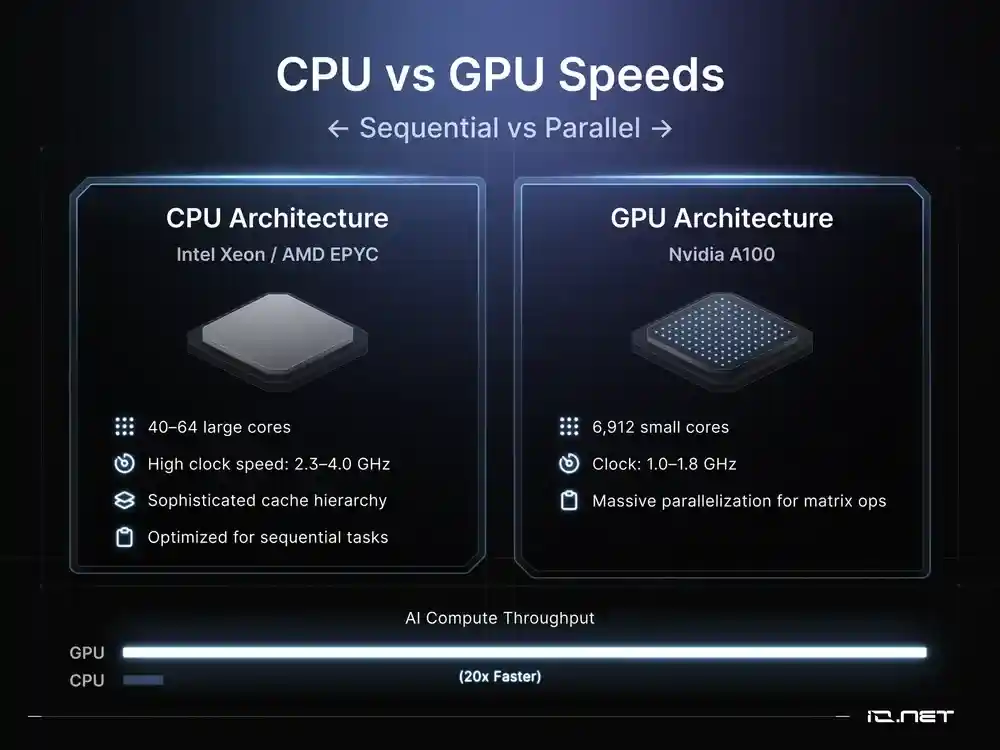
AI inference is what happens every time someone actually uses an AI application. A chatbot response or an AI-powered search. Inference is lower latency, more cost-sensitive, and often better served by CPUs or specialized inference chips than by the same GPUs used for training.
| Feature | GPU | CPU |
| Primary AI Use | Training, large-scale parallel computing | Inference, agentic workloads |
| Cost Profile | High cost per unit, optimized for parallelism | Lower cost per unit, efficient for sequential tasks |
| Key Players | NVIDIA, AMD Instinct | Intel Xeon, AMD EPYC |
| 2026 Market Stage | Established, high spend already deployed | Supply constrained, growing fast |
| Power per inference | Higher | More efficient at scale |
As AI moves from research to production, the inference layer grows faster than the training layer. And inference runs on CPUs, memory, and specialized chips, not exclusively on the H100S that trained the model. That is why the GPU market is no longer the whole AI computing story.
The Broader AI Infrastructure Boom: Who Else Is Winning Beyond NVIDIA?
The AI data center buildout isn’t only a chip story. Two companies outside the obvious AI chips names are worth watching closely.
Micron has crossed an $800 billion market cap and is dealing with a problem most businesses want: more demand than it can supply. CEO Sanjay Mehrotra confirmed that key customers are receiving only 50% to 66% of their high-bandwidth memory orders because supply cannot keep up. Building HBM capacity takes 18 to 24 months, so this shortfall is not going away quickly.
Corning landed a partnership with NVIDIA worth up to $3.2 billion for optical fiber technology. They’ll fund new U.S. factories for the interconnect infrastructure that ties AI data center clusters together. Both deals signal that the AI infrastructure trade has moved well past GPUs.
Why AI chips are the hidden bottleneck in the AI infrastructure race
Modern AI accelerators (including NVIDIA’s own GPUs) depend on HBM to feed data to compute cores fast enough to actually use them. Without sufficient memory bandwidth, the GPU just waits.
Adding more GPUs doesn’t solve a memory bottleneck. You need more and faster HBM. Micron supplies that alongside Samsung and SK Hynix, and with customers receiving well under their full orders, the company holds a structurally advantaged position in the AI data centers buildout. That advantage isn’t going away as model sizes and inference volumes scale up.
NVIDIA vs. AMD vs. Intel vs. Micron: How Do These AI Chip Stocks Actually Compare in 2026?
| Company | YTD Stock Gain | Q1 2026 Revenue | Key AI Product | Primary AI Role |
| NVIDIA | +15% | Record (ongoing) | H100/Blackwell GPUs | AI training |
| AMD | +112% | $10.3B (+38% YoY) | EPYC CPUs, Instinct GPUs | Inference + training |
| Intel | +240% | $13.6B (beat by $1.4B) | Xeon CPUs | Inference, fabrication |
| Micron | Near $800B market cap | — | HBM, DDR5 | Memory for AI accelerators |
NVIDIA has the largest market cap and the most defensible position in AI training. But the AI chips stock story in 2026 is being written by others, specifically because their stocks have more room to run.

What Wall Street Analysts Are Saying About the AI Chip Rotation
The analyst community is split, and both sides have a point.
The bull case from Mizuho’s Jordan Klein: this is a sustainable reallocation of capital, not a tactical rotation. If enterprises spend the next five years deploying AI applications at scale, the CPU and memory markets will grow substantially. AMD, Intel, and Micron are positioned directly in that demand path.
The bear case from BTIG’s Jonathan Krinsky: the Philadelphia Semiconductor Index is up 66% YTD, which is historically an uncomfortable territory. Krinsky is warning of a potential 25% to 30% correction in the Philly Semi Index, drawing a parallel to late-1990s internet infrastructure investing. He isn’t calling AI a bubble. He is saying some semiconductor stocks’ valuations have run ahead of near-term fundamentals.
Both can be right at the same time. The structural thesis can be sound while the near-term price action is stretched. That tension is worth holding onto rather than resolving early in either direction.
Should Investors Be Worried? The Risk of a Semiconductor Correction in 2026
The correction risk is real. The Philly Semi Index is up 66% in a year, and brushing that off because the AI thesis is fundamentally sound misses the point. You can be right about the trend and still overpay for the trade.
Three risks worth tracking:
- Capex slowdown: If hyperscalers pull back on AI datacenters spending (which some have signaled for late 2026), the demand driving semiconductor stocks could soften quickly.
- Inventory buildup: Companies that ordered aggressively to secure supply might sit on excess inventory if enterprise deployment timelines slip.
- Deal-driven momentum: Much of Intel’s gain came from a handful of deal announcements. Momentum built on headlines reverses faster than momentum built on earnings.
Is NVIDIA Still a Good AI Chip Investment in 2026?
NVIDIA’s business isn’t in trouble. But the stock is a separate question from the business.
For the AI training market (frontier models, hyperscaler GPU clusters, research infrastructure), NVIDIA’s position is essentially unchallenged. Xeon CPUs are not replacing H100S for model training anytime soon.
To be honest, at its current valuation, NVIDIA already prices in its dominance. Buying it today is a bet that dominance will grow faster than markets expect, not a bet that it will become dominant, because it already is. That is a harder bet than buying AMD or Intel at valuations that were priced in much less good news before this year’s rally.
For a long-term AI computing position, NVIDIA is reasonable. For the asymmetric upside that defined the 2026 semiconductor stocks story, the action was elsewhere.
Final Thoughts
What happened in 2026 is not a story about NVIDIA falling. It is a story about the AI infrastructure trade growing up.
In 2023, AI chips meant NVIDIA. In 2026, the same phrase covers AMD’s EPYC CPUs, Intel’s Xeon inference servers, Micron’s HBM stacks, and Corning’s fiber interconnects. Capital is spreading because the buildout is spreading, from GPU training clusters to the full stack required to run AI applications in production.
NVIDIA still leads AI training, and that is not a small market. But Wall Street’s AI thesis has matured from single-stock betting into ecosystem investing. AMD, Intel, and Micron are not winning because NVIDIA is losing. They are winning because the problem has grown bigger than any single company could solve.
The rotation carries risk. The Philly Semi Index is up 66%, and some gains in NVIDIA competitors look stretched. But the underlying demand direction (toward inference, toward memory, toward CPUs) looks durable. The second half of 2026 will be about which parts of the AI data centers ecosystem are priced correctly and which are running on momentum alone.
FAQs
NVIDIA’s dominance is already priced in. AMD’s gains reflect record data center revenue and growing CPU demand for inference workloads that NVIDIA’s GPUs are not built for.
Inference often runs more cost-efficiently on CPUs than on GPUs. That opens real revenue opportunities for AMD EPYC and Intel Xeon in AI data centers beyond NVIDIA’s reach.
BTIG’s Krinsky warns of a potential 25-30% correction, comparing the Philly Semi Index’s 66% YTD run to late-1990s internet infrastructure. Fundamentals are stronger, but valuations are stretched.
HBM feeds data to AI accelerators at high speed. Without it, GPUs underperform. Micron supplies it, and demand is so strong that customers are only receiving 50-66% of orders.
NVIDIA leads AI training, and that will not change soon. But the stock already prices in that dominance. AMD, Intel, and Micron offered more upside because their stocks started lower.
