



We’ve stepped into an AI era where single models can’t keep up with the scale of tasks we expect them to handle. That’s why multi-agent system is getting so much attention today.
You’ve probably seen this shift yourself – companies talking about AI “teams,” large language models (LLMs) coordinating with each other, and startups building tools where multiple agents plan, debate, and execute tasks without constant supervision.
It’s a big change from the single-model setups most of us got used to.
According to market reports, the global multi-agents market will cross $375 billion by 2034, driven by manufacturing, BFSI, healthcare, and supply chain sectors. These sectors are testing AI teams for research, automation, customer support, code generation, and even strategy planning.
In this post, I’ll walk you through what are multi-agent systems, the key architecture behind them, applications of multi-agent systems, pros and cons.
Key Takeaways
- Multi-agent systems are networks of intelligent agents that cooperate or compete to achieve common objectives.
- MAS are scalable and flexible, unlike single agent AI, which centralizes control and decision-making.
- The applications of multi-agent systems include autonomous vehicles, supply chains, smart grids, and cybersecurity.
- Limitations include coordination complexity and ethical and transparency issues.
- The future of multi-agent AI lies in a collaborative agent environment, where thinking and learning occur collectively.
What are Multi-Agent Systems?
Multi-agent systems are a network of individual units, called agents, which operate in a common environment. Every agent can sense its surroundings, reason, learn, and act independently. They are strong in coordination and communication.
Multi agent systems may be implemented through either bodily mechanisms, e.g., a group of robots or drones, or intangible mechanisms, e.g., a financial trading platform or a virtual assistant.
I think their uniqueness lies in their reflection of human teamwork: distributed, dynamic, and goal-oriented.
How do multi-agent systems operate?
Multi-agent systems (MAS) operate on the principle that a collection of simple, interacting agents can solve complex problems beyond the capability of any single agent.
Here is how multi-agent systems typically work:
- Agents perceive their environment using sensors to gather data and information.
- Agents reason and make decisions independently based on their internal rules and goals.
- Agents communicate and negotiate with each other using defined agent communication languages (ACLs).
- Agents coordinate actions to achieve collective goals or resolve conflicts efficiently and effectively.
- Overall system behavior emerges from these local interactions, rather than a centralized control mechanism.
Take a look at the global market stats of multi-agent systems.

The Evolution of Multi-Agent Systems
- Early concepts and DAI (Pre-2000s): Initial research focused on theoretical distributed artificial intelligence (DAI) and early negotiation protocols, exploring how simple, independent software components could share tasks.
- Formalization and swarm intelligence (2000s-2010s): The field matured with formal agent communication languages and a focus on nature-inspired swarm intelligence algorithms (like ant colony optimization) to manage collective behavior.
- Modern applications and LLM Integration (2010s-present): Contemporary MAS utilize decentralized control, are applied across diverse industries (robotics, smart grids), and now incorporate advanced AI like LLMs for complex reasoning and human-like communication.
The Difference Between MAS and Traditional Single-Agent AI
Take a look at this table for a quick comparison.
| Feature | Multi-agent system (MAS) | Traditional single-agent AI |
| Structure | Decentralized, multiple interacting entities | Centralized, one main processing unit |
| Problem solving | Collaborative, emergent behavior | Holistic, single-focus algorithm |
| Information flow | Peer-to-peer communication and negotiation | Internal data processing only |
| Complexity | Handles complex, dynamic, distributed problems | Best suited for well-defined, centralized problems |
| Fault tolerance | High; system can adapt if one agent fails | Low; single point of failure |
| Adaptability | High adaptability to changing environments | Limited adaptability; generally requires reprogramming |

Why the Hype Around Multi-Agent AI Systems Now?
The fact that multi-agent AI systems are gaining popularity is not by accident. Several major trends have converged to ensure that this is the ideal time for MAS to succeed:
Complexity of modern problems
Industries such as logistics, finance, and autonomous mobility have very complex multi-agent AI systems that cannot be centrally modeled by AI. MAS can subdivide these issues into small, manageable parts.
Developments in LLMs
LLMs have significantly enhanced autonomous AI agents reasoning and communication processes. Agents are now able to make sense of context, give rationalization, and cooperate using natural language.
Improved computational infrastructure
Cloud computing, APIs, and edge devices enable multi-agent interaction and work in real time, even across geographies.
Business requirement of adaptability
The trend is toward organizations shifting from less strict automation to more flexible, modular AI solutions that can adapt to the dynamics of operational scenarios, which is a major advantage of multi-agent AI systems.
Research and frameworks development
The tools and multi-agent frameworks developed over decades of theoretical work have now matured enough to render MAS realistic, dependable, and scalable, to the extent that it can be applied in the business.
All of these are leading to a rapid transition to agent networks of cooperation and interaction rather than isolated, separate AI systems.
Key Multi-Agent AI System Architecture
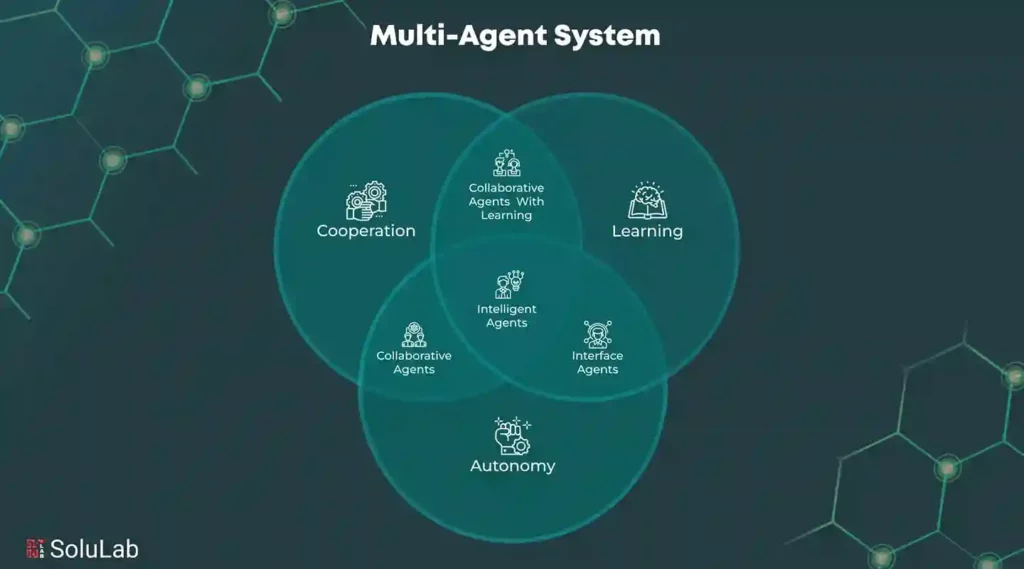
Multi-agent AI systems have a structured architecture that balances independence and coordination. This is the way in which the major elements can be combined:
- Agents: These are the self-reliant units that perceive, make decisions, and do. They can be the same like they are all doing the same thing or different like they all do a particular job.
- Environment: The similarity in the setting in which the agents operate, be it physical as in a warehouse floor or digital as in a trading network. This is where agents work and keep an eye on.
- Communication layer: The multi-agent systems use messaging protocols or agent communication languages to communicate with one another. Teamwork, information sharing, and agent-agent negotiation are ensured in this layer.
- Coordination mechanisms: To prevent accidents, agents’ actions should be coordinated in time. Some orchestrator or a self-organising behaviour may centrally organise this.
- Learning and adaptation: To allow agents to improve over time, machine learning or reinforcement learning is typically used. Even the exchange of part of multi-agent systems experiences facilitates the learning process.
- Goal alignment: Each agent’s local goals must also align with the system’s goal to ensure the system’s success, as the departments of a business organization align with the mission.
Such multi-agent AI architecture allows to combine autonomy, adaptability, and collaboration, yielding dynamic intelligence that adjusts to the environment.
Applications of Multi-Agent Systems
I think the best thing about multi-agent AI systems is that it is universal such that they are transforming several industries already:
Autonomous vehicles
Smart traffic systems act as agents, and their vehicles communicate route, speed, and road condition information. The partnership will contribute to accident prevention and traffic flow.
Also read: How Smart Cities Open Opportunities.
Supply chain management
Multi-agent systems simplify the job by harmonizing procurement, manufacturing, and logistics. If a supplier does not fulfill its time slot, the agents reroute resources or automatically reassign production.
Smart energy grids
The energy agents also monitor demand and distribution in real time to redistribute the sitting power to areas where it is most required, reducing waste and promoting efficiency. This also helps in climate change solutions that promote a sustainable future.
Cybersecurity
MAS is also ideally suited to adaptive distributed defense because agents detect anomalies, evaluate threats, and coordinate responses through networks.
Customer support systems
A multi-agent systems and their chat environment uses specialized agents that one answers frequently asked questions, another handles billing, and another handles complex escalations, making the service easier and faster.
Healthcare and research
The impact of AI in healthcare and multi-agent systems mimic the functioning of biological systems, handles patient-related information safely, and orchestrates several devices within the hospital ecosystems.
Such cases demonstrate that applications of multi-agent AI systems are successful in non-static, interdependent environments where teamwork drives financial results.
Benefits of Multi-Agent Systems
- Scalability: Add new agents with ease, and they do not need to revamp the system completely.
- Resilience: The system continues to operate even if one of the agents fails.
- Flexibility: Each agent can be developed or improved independently.
- Efficiency: Workload is distributed smartly, minimizing redundancy.
- Combined intelligence: The system is known to find solutions that even a single agent would not want to come up with.
- Parallel processing: Two or more agents may process different tasks concurrently, increasing speed and throughput.
Limitations of Implementing Multi-Agent Systems
- Complexity of coordination: With increasing numbers of agents, the coordination becomes more complex to guarantee effective communication and conflict management.
- Transparency problems: It is much more difficult to follow the logic of a system of several agents acting collectively than that of a single model.
- Emergent behavior: Independent agents can exhibit unexpected behavior, making predictability difficult.
- Ethical and governance issues: Responsibility when a multi-agent system goes wrong.
- Security risk: The more agents there are, the more potential attack surfaces there are.
- Computational requirements: It may impose significant computational resources to run multiple intelligent beings concurrently.
The Future of Multi-Agent System in AI

The way I see it, the future of AI will not be alone but will work together. Rather than a single large model that does it all, there will be networks of specialized agents that collaborate and dynamically reconfigure in response to new information.
Here are the major trends influencing multi-agent systems that I think will take momentum in the future:
- Open agent ecosystems: Cross-platform multi-agent interaction with each other using universal standards.
- Self-organizing networks: Systems automatically adapt to changes in the environment or in how they operate.
- IoT integration: Agents running on local devices to make real-time decisions.
- Autonomous agent market: This refers to independent agents negotiating or trading services across industries.
- Ethical frameworks: Regulations that oversee multi-agent frameworks ensure transparency and safety.
The future of AI, in brief, will likely not be a one-genius model but the emergence of intelligent groups that develop and become better with time.
Final Thoughts
These systems feel dynamic and decentralized, almost human in how they collaborate without a boss calling every shot.
But, the way I see it, as they get sharper at solving real-world puzzles, we can’t slack on keeping them transparent, ethical, and tuned to what us humans actually value.
The solo AI era? It’s fading fast in my view. We’re stepping into this exciting wave of networked, cooperative intelligence powered by multi-agent setups, and it’s already showing massive wins in complex tasks.
For more info on tech and AI, visit Yaabot.
FAQs
- Why are multi-agent systems becoming popular?
The combination of improved computing power, LLM convergence, and the growing complexity of the real world has rendered MAS highly feasible and essential.
- What primary challenges do multi-agent systems face?
Some current areas of research and regulation include coordination, transparency, ethics, and scalability.
- What is the future of MAS?
I’d say that we can anticipate self-organizing agent ecosystems, human-agent interaction, and ethics to inform the development.
