


Self-driving cars are just about technology, but I want to start with the money factor. The global robotaxi market is projected to hit $45.7 billion by 2030, and right now two companies are making opposite bets on how to get there. Waymo, backed by Alphabet, stacks its vehicles with lidar, radar, and cameras. Tesla bets that cameras and software alone can do what every other player in driverless cars says requires specialized hardware.
This article breaks down the Waymo vs. Tesla robotaxi comparison across sensors, safety data, business models, and who has a realistic shot at winning.
Key Takeaways
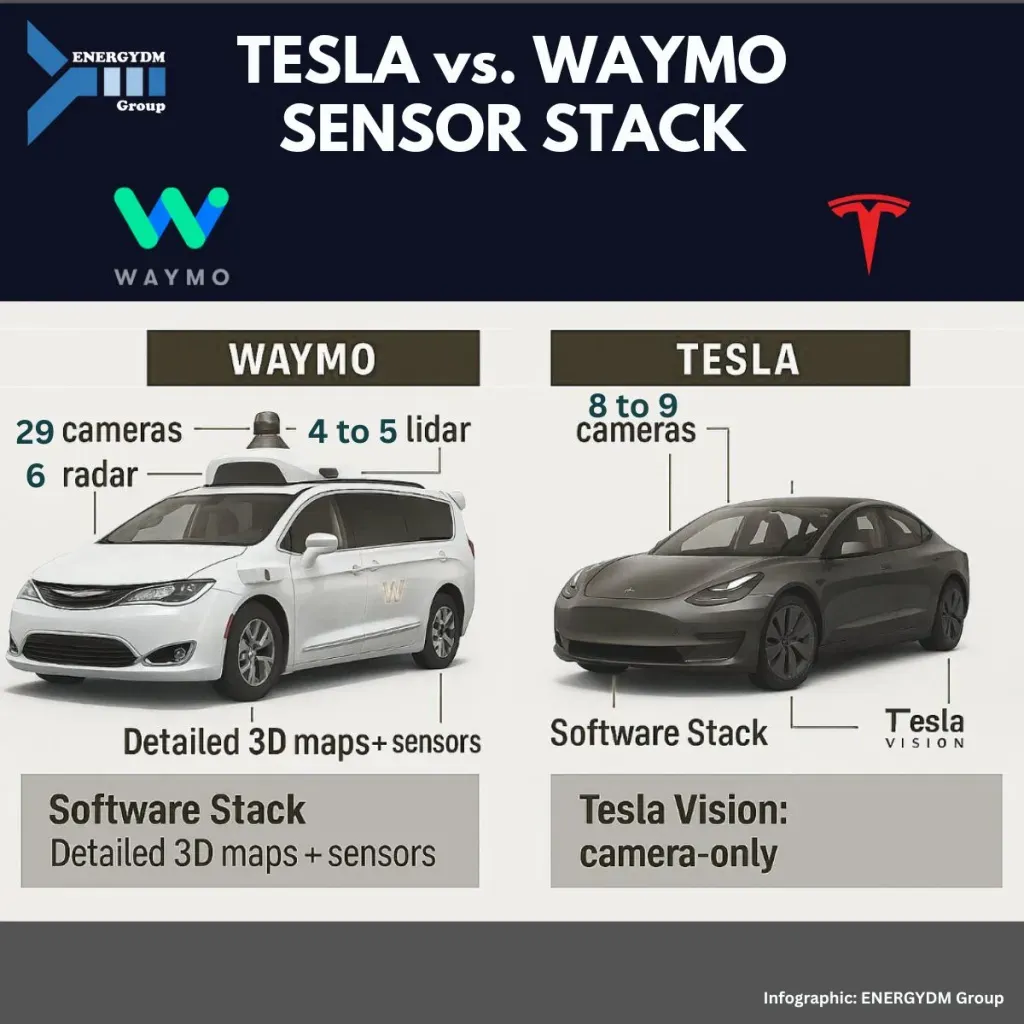
- Waymo runs a full sensor stack per vehicle, with 29 cameras, 5 lidar units, and 6 radar units, built for redundancy across all weather conditions.
- Tesla’s robotaxi strategy relies entirely on cameras and neural networks trained on data from 2+ million FSD-equipped vehicles.
- The Tesla Cybercab targets a sub-$30,000 price and a $0.20-per-mile operating cost, initial production having launched in February 2026.
- Waymo has logged over 100 million fully autonomous miles and has reported over 80% fewer injury-causing crashes per mile than human drivers. Tesla has no equivalent published dataset.
- As of May 2026, Tesla’s Austin robotaxi fleet has dropped to just 20 active vehicles on any given day due to ongoing validation pauses.
- The 2026–2030 window will either break autonomous vehicles into the mainstream or stall on regulatory and technical friction.
What Is a Robotaxi and Why Does It Matter in 2026?
A robotaxi is a driverless taxi that operates without any human behind the wheel, using autonomous vehicle technology to pick up and drop off passengers on demand.
But the stakes are huge. The global autonomous vehicle market is on track to reach $556B by 2026, with robotaxis representing the most commercially visible slice. What makes 2026 interesting is the regulatory momentum and commercial deployments being live in multiple US cities.
Waymo vs. Tesla Robotaxi: A Side-by-Side Overview
| Category | Waymo | Tesla |
| Sensor Stack | Lidar + radar + cameras | Cameras only |
| Operating Cities | SF, Phoenix, LA, Austin | Austin (limited pilot) |
| Safety Driver Required | No | No (Cybercab); Yes (FSD users) |
| Autonomy Level | SAE Level 4 | Level 2 (FSD); Level 4 (Cybercab, limited) |
| Launch Status | Commercial, actively scaling | Limited pilot |
| Business Model | Ride-hailing platform (B2C) | Owner-operator marketplace |
| Regulatory Approval | CA CPUC, Arizona DMV | Texas (limited permit) |
The Waymo vs. Tesla robotaxi comparison gets complicated because these two companies aren’t competing in the same space yet. Waymo is running a live commercial service. Tesla is running a small pilot while simultaneously trying to manufacture a purpose-built driverless taxi at consumer price points.
How Waymo Built Its Robotaxi From the Ground Up
Waymo started as a project inside Google X in 2009. That gives it a 16-year head start over most rivals, and Alphabet has poured multiple billions into it. By 2025, the company had logged over 100 million fully autonomous miles across public roads.
Waymo’s strategy has always been slow, but deliberate. They didn’t rush commercial launches. They mapped cities by each block and ran billions of simulated scenarios before launching it commercially. It’s a bet that in a market where one fatal crash can hit public trust for years, being boring actually works.
Waymo’s sensor stack: Why it uses lidar, radar, and cameras together
Each Waymo vehicle carries 29 cameras, 5 lidar units, and 6 radar units, plus external audio receivers that detect emergency vehicle sirens. That is significant hardware per car.
Here is why the multi-sensor approach matters for autonomous vehicle technology:
- Cameras handle object recognition, reading traffic signs, signals, and lane markings.
- Lidar fires laser pulses in all directions to build a real-time 3D depth map of everything around the car, something cameras physically cannot replicate.
- Radar tracks the velocity and distance of nearby objects, including in rain, fog, and low-light conditions where cameras degrade.
The redundancy logic is that if one sensor system fails or degrades, others compensate. It is the same philosophy that airplanes use. Not because any single component fails frequently, but because the consequence of a cascade failure is severe enough to justify the engineering cost.
Where Waymo operates and how fast it is expanding
Waymo One runs paid driverless rides across 10+ major US metropolitan areas. Back in early 2025, the company reported more than 150,000 paid rides per week, a figure that has since climbed to roughly 400,000 to 500,000 weekly trips in 2026, with leadership actively mapping out an operational path to clear 1 million weekly rides by the end of the year.
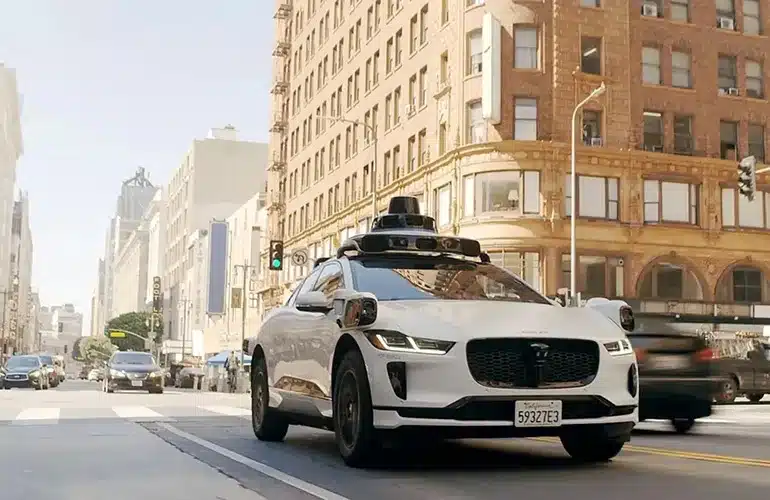
The service still uses invite-based access in newer markets. That’s mainly for demand management and partly because city-by-city permits require phased rollouts. That constraint will eventually become a growth ceiling if Waymo can’t accelerate the regulatory process in new cities.
Waymo vs. Tesla Robotaxi: Why Waymo and Tesla Disagree on Lidar
This is the genuine fault line in driverless cars, not just between these two companies, but across the entire AV industry.
Waymo’s position: cameras alone can’t generate the 3D depth information needed to safely navigate complex, dynamic environments, especially in poor weather or at speed. Lidar fills that gap and provides an independent data stream that cameras cannot replicate.
Tesla’s position: lidar is expensive, fragile, and unnecessary because cameras, given enough data and compute, can match or exceed human performance. Elon Musk has called lidar a fool’s errand.
Both positions are intellectually serious. Neither is obviously wrong. And that’s what makes this the most interesting technical argument in autonomous vehicles today.
Why Tesla believes cameras alone are enough
According to Tesla, humans navigate with two eyes and no lidar. An AI trained on billions of camera miles from real-world driving should therefore reach and eventually surpass human-level performance using the same input.
The data flywheel behind this is very real. Tesla has over 2 million vehicles actively running, and feeding real-world driving data into model training at a scale no competitor can match. More miles generate smarter models, which generate better autonomous performance.
Why Waymo prioritizes sensor redundancy
Cameras do fail, but not all the time. They can get damaged in heavy rain, fog, direct sunlight at low angles – anything. But when a human driver’s visibility drops, they slow down and compensate. So, when a camera-only AV loses input quality, there is no falling back.
Contrary Research’s analysis of Waymo’s approach frames it as genuinely multi-modal. They use cameras for recognition, lidar for 3D spatial awareness, and radar for velocity and distance. Each hardware works independently, so degradation or damage in one doesn’t result in a total shutdown.
The cost vs. safety tradeoff in autonomous vehicle technology
| Metric | Waymo | Tesla |
| Estimated hardware cost per vehicle | $100,000+ | ~$15,000 incremental |
| Lidar units | 5 | 0 |
| Camera count | 29 | 8 |
| Training data source | Mapped ODDs + sensor fusion | 2M+ FSD vehicles globally |
Tesla’s cost advantage over Waymo is huge. A $15,000 hardware increment across millions of vehicles is a fundamentally different financial model than a $100,000+ Waymo car. Waymo’s counter is that math only works if camera-only achieves equivalent safety outcomes, and that hasn’t been demonstrated in a comparable real-world deployment.
How Tesla Is Approaching the Driverless Taxi Differently
Tesla’s core thesis is that software scales in ways hardware doesn’t. You can retrain a neural network overnight. You can’t retrofit lidar onto 2 million existing cars.
The robotaxi strategy is built on that. Use the FSD fleet as a training ground, develop a purpose-built driverless taxi at consumer price points, and deploy it through an owner-operator marketplace.

The Tesla Cybercab: What we know so far
The Tesla Cybercab was unveiled at the We, Robot event in October 2024.
- Design: A twin-seat car with no steering wheel and pedals.
- Price target: Under $30,000.
- Operating cost: Musk claims $0.20 per mile at scale, versus $0.60–$0.80 for typical human-driven rideshare.
- Production timeline: Initial assembly started in February 2026, though Tesla has a well-documented history of timeline slippage.
If those numbers hold, the Cybercab would structurally undercut every human-driven ride-hailing competitor. That “if” is doing significant work in that sentence.
Full self-driving and the fleet advantage Tesla is betting on
The owner-operator model. A Cybercab owner opts their car into the Tesla network when not in use. Riders book through an app, pay per trip, the owner earns a revenue share, Tesla takes a platform cut. Tesla has described this as an Airbnb model for cars.
But there are some unresolved questions too:
- Who is accountable and legally liable when the car crashes?
- How does insurance work when ownership and operation are separated?
- What happens to vehicle value after commercial utilization at 5–6x normal annual mileage?
None of those are small problems, and none have clear answers yet.
Waymo vs. Tesla Robotaxi: Which System Has the Better Safety Record?
Waymo’s real-world safety data
Waymo’s 2023 safety report shows 7x fewer injury-causing crashes per mile compared to human drivers across its San Francisco and Phoenix operations. 50M fully autonomous miles. No fatalities on record.
But this has some downsides too. Waymo operates in geofenced urban areas under specific conditions, not on highways or in unmapped cities. It has a real safety record but is bounded by its operational design domain.
Tesla FSD, investigations, and the debate around “supervised autonomy.”
Tesla FSD today is a supervised autonomy system. The driver is legally required to remain alert and ready to intervene. It is not a driverless taxi. Treating Tesla FSD safety data as equivalent to Waymo’s autonomous miles is a category error that a lot of coverage makes.
NHTSA has opened multiple investigations into Tesla’s Autopilot and FSD systems following crashes involving suspected disengagement. The investigations are ongoing. Tesla has maintained that FSD reduces crash probability compared to unassisted driving, but has not published a safety dataset comparable in scope or methodology to Waymo’s.
Business Model Differences: Who Pays, Who Profits?
| Model | Waymo | Tesla |
| Revenue source | Per-ride fees | Platform fee + owner revenue share |
| Capital structure | Alphabet-funded fleet | Owner-funded vehicles |
| Cost per mile | ~$2–$3 | $0.20 target |
| Scaling strategy | Expand fleet and cities | Enroll more owners |
Waymo’s ride-hailing strategy
Waymo One operates as a direct B2C ride-hailing service, priced roughly on par with Uber or Lyft. The Uber distribution partnership expands reach without requiring Waymo to build a competing consumer app.
The economics are improving but still require substantial capital per city launch, like mapped infrastructure, vehicle maintenance, and regulatory compliance. While parent company Alphabet remains a major baseline backer, Waymo has eased solo capital strains by pulling in a massive $16 billion external funding round from heavy-hitting institutional investors like Sequoia Capital and DST Global.
Tesla’s owner-operator Robotaxi marketplace
The model looks really nice on paper. But the unresolved questions around liability, insurance, and commercial wear-and-tear aren’t. A personally owned car doing 10,000 miles a year deteriorates very differently from the same car doing 60,000+ commercial miles annually. Warranty terms, residual values, and maintenance costs for that use case are not yet clearly defined.
Challenges Both Companies Still Need to Solve
Two structural challenges apply to every driverless car company regardless of sensor approach.
Regulatory fragmentation: There is no federal AV framework in the US. Each state has its own rules. California’s CPUC permit system is among the most stringent. Arizona is comparatively permissive. A nationwide robotaxi rollout is actually complying with 50 separate rollouts, each with different timelines, compliance costs, and political risk.
Liability gaps: When an AV hits someone, the current law has no answer for who pays. Manufacturer? Platform? Vehicle owner? So the state legislatures are trying to fill this gap. But the absence of a federal standard creates legal exposure for any company scaling aggressively.
Weather, edge cases, and public trust
Even best-in-class AV systems still struggle with:
- Heavy rain, snow, and fog. Especially the ones that rely on camera-only systems.
- Construction zones with nonstandard lane markings.
- Emergency vehicle interactions.
- Unusual road events that fall outside model training distribution.
A 2023 AAA survey found 68% of U.S. drivers were afraid of fully self-driving vehicles. Public trust is the core metric for the AV market. It directly constrains commercial rollout speed regardless of technical capability.
Tesla’s Robotaxi fleet: Growing or shrinking?
This is where the current data actively contradicts Tesla’s narrative.
According to Electrek’s Robotaxi Tracker as of May 26, 2026, Tesla’s active unsupervised fleet in Austin has dropped to just 20 vehicles, with a total fleet of 34. It’s a direct reversal from the growth trajectory reported weeks earlier. Tesla hasn’t issued a public explanation for the contraction.
Whether this is a safety-related pause, a technical issue, or a sign of deeper operational friction isn’t clear yet. But what is clear is that for a company publicly targeting millions of deployed robotaxis, 20 active vehicles is a number that deserves scrutiny.
What Experts and Industry Leaders Are Saying
Waymo CEO Tekedra Mawakana has consistently said that the company’s approach is a long-term investment in public trust, and not just hardware. In public appearances, she has emphasized that regulatory credibility and independently verified safety data are Waymo’s actual objective.
But Elon Musk has a very different perspective. Waymo’s approach is unscalable because the hardware cost structure prevents it from reaching the price points that drive mass adoption. Elon’s thesis is that Tesla’s data flywheel will eventually close any remaining safety gap.
Brad Templeton, writing for Forbes, has noted that the core question isn’t which sensor approach is theoretically superior; it’s which approach can be verified as safe enough for regulators to permit at scale, and on what realistic timeline.
Which Robotaxi Approach Is More Likely to Win?
The honest answer: both have credible paths, and the outcome likely depends on which specific market you are talking about. The Waymo vs. Tesla robotaxi question may not have a single answer.
Why Waymo could win on safety and regulation
Waymo’s 50-million-mile safety record and established regulatory relationships are a real advantage in urban markets. San Francisco, Los Angeles, and Manhattan have dense populations, with serious accident visibility. In those environments, liability exposure is high, and the cost of a fatal crash is existential for a company’s operating permits.
Waymo’s multi-sensor redundancy and published safety data give it a structural advantage where regulators are the judge. Alphabet’s capital depth means Waymo can sustain losses longer than almost any competitor.
Why Tesla Could Win on Scale and Cost
Suppose camera-only autonomous vehicle technology can reach Waymo-equivalent safety thresholds, which is a genuine open question. A sub-$30,000 Cybercab at $0.20 per mile undercuts any sensor-heavy competitor by a factor of 10 or more. At that price point, adoption accelerates because the economic pressure on regulators to approve it becomes enormous.
Tesla’s 2+ million FSD vehicles generating training data are also a real advantage in machine learning at scale. The data flywheel is not just marketing.
Could Both Companies Win Different Markets?
Probably the most realistic near-term scenario:
- Waymo dominates premium urban corridors, like San Francisco, Manhattan, dense city centers, where safety scrutiny is highest, and riders expect reliability.
- Tesla dominates mass-market suburban and intercity routes where cost matters more, regulatory environments are less restrictive, and scale beats precision.
Market segmentation does not require a loser. It requires two companies with different strengths finding the terrain that rewards those strengths.
Final Thoughts
Waymo bets on precision: hardware redundancy, regulatory trust, and the idea that verified safety data is the only currency that ultimately matters in driverless cars. Tesla bets on scale: camera-based AI, consumer price points, and a data flywheel that no legacy sensor stack can outrun.
Both are serious bets. Both have real problems. Tesla’s Austin fleet data from May 2026 is not encouraging for the scale narrative. Waymo’s cost structure is not encouraging for anyone expecting $2 robotaxi rides in the next few years.
The 2026–2030 window will determine which proposition the market and regulators actually validate. Driverless cars are not a prediction problem anymore. They are a deployment and trust problem, and whoever solves that first wins.
FAQs
Waymo combines lidar, radar, and cameras for safety and redundancy, whereas the driverless taxi approach from Tesla relies exclusively on cameras and is looking for much lower vehicle hardware costs.
Yes, Tesla launched initial assembly of the Cybercab in February 2026. However, their unsupervised operational testing fleet in Texas remains small, hovering around 20 active vehicles.
In the cities where Waymo One has begun operating, it costs about $2–$3 per mile for the service, similar to Uber and Lyft standard rides.
Tesla Full Self-Driving (FSD) is a supervised driver-assistance system that requires a human driver to remain attentive and ready to take control at any time. A driverless taxi, by contrast, operates without a human driver actively monitoring the vehicle and is designed for fully autonomous passenger transport.
Waymo One has a commercial program in San Francisco, Phoenix, Los Angeles, and Austin, and expansion to Atlanta and Miami is planned.
When not in use, the owners of the Cybercabs join a network to enable them to share the taxi, and Tesla receives a commission per ride, similar to how Airbnb works for property owners.
There is no Federal AV framework. A national rollout would, therefore, be 50 different processes and timelines with varying liability requirements, since each state has its own set of rules.
