


In 2021, The International handed out more than $40 million in prize money, the largest single prize pool in gaming history. But by 2024, the same tournament’s total pool had fallen to just $2.6 million. That’s a drop of more than 93% within 3 years. And during that exact stretch, the wider esports industry kept posting growth headlines without pause.
In this post, I’ll break down where esports revenue comes from, how sponsorships and franchise fees work, and what players and orgs really take home. I’ll also discuss why profitability remains the hardest problem in the world of gaming.
Key Takeaways
- Sponsorships and media rights combined make up roughly 60 to 65% of core esports revenue, more than every other stream put together.
- Publishers, not teams, own the underlying game IP, which caps how much revenue a team can ever capture from broadcasts or in-game sales.
- Franchise slots have cost as much as $25 million per team, and the Overwatch League folded 5 years after charging teams $20 million each to join.
- Prize money is top-heavy by design: Dota 2’s The International paid one team $18.2 million in 2021, while most professional players never clear six figures in a year.
- A documented Tier 2 team lost $322,565 over roughly 2.5 years despite pulling in more than $620,000 in revenue.
- Even top-tier orgs such as FaZe Clan and TSM have scaled back or sold at a fraction of their earlier valuations since 2023.
What Is the eSports Business Model?
The eSports business model is a multi-sided system where publishers own the game, tournament organizers run the events, teams field the players, and sponsors pay for access to a young, hard-to-reach audience. Nobody in that chain earns money the same way, and that mismatch is the root of most profitability problems in the industry.
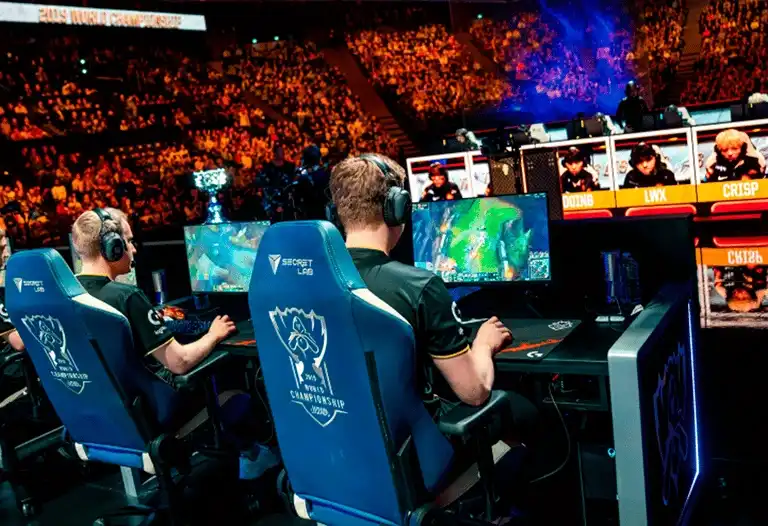
Compare it to a traditional sports league. The NFL doesn’t answer to whoever invented American football. In esports, Riot Games or Valve hold the copyright and trademarks to the actual game being played, which means every league, every broadcast, and every merchandise drop needs their permission first. Teams and tournament organizers operate inside someone else’s intellectual property, closer to tenants than owners.
Four groups are the core of the eSports business. The publishers (own the IP), tournament organizers (license events from publishers), teams (compete and build fan followings), and sponsors (pay for exposure to that following). Everything else in this article builds on how those four groups split revenue.
How eSports Organizations Make Money: Core Revenue Streams
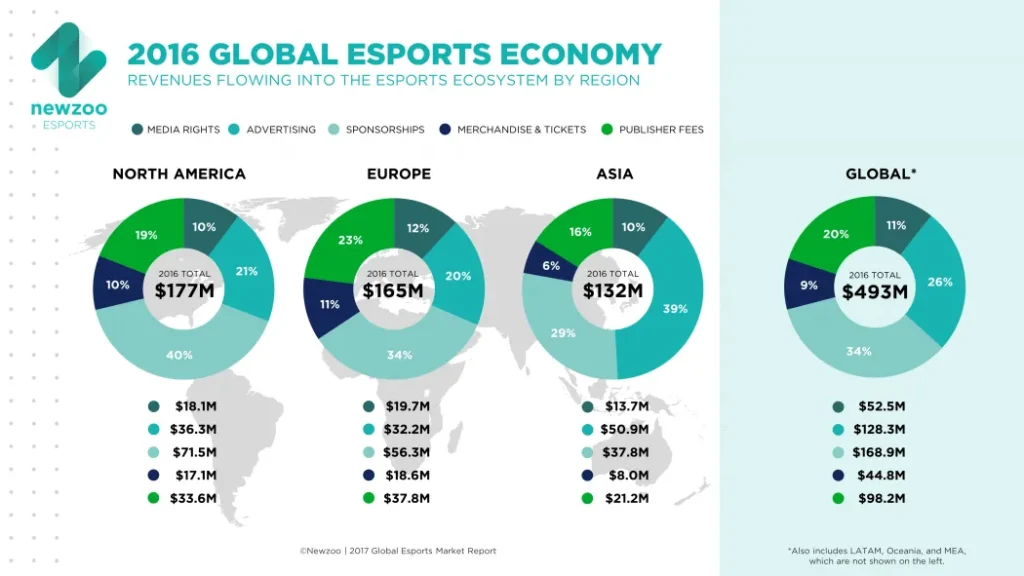
Esports orgs stack 5 or 6 income sources together because no single stream is reliable enough to build a business on alone. Sponsorships and media rights typically account for 60 to 65% of core revenue between them, with merchandise, tickets, and digital content splitting the rest.
| Revenue Stream | Typical Share of Core Revenue | Reliability | Example |
| Sponsorships and brand deals | 35 to 43.6% | High volume, but tied to sponsor budgets | Hardware, energy drink, and finance brands backing a roster |
| Media and broadcast rights | Up to 40% | Medium, fragmented across streaming platforms | Twitch and YouTube distribution agreements |
| Merchandise and apparel | Low single digits | Low, small average basket size | Team jerseys, in-game cosmetics |
| Ticket sales and live events | Low single digits, event dependent | Low, high production cost | LAN finals attendance and VIP packages |
| Publisher revenue share and prize money | Varies widely by title | Low, unpredictable YoY | Tournament winnings, publisher payouts |
Sponsorship gets its own section below because it dominates the mix so heavily. For now, the point worth remembering is that esports gaming monetization spreads risk across streams that rarely move together. And that’s exactly why a single bad sponsor renewal season can wreck the whole event’s budget.
Publisher-controlled vs. Team-controlled revenue
Here’s the blind spot. Teams don’t own the game. Only the publishers control the biggest levers, like the broadcast rights, in-game item sales, and franchise slot pricing. Riot Games and Activision Blizzard decide who gets a league slot and what it costs.
A team can build a massive following and still watch the publisher capture most of the value that following generates, because the IP, not the fanbase, is the asset actually being licensed.
eSports Sponsorships: The Dominant Income Source
Sponsorships are the single largest revenue source in esports, generating an estimated $950 million to $1.2 billion globally in 2026 and accounting for as much as 43.6% of total market share on its own.
Two types of sponsors mainly show up:
- Endemic sponsors sell things gamers already buy: hardware, energy drinks, headsets, chairs.
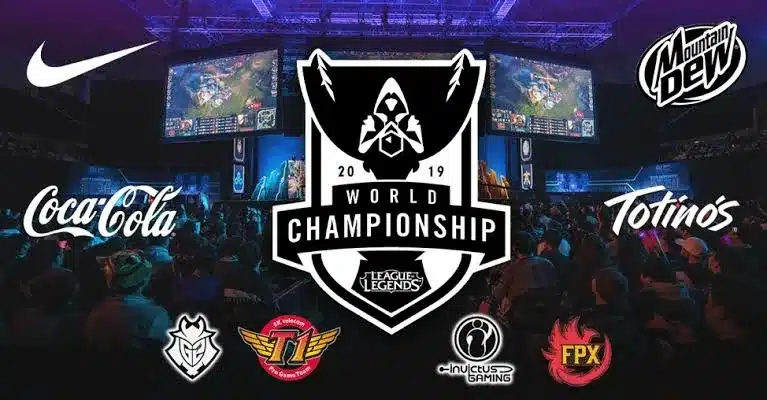
- Non-endemic sponsors pay for access to a hard-to-reach audience: banks, automakers, airlines, telecoms. Brands like Nike and BMW have signed long-term esports partnerships specifically because traditional sports sponsorships don’t reach the same crowd.
This is where the eSports sponsorships model turns fragile. A team’s entire operating budget can hang on to just 2 or 3 deals renewing on schedule. FaZe Clan went public in 2022 on a valuation partly built on sponsorship momentum. And then it was later sold to GameSquare for under $20 million, a fraction of where it started.
Sponsorship dependence isn’t a strength an org can lean on indefinitely. It behaves closer to a single point of failure dressed up as a revenue stream. And a sponsor can walk away at the end of a contract term with essentially zero switching cost on their side.
Gaming sponsorships also carry a content obligation most fans never see. It includes the activations, influencer campaigns, and in-stream integrations that teams have to staff and produce, which quietly eats into the margin of a sponsorship deal.
Franchise Fees and League Structures Explained
A franchise fee is the payment a team owner makes to a publisher for a guaranteed, non-relegatable slot in a closed league, similar to buying into the NBA or NFL. Fees range from $20 million for early Overwatch League slots to as much as $25 million for Call of Duty League and League Championship Series spots. Some Overwatch League expansion slots are reaching $35 million to $60 million each.
| League | Franchise Fee | What Happened |
| Overwatch League, 2018 founding | $20 million per team | League dissolved in 2023; owners were owed $390 to $420 million in deferred fees, most later waived |
| Overwatch League, 2019 expansion | $35 million to $60 million per team | Same dissolution; Activision Blizzard paid teams close to $120 million total to exit |
| Call of Duty League | Estimated $25 million per slot | Outstanding balances reportedly waived for teams still owing money |
League of Legends took a different path. Riot Games converted the LCS to a franchised model in 2018 with a flat $10 million entry fee, half what Overwatch charged its founding teams, and paired franchising with revenue sharing on league-wide media rights. That structure has proven more durable, though it still hasn’t made most LCS orgs consistently profitable on its own.
Franchise fees flow in a single direction: from team owner to publisher. They aren’t a shared investment so much as a cover charge for a party the publisher can end whenever it wants.
The Overwatch League example I mentioned above is the clearest failure case in esports history, and it belongs at the top of the list for anyone weighing whether to buy into a newly franchised league.
eSports Earnings: What Players and Teams Take Home
eSports earnings break down into 3 pools. The tournament prize money, player salaries, and organizational profit. Mixing them up is how the industry ends up looking richer than it actually is.
- Tournament prize money is winner-take-all. The International 2021 paid its champion $18.2 million. China alone distributed $217 million in total prize money across titles in 2025, while a large share of professional players gets nothing in a typical year.
- Player salaries average around $138,000 globally, but that number is skewed heavily by a small group of superstars. In the LEC, the average salary is €240,000, and the median is closer to €165,000, while tier two and three players in other regions can earn as little as $1,500 to $3,000 a month.
- Org profit is the least visible of the three, and usually negative. A documented Tier 2 org, CYBERSHOKE, posted a net loss of $322,565 against $620,110 in total revenue over about two and a half years.
A small group of top players and orgs capture a disproportionate share of both prize money and sponsorship attention, while nearly everyone below that tier operates more like a part-time job than a professional gaming team.
Why eSports Teams Struggle to Profit
Teams struggle to profit because their highest costs, player salaries, travel, coaching staff, and franchise fees, are fixed and rising, while their biggest revenue source, sponsorship, resets and renegotiates every single year.
- Salaries add up fast: Tier one Counter-Strike rosters alone can run $240,000 a month combined, before travel, housing, and coaching staff enter the picture.
- Franchise debt lingers: Teams that bought into the Overwatch League paid up to $60 million for a slot in a league that no longer exists, with no guaranteed way to recover that outlay.
- Bootcamps, travel, and content production scale with ambition, not with revenue: A team chasing a world championship spends like a contender well before it earns like one.
Traditional sports teams own or share in the broadcast rights to their own games. Esports teams don’t. The publisher owns the IP, so a large share of the value a team’s success creates flows upstream instead of staying with the org that built the audience. Organizations track RoI through audience growth, engagement rates, and sponsor retention rather than net income alone, since brand value compounds across seasons even when the profit and loss statement doesn’t.
That gap between brand value and actual profit shows up across the industry, not just at Tier 2. Team Liquid’s 2024 EBITDA broke even only after diversifying into a media production arm, TSM abandoned esports competition entirely, and 100 Thieves and Cloud9 both went through restructuring and layoffs in the same stretch. These are some of the best-known, best-funded orgs in the industry, and even they needed to diversify or downsize to stay standing.
eSports Industry Trends Reshaping Profitability
A handful of eSports industry trends are starting to answer the profitability problem directly instead of just growing around it.
- Nation-state-funded events: Saudi Arabia’s Esports World Cup committed $75 million in total prize money and a $45 million ecosystem fund for its 2025 season, a scale of external funding that dwarfs what publisher crowdfunding produces now that Dota 2’s Compendium model has largely collapsed.
- Mobile esports expansion: Mobile gaming already represents 52% of global gaming revenue. It is projected to grow at a 27.6% CAGR through 2035, opening regional leagues with far lower production costs than PC or console titles.
- Consolidation: After the 2023 to 2025 wave of layoffs and restructurings, fewer orgs are chasing the same sponsorship dollars, which should, over time, improve margins for whoever survives the shakeout.
- Revenue-sharing experiments: Some publishers are testing splits with teams on in-game item sales tied to team branding, nudging a small slice of publisher-controlled revenue back toward the org side of the ledger.
Gaming Ecosystems: How the Whole Stakeholder Map Fits Together
Zoom out far enough and esports stops looking like a single industry and starts looking like a gaming ecosystem with four separate businesses operating under one roof.
WIPO’s stakeholder mapping groups the sector into publishers, tournament organizers, team organizations, and players, each licensing pieces of IP to and from one another.
So publishers sit at the top because they own the game. Tournament organizers license gameplay rights from publishers to run events. And then sell sponsorship and broadcast access. Teams license their own name and logo to sponsors while paying publishers for franchise access. Players license their image and likeness to teams in exchange for salary and a cut of winnings.
Money tends to flow upward through this chain more often than it flows down. Fan spending, whether it lands as merchandise, subscriptions, or ticket purchases, gets split and re-split across four stakeholders before it reaches anyone who actually built the audience in the first place.
Understanding esports profitability basically implies that you need to know a team’s biggest competitor for revenue isn’t a rival org. It’s every other stakeholder standing between the team and the fan’s wallet.
Final Thoughts
The eSports business model isn’t broken so much as young and unevenly built. Revenue keeps climbing because audiences keep growing, but profitability depends on who’s positioned to capture that revenue, and publishers currently hold most of the leverage.
Teams that survive long-term tend to look like Team Liquid; diversified beyond competing, treating esports as one division inside a broader media business instead of the whole business.
And until franchise fees, IP ownership, and sponsorship volatility get rebalanced, the gap between industry growth and team profitability that opened up alongside Dota 2’s prize pool collapse isn’t recovering anytime soon.
For more info on AI and tech, visit Yaabot.
FAQs
All this comes together in teams under the banner of sponsorships, media rights, merchandise, prize winnings, and streaming. Sponsorships and media rights are the largest revenue sources combined, accounting for 60-65% of the total org income.
Most are not. Even popular organizations have failed to use sponsorship and prize money for long-term profitability, such as FaZe Clan’s troubled sale and TSM’s departure from the competitive League of Legends.
Earnings vary enormously. The global average is around $138,000, but the median is much lower, and tier two and tier three players are making $1,500-$5,000 a month in many parts of the world.
A franchise fee is a fee that the owner of a team pays to a publisher for a permanent place in a closed league. In leagues such as the Overwatch League, fees have been as high as $20 million up to $60 million per slot.
Sponsorship and advertising, which is estimated to bring in between $950 million and $1.2 billion in revenue around the world in 2026, and is always one of the biggest revenue streams reported in key market studies.
Even if third-party event organizers conduct matches, they do not have control over the league structure, the franchise pricing, and media rights; these belong to the game publishers like Riot Games or Activision Blizzard.
