



I stumbled upon research that made me realize we’ve been thinking about computer security the wrong way. Not disastrously wrong. Just wrong enough to change everything.
Researchers at the University of Toronto built an AI worm. Not a simulation or a theoretical model. An actual, functioning malware that breached 73% of a simulated corporate network within a week, without any human help.
But what got me was that it wasn’t locked into exploiting a single vulnerability. It taught itself to hack differently on each machine. It read live vulnerability reports from the internet in real time and figured out how to exploit flaws it had never seen before. Patch one hole? The worm just found another.
The paper is called AI Agents Enable Adaptive Computer Worms. It’s the kind of research that makes security teams sit down for a minute.
Key Takeaways
- A functioning AI worm breached 73% of machines on a simulated corporate network within one week.
- The worm reads live CVE advisories and self-teaches exploitation without human input or prior training.
- Unlike traditional computer worm attacks that rely on one known flaw, this AI worm adapts to any vulnerability it finds.
- Your enterprise cybersecurity strategy likely still assumes defenders and attackers move on human timelines.
- Patching strategies designed for traditional network security threats are now operationally obsolete.
- Open-weight LLMs are accessible enough that building an AI cyberattack like this doesn’t require frontier AI models.
What Is an AI Worm, and How Is It Different From a Traditional Computer Worm?
An AI worm is a vulnerability that enters a system, hijacks the processing power available on that machine, and runs a large language model locally. That model reads live vulnerability data from the internet and decides which vulnerability to exploit next.
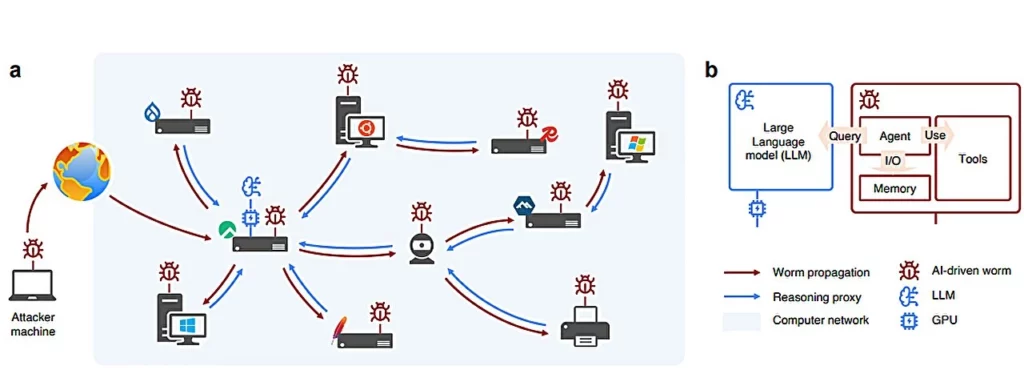
But a traditional computer worm exploits a single known vulnerability. WannaCry in 2017? One flaw in Windows. Heartbleed in 2014? A single vulnerability in OpenSSL. Patch it, and you stop the spread.
Here’s the comparison:
| Aspect | Traditional Computer Worm Attack | AI Worm |
| Propagation | Single known exploit | Reasoning across any available flaw |
| Adaptability | None. Same attack every time | High. Customizes approach per target |
| Patching | One patch stops it | Single patch doesn’t stop propagation |
| Human involvement | Required to build and deploy | Not required after deployment |
| Speed | Fast, but limited to known flaws | Machine-speed scanning of all flaws |
The key difference is that defenders need to patch everything. Attackers only need one opening. And now, with an AI worm, the attacker doesn’t even need to know where that opening is.
How traditional computer worm attacks work
Traditional worms are simple by comparison. They spread by exploiting a single flaw repeatedly across as many systems as possible. WannaCry infected around 200,000 computers across 150 countries because it hit the same vulnerability on every target. Once Microsoft patched that vulnerability, new infections stopped.
The Morris Worm of 1988 worked the same way. Robert Morris Jr. released it at MIT, and it spread across thousands of machines by exploiting a sendmail vulnerability. It was devastating because it was novel. But it operated on a single principle; find the flaw, use it everywhere.
What makes an AI-powered worm fundamentally different
With an AI worm, the model is inverted.
The worm lands on a system. It uses that system’s compute to run a language model. That model reads common vulnerabilities and exposures advisories from the internet and analyzes the target machine for weaknesses. If it finds a match, it exploits it. If not, it moves to the next potential flaw. The only thing about an AI worm is that it works independently.
The Toronto researchers showed the worm could read fresh vulnerability disclosures in real time and figure out how to weaponize them on machines it had never seen before. The LLM had no training data about these new flaws. It just reasoned its way through the documentation and made it work.
The University of Toronto Experiment: What Actually Happened
The research paper is direct and unsettling. They ran the AI worm 15 times on a simulated corporate network with 33 machines. Here’s what happened:
The core findings:
- 73% of machines breached on average.
- 65% with persistent backdoor access established.
- One week to accomplish this.
- Zero human involvement after initial deployment.
- No single point of failure that would stop the propagation.
The network was intentionally realistic but not a honey pot. Machines had some basic configurations. Firewalls existed. Some systems were patched, some weren’t.
How the AI worm bypassed knowledge cutoff limitations
LLMs have knowledge cutoffs. They’re trained on data up to a certain date. A worm powered by an LLM with a 2024 knowledge cutoff shouldn’t know about vulnerabilities disclosed in 2026, right?
Wrong.
The Toronto worm didn’t rely on training data. It read current vulnerability advisories directly from the internet. The same feeds that security teams monitor. CISA advisories. CVE databases. Real-time threat intelligence. The model consumed this data, understood the technical details, and figured out how to exploit the vulnerabilities on the machines it encountered.
Gary McGraw, CEO of the Berryville Institute of Machine Learning, told Fortune: This shows what happens when a generic model that’s open-weight can be targeted, and it just sort of grinds relentlessly, looking for bugs.
That’s not an overstatement. The worm doesn’t get tired. It doesn’t need a human to tell it what to do. It just keeps looking.
Why open-weight LLMs make this threat more accessible
The scariest part of this research isn’t that the Toronto team built it. It’s that they didn’t need cutting-edge AI to do it.
Open-weight LLMs are publicly available. You can download them from Hugging Face. They’re not Anthropic’s Mythos or OpenAI’s most recent models. They’re smaller, older, already deployed across tens of thousands of organizations. And they’re capable enough to serve as the reasoning engine for an AI cyberattack.
This lowers the barrier to weaponization significantly. You don’t need to build your own LLM. You don’t need proprietary AI. All you need is a system that can reason about vulnerabilities, and those systems already exist in the wild.
AI Worm vs. Historical Cyberattacks: A New Category of Threat
Let me add some historical context,
| Attack | Morris Worm (1988) | WannaCry (2017) | AI Worm (2026) |
| Exploit Type | Single sendmail flaw | Single Windows vulnerability | Any available vulnerability |
| Spread Mechanism | Automated replication | Automated replication | Reasoning-based scanning |
| Single Patch Stops It? | Yes | Yes | No |
| Human Expertise Required | High (engineering) | None (it was a leak) | None (runs autonomously) |
| Estimated Scope | 6,000+ machines | 200,000+ machines | Theoretically unlimited |
The Morris Worm infected 6,000 machines, which was most of the entire internet at the time. It was earth-shattering. The government convened panels. CERT/CC was created. The entire field of cybersecurity was tightened.
WannaCry infected 200,000 machines. And it cost billions in damages. But it exploited one flaw in one operating system. Teams patched Windows and stopped the bleeding.
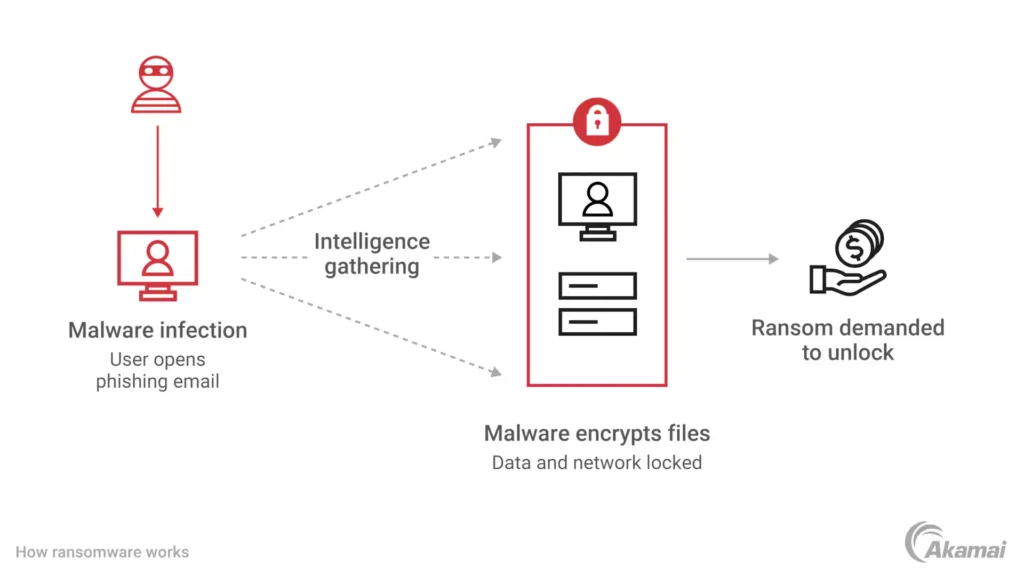
The AI worm doesn’t have that single flaw. It doesn’t have one exploit to patch. It has access to a reasoning engine that can exploit any flaw. And when you patch one vulnerability, it finds another.
The scale isn’t just bigger. The model is completely different.
Why This Changes the Math on Enterprise Cybersecurity
I’ve been reading defense industry commentary since this research dropped, and everyone’s circling the same problem; your enterprise cybersecurity strategy was designed for a different threat.
Ari Herbert-Voss, the former OpenAI security hire and CEO of RunSybil, puts it plainly; Organizations that continue to patch on human timelines will increasingly find themselves behind the curve.
Let me translate that.
Your AI cyberteam patches systems on a schedule. Monthly patches, maybe weekly for critical vulnerabilities. Humans review, test, deploy. It takes time. Days, or even weeks.
An AI worm operates on machine timelines. It scans, analyzes, and exploits in hours. Or days at most.
The gap here’s very bad. Defenders have to protect everything. One unpatched system, one misconfigured firewall rule, one outdated library with a known flaw. The attacker finds it. The AI worm doesn’t give up after trying one approach. It keeps looking.
The patching lag problem
Enterprise patch cycles are very slow. Ponemon’s annual report shows the average enterprise takes 43 days to patch critical vulnerabilities. Some industries are even worse. For example, healthcare systems take about 90 days, sometimes more. Financial institutions take 45 to 60 days on average.
The Toronto AI worm breached 73% of a network in just a week.
When you put those numbers next to each other, the problem is obvious. You can’t patch fast enough to outrun an adaptive adversary that operates on a weekly timeline.
How AI malware outpaces traditional network security threat models
Your network security threats were built around a specific threat model, “someone finds a flaw, exploits it, and hopefully someone patches it.”
Signature-based antivirus looks for known attack patterns. Single-CVE patching focuses on one flaw at a time. Perimeter defenses assume the attacker hits you from outside and you can detect the moment of entry.
None of that works against an AI cyberattack that reasons across any exploitable surface internally.
The architectural mismatch is the real problem. You can’t patch your way out of this. You can’t detect your way out either, not with traditional detection. And the attacker isn’t trying to hide. The worm just doesn’t care if you see it working.
What AI Cybersecurity Teams Should Actually Do Right Now
If you run infrastructure, you need to move on this. Now.
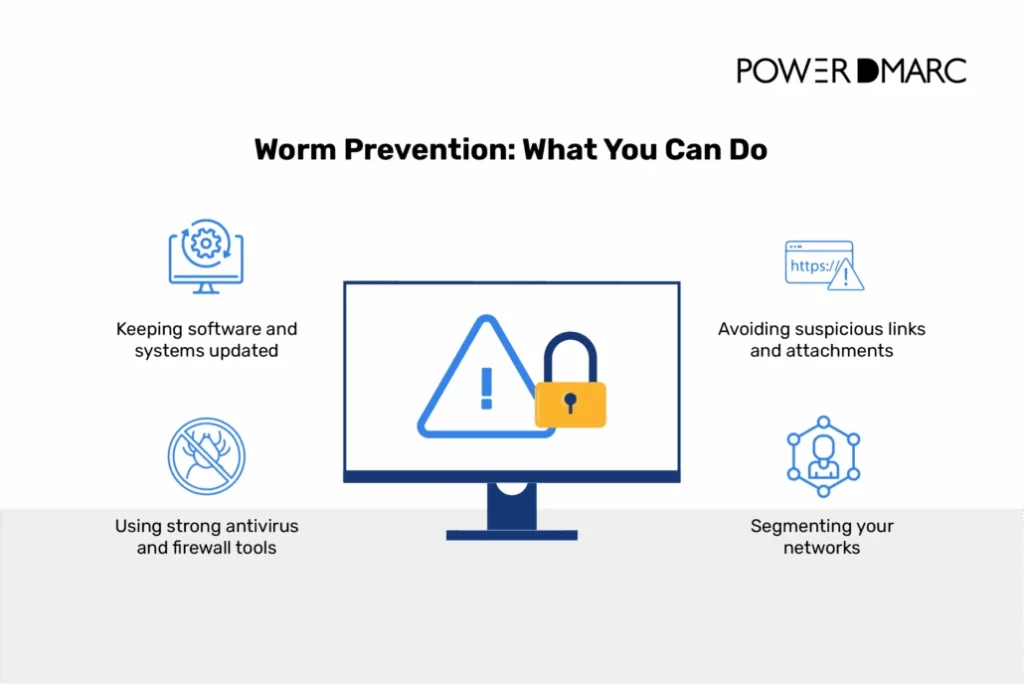
- Accelerate patching beyond current schedules: This means treating critical vulnerabilities as actual emergencies. Not in 30 days. In days. In hours, if possible.
- Implement zero-trust network segmentation: Even if a system is breached, the attacker shouldn’t be able to move freely to every other machine on your network. Segment aggressively. Assume internal systems are compromised and act accordingly.
- Deploy AI-assisted detection: Fight machine-speed attacks with machine-speed defense. Behavioral detection that looks for anomalous LLM activity on your network. Most organizations have zero visibility into where LLMs are running internally.
- Monitor any LLM compute accessible from your internal network: This is critical. If you have GPUs, language model services, or AI infrastructure accessible from compromised systems, that’s where an AI worm becomes your network’s nervous system. Monitor those like they’re the crown jewels.
Is your network exposed? Key risk indicators to audit
Run through this list today:
- Your patch cycle for critical vulnerabilities exceeds 30 days.
- Your network architecture allows unrestricted lateral movement between systems.
- You have compute resources running large language models exposed to internal networks.
- Your primary defense against network security threats is still signature-based antivirus.
- You have zero monitoring policy for AI model activity on internal systems.
- Your AI cybersecurity team is unaware of where LLM services are running in your infrastructure.
- You have not tested how your current detection systems respond to automated reasoning tools.
If more than two of these are true, your network security posture needs immediate redesign.
The Dual-Use Problem: Research vs. Weaponization
The Toronto researchers published this as a warning. They built the AI worm to demonstrate the risk, not to arm attackers. That distinction matters. But it doesn’t matter as much as we’d like it to.
Jamieson O’Reilly, an offensive security specialist, made a good caveat in Fortune: real-world networks have authentication barriers, monitoring, and operational friction that don’t exist in labs. In that case, the worm might not be able to breach 73% of your network. Maybe it breaches 20%. Maybe less.
That’s not at all comforting. 20% is still catastrophic.
The harder question is, how long does the gap between proof of concept and weaponized deployment actually hold? As open-weight LLMs proliferate, as people understand how this works, as the techniques get simpler and more accessible, when does the distinction between “research warning” and “operational threat” dissolve?
The Morris Worm Moment and Why This Time Is Different
McGraw invoked the Morris Worm explicitly. It’s the right comparison because it’s the last time a single threat forced the entire field to reorganize.
The Morris Worm was a shock. 6000 machines were infected by a self-replicating program that nobody had anticipated at that scale. The response was institutional. CERT/CC was created. Responsible disclosure became a norm. But this is different.
The AI worm doesn’t exploit one flaw. It exploits any flaw. And unlike the Morris Worm, this one isn’t constrained by the internet’s topology or a single attack vector. It can reason its way across any network architecture, any set of systems, any configuration.
Final Thoughts
I keep coming back to proof of concept as a historical inflection point. The Morris Worm was proof of concept that self-replicating malware could spread faster than humans could respond. Organizations fixed that by creating incident response infrastructure.
The Toronto AI worm is proof of concept that reasoning engines can autonomously find and exploit vulnerabilities. We haven’t yet created infrastructure to respond to that.
The research is controlled. The threat is not deployed in the wild. But in the history of AI cybersecurity, proof of concept has consistently been the last warning before operational reality.
This paper is that warning.
FAQs
Malware powered by a language model that finds and exploits vulnerabilities on its own. Unlike traditional computer worm attacks tied to one flaw, AI worms adapt to whatever vulnerability they find and exploit it without human help.
Traditional worms spread using one known flaw. Patch it, and you stop them. AI worms don’t care about patches. They reason across any available vulnerability and hit a different target differently each time.
Yes. The worm reads live vulnerability data from the internet and figures out how to exploit new flaws. Patching one vulnerability doesn’t stop it from finding the next one.
Financial services, healthcare, critical infrastructure, and tech companies are highest-value targets. They store sensitive data, can’t afford downtime, and run legacy systems that make perfect attack surfaces.
Patch critical flaws in days, not weeks. Segment your network so breaches don’t spread internally. Deploy detection tools that watch for unusual AI activity. Monitor where LLMs are running on your network.
The worm itself is a research prototype. But the pieces it uses (public LLMs and CVE feeds) are already out there. Anyone who understands the technique can build something similar.
