



Most people assumed OpenAI would win the AI race by default. It had the head start, the consumer brand, the Microsoft money, and ChatGPT. Anthropic had a safety pitch and a quieter model named Claude.
But somehow that assumption got expensive.
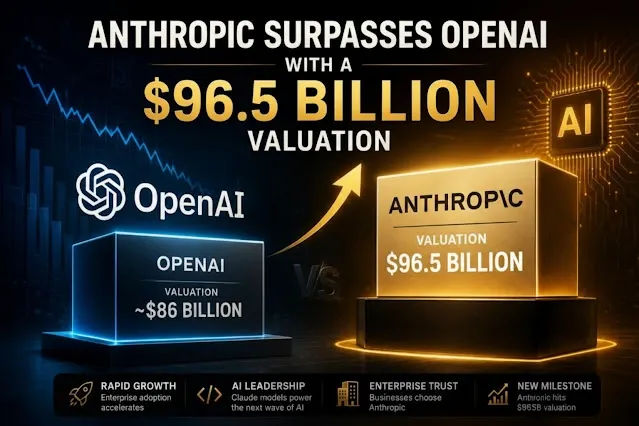
In May 2026, Anthropic closed a $65 billion Series H round, putting its post-money valuation at $965 billion. OpenAI, by comparison, was most recently valued at $852 billion. That means Anthropic, a company that didn’t exist six years ago, is now the most valuable pure-play AI company in the world.
The question is not just how. It is why now, and whether it holds.
Key Takeaways
- Anthropic’s $965B valuation now exceeds OpenAI’s $852B, both as private companies, not public market caps.
- Anthropic’s annualized revenue run rate crossed $47B in May 2026, up from $4B just over a year earlier.
- Claude Code’s impact on enterprise software workflows is the single biggest driver of that revenue acceleration.
- Anthropic still carries massive compute obligations: hundreds of billions committed to Amazon, Google, and Broadcom, plus $1.5B per month to SpaceX.
- Both companies are heading for IPOs. Anthropic’s valuation now shapes the public market narrative for the entire AI sector.
Anthropic vs. OpenAI Valuation: What the Numbers Actually Show
Anthropic’s $965B valuation and OpenAI’s $852B are both private, post-money figures. These aren’t market capitalizations determined by trading volume. They’re investor-assigned valuations from funding rounds, which means they reflect what a set of sophisticated investors agreed to pay, not what the broader market would clear.
That said, the gap is real, and the signal is clear.
| Metric | Anthropic | OpenAI |
| Latest Valuation | $965B (post-money, Series H) | $852B |
| Last Funding Round | $65B Series H (May 2026) | N/A (most recent disclosed) |
| Annualized Revenue Run Rate | $47B+ (May 2026) | ~$10B (estimated late 2025) |
| Year Founded | 2021 | 2015 |
| Primary Product | Claude AI, Claude Code | ChatGPT, GPT-4o |
The investor list for the Series H is also worth noting. It includes Altimeter, Dragoneer, Greenoaks, Sequoia, Capital Group, Coatue, GIC, ICONIQ, Temasek, and Blackstone. That’s not a group making some speculative bet. That’s a convergence of growth-stage and institutional capital that typically demands revenue traction.
Why private valuations aren’t the same as market value
Post-money valuation means the last agreed price per share, multiplied by total shares outstanding, after the latest round closes. It tells you what insiders paid. But it doesn’t tell you what a public market would assign on day one of trading. A company can be valued at $965B privately and open significantly lower or higher on a public exchange, depending on liquidity, sentiment, and disclosed financials. Keep that in mind as IPO conversations for both companies accelerate.
How Anthropic Got Here: A Timeline of the Climb
Anthropic was founded in 2021 by Dario Amodei, Daniela Amodei, and a group of researchers who left OpenAI. The origin is exactly two sentences, because the founding story isn’t what got Anthropic here. The revenue trajectory did.
Key inflection points:
- 2021: Anthropic was founded and got early focus on safety research and Constitutional AI methodology.
- 2023: Then Claude 1 was launched. Google committed early investment, and AWS announced Anthropic as their primary AI partner.
- Early 2025: The revenue was around $4B annualized. Claude was competitive but not dominant.
- January 2026: Revenue doubled from $4B to $9B within just six months, driven by an influx of enterprise clients.
- May 2026: Annualized revenue run rate crosses $47B. Series H closes at $65B. Valuation hits $965B.
That isn’t a gradual climb. That’s a near-vertical revenue spike in under 18 months. Something changed, and that something was scaled-up enterprise AI adoption, specifically through Claude Code.
The Revenue Engine Behind Anthropic’s Valuation Jump
The simplest answer to how Anthropic’s valuation surpassed OpenAI’s is that enterprise clients showed up in enormous numbers, and they started paying.
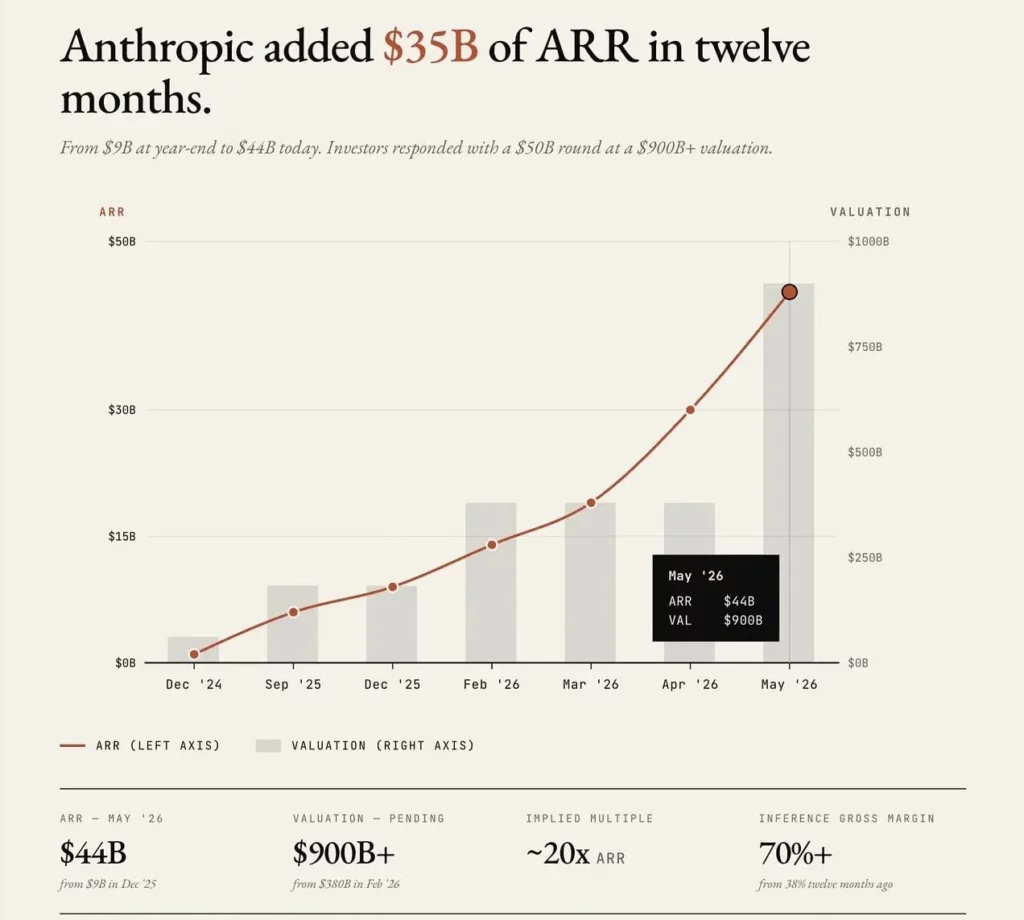
Investors understand that Anthropic’s annualized revenue run rate crossed $47B because businesses are now deploying Claude across core operations. The company’s own explanation for the Series H is two-pronged, accelerating AI adoption is driving revenue, and that adoption creates compute pressure that demands more infrastructure spending.
That’s the cycle. More enterprise clients mean more revenue. More revenue gets reinvested into model quality and compute. Better models attract more enterprise clients.
What broke the cycle open was Claude Code.
How Claude Code and enterprise AI adoption changed the calculus
Enterprise AI adoption is basically the number that explains the valuation more than anything else. And Claude Code was the product that unlocked that revenue surge.
The trend of vibe coding, where developers use AI models to handle the bulk of routine coding tasks, hit a critical mass in early 2026. Fortune 500 companies began redirecting software development budgets away from manual engineering roles towards AI tooling. And Claude Code was the primary beneficiary of that shift.
The compute cost to support that scale is just as telling. Anthropic has committed $1.5 billion per month to SpaceX for infrastructure. That number is evidence of both how much the company is growing and how much it is spending to keep up.
What Anthropic Is Doing Differently From OpenAI
I want to be careful here, because this section could easily become a PR summary for Anthropic, which isn’t the point.
Anthropic’s strategy is genuinely different from OpenAI’s in a few specific ways. Whether those differences are advantages or liabilities depends on the time horizon.
Where Anthropic diverges:
- Go-to-market: Anthropic is primarily B2B. Claude AI is an enterprise product first, a consumer product second. OpenAI went the opposite direction. Anthropic skipped that step and went straight for the procurement budget.
- Safety architecture: Constitutional AI is a concrete methodology, not a marketing phrase. It holds back Claude on its capabilities, which is either a trust signal or a product limitation depending on the use case.
- Revenue source: Anthropic’s revenue is predominantly API and enterprise contracts. OpenAI’s revenue mix includes consumer subscriptions, enterprise, and Microsoft-adjacent deals.
- Brand: OpenAI still dominates consumer mindshare. If you asked a random person to name an AI model, they say ChatGPT. Anthropic doesn’t have that problem in the enterprise, but it has not solved the consumer recognition problem either.
| Dimension | Anthropic | OpenAI |
| Primary Revenue Source | Enterprise API, Claude Code contracts | Consumer subscriptions, enterprise API |
| Go-to-Market Focus | B2B first | Consumer first, then B2B |
| Safety Approach | Constitutional AI (methodology-level) | RLHF-based, policy-driven |
| Flagship Product | Claude AI, Claude Code | ChatGPT, GPT-4o |
The “trust premium”: Does safety positioning actually drive enterprise deals?
Enterprise buyers in regulated industries (finance, healthcare, legal) do care about safety and compliance. Constitutional AI gives Anthropic a concrete answer when those industries ask them, How do you prevent the model from producing harmful outputs? And that becomes a real differentiator.
But I haven’t seen data showing that enterprise clients are paying extra specifically for Constitutional AI over, say, API reliability, model performance benchmarks, etc. The evidence that safety is a direct revenue driver is really thin. But what is clear is that it removes a procurement objection, which is a different and narrower claim.
OpenAI’s Valuation Slide: What Went Wrong
OpenAI didn’t lose to Anthropic because Anthropic outcompeted it on every axis. It lost ground for specific, traceable reasons.
The governance crisis: The board firing and rehiring Sam Altman created real uncertainty within the company. Institutional investors have long memories about governance risk, and that episode introduced a variable that Anthropic simply does not have.
The Microsoft deal cut both ways: Microsoft’s investment gave OpenAI capital and distribution, but it also created a perception issue; is OpenAI an independent AI company or a Microsoft product division? That ambiguity made some enterprise buyers hesitant to bet heavily on OpenAI as a primary vendor.
GPT-4o saturation: By 2025, GPT-4o was the most-used AI model in the world, which is also a different problem. Like, if everyone has the same model, it becomes a regular commodity and not a competitive edge.
The HSBC signal: HSBC analysts flagged a potential $207B crater in OpenAI’s expansion goals, citing concerns about sustainable enterprise revenue against aggressive capital spending. That kind of mainstream institutional skepticism affects funding rounds in ways that press coverage alone does not.
OpenAI is not failing. But for the first time since 2022, it’s clearly reacting rather than setting the pace.
Anthropic’s Biggest Risks That Investors Are Choosing to Ignore
This section exists because any article that reads like an Anthropic press release is a useless article.
The profitability claim is shaky: Anthropic claims it turned an operating profit for one quarter, as reported by the Wall Street Journal. The same WSJ story notes that it is unclear what accounting methods were used to book revenue and costs, and that the company may not remain profitable for the full year given planned spending increases.
The compute obligations are enormous:
- Hundreds of billions committed to Amazon, Google, and Broadcom over the next decade.
- $1.5B per month to SpaceX for infrastructure, an ongoing burn that does not slow down with revenue fluctuations.
- The compute cost to run frontier AI models at scale is not a temporary problem. It is structural.
The AI business model is still unproven at scale: Critics like Ed Zitron and mainstream analysts at institutions like HSBC have both pointed out that AI as a core business strategy hasn’t shown long-term profitability at the revenue levels being priced in. Anthropic’s revenue is real and growing fast. But whether it can cover the capital obligations while sustaining margins is a different question, and the answer isn’t available yet.
The risk of revenue concentration: If Claude Code is the primary engine behind the $47B run rate, and enterprise AI adoption plateaus or enterprise buyers consolidate to fewer vendors, Anthropic’s growth curve is vulnerable in many ways.
The talent dependency risk: Anthropic’s technical edge is built on a relatively small group of researchers who came from OpenAI, DeepMind, and Google Brain. At near-trillion valuations, retention becomes expensive and competitive poaching becomes aggressive. No competitor has unlimited resources to prevent this, including Anthropic.
I’m not saying that Anthropic is overvalued. I’m saying that the risks are being priced more generously than the evidence warrants, and that is worth naming.
What Anthropic’s $965B Valuation Means for the AI Industry
The number that matters here isn’t the $965B. It is $965B vs. $852B, and what that gap means for the public markets both companies are heading into.
The foundation model competition is no longer a two-horse race in one direction: For most of the past three years, OpenAI was assumed to be the default infrastructure layer for enterprise AI. Anthropic’s valuation, backed by the revenue traction behind it, signals that enterprise buyers are diversifying. That is structurally important for anyone building on foundation models.
The IPO narrative just changed: If Anthropic files first at a $965B private valuation, it sets a pricing anchor for the entire AI IPO cycle. And that makes OpenAI’s path to a comparable public market valuation harder to justify without closing the revenue and product gap.
Enterprise AI adoption is the variable that matters most: The question both companies are essentially betting on is whether enterprise AI adoption continues to accelerate, or whether they’ve hit the saturation point. And if adoption does plateau, the revenue curves that justify these valuations flatten with it. Foundation models that can’t prove retention and expansion in enterprise accounts will be re-rated sharply.
Legacy tech is watching a different kind of pressure. The valuation gap between AI-first companies like Anthropic and traditional enterprise software companies is now undeniable. That creates M&A pressure and partnership urgency across the software industry, and foundation models are at the center of it.
Final Thoughts
Anthropic passed OpenAI on valuation because it turned the enterprise bet into real revenue faster than anyone outside the company expected. The $47B annualized run rate is not hype. The $965B valuation is a response to it.
What to watch next: whether the IPO timelines hold, whether Anthropic’s revenue growth can outpace its compute obligations, and whether enterprise AI adoption in 2026 and 2027 sustains the trajectory or reveals that 2025 was the peak.
The scoreboard just changed. Whether the score holds is the actual story.
FAQs
Yes. Anthropic’s post-money valuation stands at $965B after its Series H round. OpenAI’s most recent disclosed valuation is $852B. Both are private companies, not publicly traded.
$965 billion, post-money, following a $65 billion Series H round closed in May 2026 and led by Altimeter Capital, Dragoneer, Greenoaks, and Sequoia Capital.
To a major extent, via enterprise API contracts and Claude Code Subscriptions. Companies invest in using Claude AI for their core business and developer processes. There is consumer revenue, but it is a secondary source.
Claude AI is Anthropic’s model using the Constitutional AI methodology designed primarily for enterprise use cases. ChatGPT is the more consumer-friendly product of OpenAI, where it has been adopted by the public. OpenAI’s Codex is competing with Claude Code on developer tooling.
Anthropic is a privately owned company. The major backers are Google, Amazon, Sequoia Capital, Altimeter Capital, Dragoneer, Greenoaks, Coatue, ICONIQ, Temasek, GIC, and Blackstone. Dario and Daniela Amodei are co-founders and still in leadership.
Not reliably. In early 2026, Anthropic reported a Q1 operating profit, though the accounting process used has not been independently verified. The company has a large ongoing compute requirement, which makes it uncertain whether it will be profitable throughout the year.
