


I’ve followed Computex for years, but this one feels different, in a good way. Computex 2026 ran from June 2-5 in Taipei under the theme AI Together. And for the very first time, every single product on the show floor, from a $300 budget laptop to a $1,000+ gaming handheld, shipped with a dedicated NPU running AI workloads locally. But NVIDIA, Intel, AMD, and Qualcomm’s stories defined the show.
So we’ll look into some of the brand-new innovations and how the world’s biggest PC hardware trade show took the spotlight.
Key Takeaways
- NVIDIA RTX Spark is the first Windows-on-Arm platform from NVIDIA, combining a 20-core Arm CPU, Blackwell GPU, and 128GB unified memory in a single SoC.
- Microsoft Surface Laptop Ultra is the first RTX Spark device, capable of running 120B parameter AI models entirely on-device.
- Intel Crescent Island AI GPU packs up to 480GB LPDDR5X, specifically targeting agentic AI workloads in the data center.
- AMD’s Radeon RX 9070 GRE launched globally at $549 on June 2, with roughly 22% better 1440p performance than the RTX 5060 Ti 16GB in independent tests.
- Qualcomm Snapdragon C powers Acer’s Aspire Go 15, targeting the sub-$300 AI PC segment.
- AMD Ryzen 7 5800X3D 10th Anniversary Edition returns at $349, bundled with a Carbice carbon nanotube thermal pad.
- On-device AI inference is no longer a premium feature: it ships at every price point this year.
What Is Computex 2026 and Why Does It Matter This Year?
Computex is the world’s biggest PC and computer hardware trade show, held annually in Taipei, Taiwan. The 2026 edition ran from June 2-5, and unlike recent years of iterative CPU refreshes, this one was about full platform redesigns built around AI agents.

And the redesigns matter, especially this year. Apple’s MacBook Neo has put some real pressure on the affordable Windows PC market, while a RAM pricing crisis squeezed OEM margins across the board. Every major manufacturer came to Taipei with something to prove.
NVIDIA RTX Spark Superchip: The Show Defining Announcement
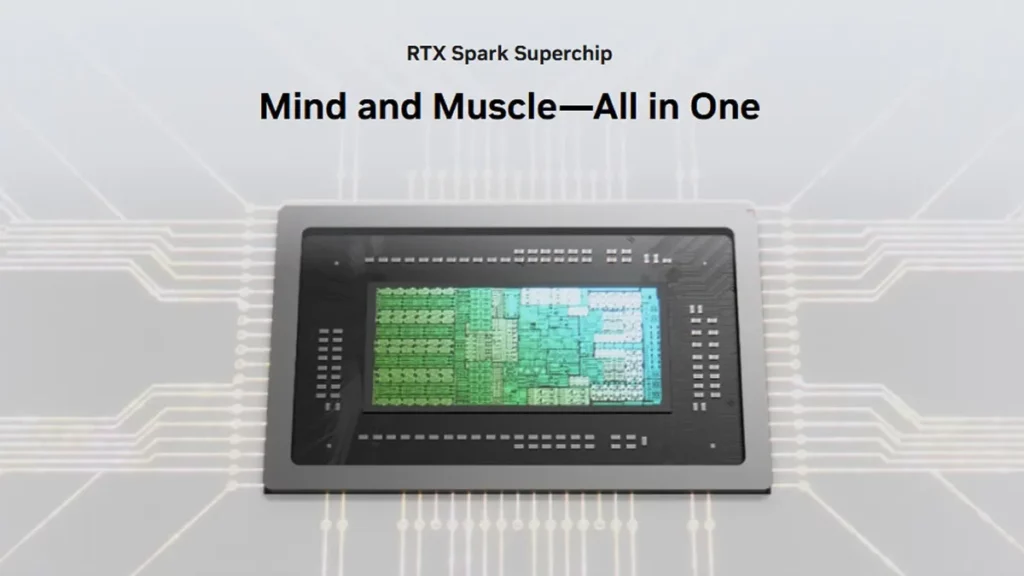
NVIDIA didn’t just announce a chip. The NVIDIA CEO Jensen Huang walked in and said, We’re building the PC now. The RTX Spark Superchip is NVIDIA’s first Windows processor.
RTX Spark Superchip specs and architecture
The RTX Spark Superchip is built around a co-design between NVIDIA and MediaTek:
- CPU: 20 Arm CPU cores.
- GPU: Blackwell-class with 6,144 CUDA cores.
- Memory: 128GB LPDDR5X unified memory.
- Bandwidth: 300 GB/s.
- Interconnect: NVLink-C2C.
- AI Compute: 1 petaflop (NVIDIA’s claim).
The unified memory architecture is the real story here. Apple does it with its M-series chips. Qualcomm does it with Snapdragon X2 Elite Extreme. Now NVIDIA does it too, and with 128GB, it’s the largest pool of any of them.
How does it compare?
| Platform | Unified Memory | Architecture | AI Compute |
| NVIDIA RTX Spark | 128GB LPDDR5X | Arm + Blackwell GPU | ~1 PFLOP |
| Apple M4 Max | Up to 128GB | Apple Silicon | ~38 TOPS (NPU) |
| Snapdragon X2 Elite | Up to 64GB | Arm + Adreno | ~75 TOPS (NPU) |
What “Agentic AI” actually means for Windows users
Jensen Huang’s framing at Computex 2026 was clear: the mouse and keyboard have defined personal computing for 40 years, and AI agents are going to be the next interface layer.
This means software agents that can browse, write, execute code, and manage files on your behalf, without sending your data to the cloud. NVIDIA’s OpenShell framework, built around RTX Spark, has three security layers designed to make that feel less dystopian:
- Per-agent sandboxing: Each agent operates in isolation and can’t touch your system files until you give permission.
- Customizable permission rules: You define what each agent can and can’t do.
- Privacy gateway: Sensitive tasks are processed locally.
But most of this will require Windows 12. Day one, RTX Spark devices run standard Windows 11 with enhanced local AI inference for productivity tasks. If you want to get the full agentic OS experience, that’s a story for the next year.
NVIDIA RTX Spark roadmap: Rubin and Rosa Feynman confirmed
NVIDIA didn’t just announce; it committed to a multi-generation roadmap. After the current Grace Blackwell Spark, the next generation will be about Vera Rubin (with LPDDR6 memory), followed by Rosa Feynman.
For buyers, NVIDIA sticking to its roadmap is all that matters. But it also means RTX Spark isn’t some one-time experiment. NVIDIA is treating Windows ARM as a long-term platform investment, similar to how Apple has handled Apple Silicon across multiple generations.
Microsoft Surface Laptop Ultra: The First RTX Spark Device
The Surface Laptop Ultra arrived at Computex 2026 as a direct competitor to MacBook Pro, and on paper, it’s the most powerful Surface ever built.
Specs at a glance:
- A 15-inch mini-LED display.
- Equipped with a 20-core Arm CPU (via RTX Spark Superchip).
- Blackwell-class GPU attached to it.
- Arming it with 128 GB of unified RAM.
- With HDMI, USB-C, USB-A ports, and an SD card reader.
It can run 120B parameter AI models locally without any cloud round-trips, and that’s the USP. Microsoft also optimized how Windows manages memory page sizes specifically for the Surface Laptop Ultra’s larger memory pool, improving heavy workloads and multitasking performance.
Who is this actually for?
| Consideration | Verdict |
| Power users and AI developers | Strong fit |
| Mainstream laptop buyers | Likely overpowered (and overpriced) |
| MacBook Pro switchers | Compelling spec match, software ecosystem TBD |
| Gaming | Not the primary use case |
The Surface Laptop Ultra is a statement device. Microsoft’s product team described it as “laser-focused” on taking advantage of the unified memory pool for demanding workloads. Whether the price lands in territory most buyers can stomach is a different conversation, and Microsoft hasn’t finalized pricing publicly.
Intel at Computex 2026
Intel had a quieter Computex than NVIDIA, but still they made up their mark. They came up with two products, and both stood out. The Crescent Island AI GPU for the data center, and the Arc G3 Extreme for gaming handhelds.
Crescent Island AI GPU: 480GB LPDDR5X for the Data Center
Intel’s Crescent Island AI GPU is built on the Xe3P architecture and is positioned squarely for agentic AI workloads, not consumer gaming. The standout figure: up to 480GB of LPDDR5X memory.
In a market where DRAM prices are creating a bottleneck for AI infrastructure buyers, 480GB on a single GPU card is Intel’s most direct answer to that problem. Raw performance specs are still thin at this stage, which is the honest caveat here. Intel detailed the memory capacity and architecture at Computex 2026, but independent benchmarks aren’t out yet.
Still, as a data-center play targeting the same agentic AI narrative as NVIDIA, it puts Intel in a credible position for enterprise buyers who need massive memory pools without going the HBM route.
Intel Arc G3 Extreme for gaming handhelds
This was Intel’s mic-drop moment. The Arc G3 and G3 Extreme chips target gaming handhelds directly, and early hands-on reviewer verdicts from the Computex floor favored Arc G3 Extreme over AMD-powered gaming handhelds in direct comparisons.
The 18A compute tile includes an integrated NPU, keeping Intel relevant in the on-device AI inference conversation even in handheld form. And on the laptop side, Dell’s XPS 13 showed up using Intel’s Wildcat Lake, positioned directly to compete with MacBook Neo in the premium thin-and-light segment.
Qualcomm Snapdragon C: A $300 Windows Laptop Is Now Real
While NVIDIA grabbed headlines with 128GB of RAM, Qualcomm was busy solving a different problem: how do you get a capable Windows AI PC to $300?
The Snapdragon C platform is Qualcomm’s answer. Acer’s Aspire Go 15 is the first device to use it, targeting a $300 and up price point, but with no confirmed launch date yet. The CPU architecture seems more like a mystery. Qualcomm hasn’t fully disclosed the core configuration, though some hands-on reports confirm an 8-core setup.
What I find interesting is the positioning. Qualcomm is fighting on two fronts simultaneously:
- The premium end: NVIDIA’s RTX Spark platform now competes with Snapdragon X2 Elite at the top.
- The affordable end: Apple’s MacBook Neo has made the sub-$700 laptop conversation much harder for Windows OEMs.
The Snapdragon C carves out the sub-$300 territory where Apple doesn’t play. And critically, it still includes a budget NPU. On-device AI inference isn’t reserved for $700+ machines anymore. It ships on a $300 laptop from this year’s Computex.
AMD at Computex 2026: RX 9070 GRE Goes Global and AM5 Lives Until 2029
AMD’s Computex 2026 story was more grounded than NVIDIA’s. Their main focus was to extend platform life, give budget-conscious gamers some real options, and deliver an accessible GPU.
Radeon RX 9070 GRE: $549, global launch, RDNA 4
AMD’s Radeon RX 9070 GRE launched globally on June 2, priced at $549. It sits between the RX 9060 XT and the standard RX 9070 in the RDNA 4 lineup.
The specs:
- 12 GB of GDDR6 memory.
- With a RDNA 4 architecture with matrix accelerators.
- Targeted at 1440p gaming.
Performance context: independent reviews confirm it outperforms NVIDIA’s RTX 5060 Ti 16GB by roughly 22% at 1440p. That’s a solid win at that price point.
But honestly, 12GB of GDDR6 is a framebuffer limitation at 4K, particularly in ray-traced titles. You won’t hit that wall if you’re gaming at 1440p. But if you’re planning a 4K upgrade, look at the standard RX 9070 with 16GB instead.
AMD extends AM5 platform support to 2029
AMD previously committed to AM5 through 2027. At Computex 2026, that was extended to 2029, with both Zen 4 and Zen 5 getting further CPU generations on the platform.
For anyone who already owns an AM5 board, this is going to be very helpful. It means your current motherboard investment stays viable for at least two more CPU generations, and future Zen 6 processors won’t require swapping the whole platform.
AMD also announced its EXPO Ultra Low Latency DDR5 overclocking technology, claiming a 13% performance uplift on certified memory kits.
The Return of a Legend: Ryzen 7 5800X3D 10th Anniversary Edition and 7700X3D
This was the announcement that caught me most off guard. AMD discontinued the 5800X3D back in 2023. But it came back at Computex 2026, and with a pretty clear reason; with DRAM prices destroying upgrade budgets, reviving AM4’s best gaming CPU removes the need for a costly platform swap.
The Ryzen 7 5800X3D 10th Anniversary Edition launches June 25 at $349, which is $100 less than its original $449 MSRP in 2022. The chip itself is unchanged: same Zen 3 cores, same 96MB 3D V-Cache, same AM4 compatibility across all 400 and 500 series motherboards. What’s new is the packaging and a Carbice Ice Pad thermal pad included in the box (more on Carbice below).
For the AM5 crowd, AMD simultaneously announced the Ryzen 7 7700X3D at $329, launching July 16:
- 8 cores / 16 threads.
- 4.5GHz boost clock.
- 104MB total cache.
- TDP: 120W.
- Platform: AM5.
Who should actually care?
- AM4 owners on aging CPUs (Ryzen 5 3600, 2700X, etc.): The 5800X3D Anniversary Edition is the cleanest upgrade available without touching anything else in your system.
- AM5 buyers who want 3D V-Cache affordably: The 7700X3D at $329 is a cheaper entry than the 7800X3D.
- Anyone waiting for Zen 5 refresh parts on AM5: Probably still worth waiting unless you need an upgrade now.
New Laptops and Devices: Acer, Asus, Dell, and Samsung
Beyond the platform announcements, the Computex 2026 show floor had a lot of interesting PC hardware. Here’s what stood out in the OEM device category.
Acer Swift Air 14 and Aspire Go 15
At Computex 2026, Acer brought three noteworthy products:
Acer Swift Air 14 ($699 starting): Positioned as a direct MacBook Neo competitor. All-metal build, NPU inside, four color options (sage green, frost blue, blossom pink, lilac purple). The Swift Spin 14 AI was also announced alongside it with similar AI credentials. The $699 price undercuts the MacBook Neo slightly while offering the Windows ecosystem.
Acer Aspire Go 15 (sub-$300 target): First device to be based on Qualcomm’s Snapdragon C platform. No launch date confirmed. For anyone who needs a capable Windows machine on a tight budget, this is the one to watch.
Acer Nitro Blaze Link: A streaming-only gaming handheld running Linux, not Windows. It uses open-source apps (Sunshine and Moonlight) for device-to-device game streaming. No pricing, no launch date. Interesting concept, though I’d want to see how the Linux software experience holds up in practice before getting excited.
Asus ROG, Dell XPS 13, and MSI Claw 8 EX AI+
A few notable device announcements in this tier:
- Asus ROG Ally X20: Comes bundled as an Xbox gaming package. Features a 7.4-inch OLED screen for handheld gaming.
- Dell XPS 13 (Wildcat Lake): Intel-powered and aimed squarely at MacBook Neo buyers who want a premium thin-and-light running Windows.
- MSI Claw 8 EX AI+: A premium gaming handheld that exceeds $1,000. That price point raises real questions about who the gaming handheld market is actually for right now, especially with RAM prices still elevated.
Samsung’s 4K 360Hz QD-OLED Panel
Samsung unveiled its first 4K 360Hz QD-OLED monitor panel at Computex 2026, and it’s the standout announcement from the show. Pairing 4K resolution with a 360Hz refresh rate on a QD-OLED panel is genuinely impressive.

Two other premium monitor announcements worth noting:
- Alienware AW3926QW: 39-inch, 5120×2160, 330Hz native on OLED.
- Asus ROG Swift OLED PG32UCWM: Another OLED addition to the ROG Swift lineup.
Next-Gen Thermals: Noctua and Carbice Carbon Nanotube Pads
This one’s for the builders. Noctua and Carbice announced a strategic partnership at Computex 2026 to bring carbon nanotube thermal pads to the DIY PC market under the Noctua NT-CP1 name.
Here’s what makes these pads different from standard thermal paste or graphite pads:
- Carbon nanotube forest anchored to an aluminum backbone.
- Nanoscale polymer coating makes them non-electrically conductive and easier to handle than graphite.
- Improves over time through repeated thermal cycles, gradually conforming to microscopic surface irregularities.
- Zero maintenance: no repasting needed, unlike standard pastes that dry out every 3-5 years.
The same Carbice technology already goes into satellites, aerospace systems, and AI infrastructure. It ships with the AMD Ryzen 7 5800X3D Anniversary Edition as the included “Carbice Ice Pad,” which is the first time this material has appeared in a retail CPU box.
The Noctua NT-CP1 AM5/4 launches in September 2026. Pricing isn’t confirmed yet, though Noctua holds an exclusive distribution agreement for the DIY market, which rarely signals budget pricing. It’s validated for both AM4 and AM5 processors.
The One Theme That Connected Every Computex 2026 Announcement
I kept coming back to one observation all week: every device at Computex 2026 had a dedicated NPU, regardless of price tier. From NVIDIA’s NVLink-C2C architecture running 1 petaflop of AI compute, to Qualcomm’s budget NPU in a sub-$300 laptop, to AMD’s Ryzen AI branding across its consumer lineup, on-device AI inference is now the floor, not a ceiling.
That’s a meaningful shift. Two years ago, NPUs were a selling point. This year, their absence would be the story.
The uncomfortable counterpoint is cost. AI PC adoption is accelerating, but so is the cost of building a PC. The ongoing DRAM pricing crisis means that the industry is pushing AI everywhere while simultaneously making the computer hardware required to run it harder to afford. A $1,000 gaming handheld and a $349 CPU relaunch at the same show tells you everything about how bifurcated this market is getting.
Final Thoughts
Computex 2026 made the AI PC era feel real in a way prior years didn’t. The shift from “this chip has an NPU” to “every chip has an NPU” happened quietly but completely. NVIDIA’s RTX Spark is the headline, but the more interesting long-term story might be Qualcomm proving that AI inference can ship at $300.
A lot of what was announced won’t ship until late 2026 or early 2027. RTX Spark’s full agentic capabilities need Windows 12. The Noctua NT-CP1 thermal pad ships in September. Several Acer devices have no confirmed launch dates. So while the roadmap is credible, there’s a gap between what was shown in Taipei and what you can actually buy right now.
The clearest near-term purchase decisions from Computex 2026: the AMD RX 9070 GRE is already on shelves and delivers strong 1440p value at $549. The Ryzen 7 5800X3D Anniversary Edition launches June 25 for AM4 owners who’ve been waiting for an upgrade reason. Everything else requires patience.
FAQs
Computex 2026 ran June 2-5, 2026, in Taipei, Taiwan. Several major announcements came out before the official start date.
NVIDIA’s RTX Spark Superchip was the most consequential: a Windows-on-Arm SoC with 20 Arm CPU cores, a Blackwell GPU, and 128GB unified LPDDR5X memory, all in one package.
The Acer Aspire Go 15, powered by Qualcomm’s Snapdragon C platform, targets $300 and up, making it the most affordable AI PC announced at the show.
Yes. AMD launched the RX 9070 GRE globally at $549, revived the Ryzen 7 5800X3D as a 10th Anniversary Edition at $349, announced the new Ryzen 7 7700X3D at $329, and confirmed AM5 platform support through 2029.
It is NVIDIA’s first Windows processor: a Windows-on-Arm SoC combining 20 Arm CPU cores, a Blackwell-class GPU with 6,144 CUDA cores, and up to 128GB of unified LPDDR5X memory, built for on-device agentic AI workloads.
