



On January 6, 2026, the FDA released updates to two foundational guidance documents: General Wellness: Policy for Low Risk Devices and Clinical Decision Support Software.
FDA Commissioner Marty Makary announced the changes at the Consumer Electronics Show, framing them as a push to “promote more innovation with AI in medical devices.” Both documents allow a wider range of digital health devices to reach consumers without going through full premarket review.
The updates are not entirely new rules. They draw clearer lines around things that have been frustratingly vague for anyone building AI-enabled medical devices, AI wearables, or wearable biosensors. This article breaks down what actually changed, what it means in practice, and where the uncertainty still lives.
Key Takeaways
- The FDA eased requirements for low-risk AI wearables and CDS software on January 6, 2026.
- Non-invasive wearable biosensors can now qualify as general wellness products if they make no diagnostic claims.
- Single-recommendation CDS software may now be exempt from medical device regulation.
- sDHT (sensor-based digital health technology) devices remain subject to premarket notification if they cross into medical device territory.
- High-risk AI-enabled medical devices that substitute for clinical judgment still face full FDA oversight.
- Significant regulatory grey areas remain, especially around adaptive AI systems and real-time health monitoring tools.
What Changed in the FDA’s 2026 Guidance for AI-Enabled Medical Devices
The 2026 updates supersede guidance from September 2019 (General Wellness) and September 2022 (CDS Software). The shift is toward enforcement discretion for lower-risk digital health devices, while maintaining stricter oversight for anything that replaces clinical judgment.
Two changes matter most for AI-enabled medical devices:
| Area | Previous Guidance | 2026 Update |
| Wearable biosensors (blood pressure, SpO2, glucose signals) | Required FDA clearance regardless of intent | Can qualify as general wellness products if non-diagnostic |
| CDS software recommendations | Required multiple options to avoid device classification | Single clinically appropriate recommendation now permitted |
| Risk score functions | Explicitly excluded from CDS exemption | Permitted, provided input data has established clinical relevance |
| General wellness notifications | Limited flexibility on out-of-range alerts | May suggest professional evaluation without triggering device status |
The Difference Between Wellness Wearables and Medical-Grade Devices
This distinction is the central axis around which everything else in the guidance turns. It directly determines how AI wearables and wearable biosensors get classified.
A general wellness product:
- Encourages or maintains a healthy lifestyle.
- Does not diagnose, treat, cure, mitigate, or prevent any disease.
- Poses no significant safety risks to users.
- Does not substitute for an FDA-authorized device.
A regulated medical device (including AI-enabled medical devices):
- Makes specific diagnostic or treatment claims.
- Provides ongoing disease monitoring or alerts.
- Outputs data intended to guide clinical decisions.
- Uses invasive or potentially risky sensing technology.
Manufacturers of wellness products can make wellness claims, like improving sleep, activity, or stress, but cannot make medical or clinical claims such as screening, diagnosing, monitoring, alerting, or managing a disease or condition.
They can, however, include a soft notification telling users that “evaluation by a healthcare professional may be helpful” when values fall outside normal ranges, as long as that notification does not give a specific diagnosis.
The WHOOP example:
WHOOP (a fitness and health wearable company known for its recovery-tracking ring) found itself at the center of this debate. The FDA sent WHOOP a warning letter in 2025 over its blood pressure feature.
Under the 2026 guidance, the agency reversed that position, saying non-invasive blood pressure features in AI wearables can be considered wellness features when designed for non-medical purposes.
Sensor-Based Digital Health Technology (SDHT) and Wearable Biosensors
What qualifies as sDHT
The FDA defines sDHT as medical devices that incorporate sensor-based digital health technology capable of capturing health information in real time, often outside a clinical setting.
These digital health devices must have received FDA premarket authorization.
To appear on the FDA’s sDHT list, a device generally needs to:
- Be usable in non-clinical settings (such as at home).
- Have met applicable premarket requirements.
- Have decision summaries published in the FDA’s database.
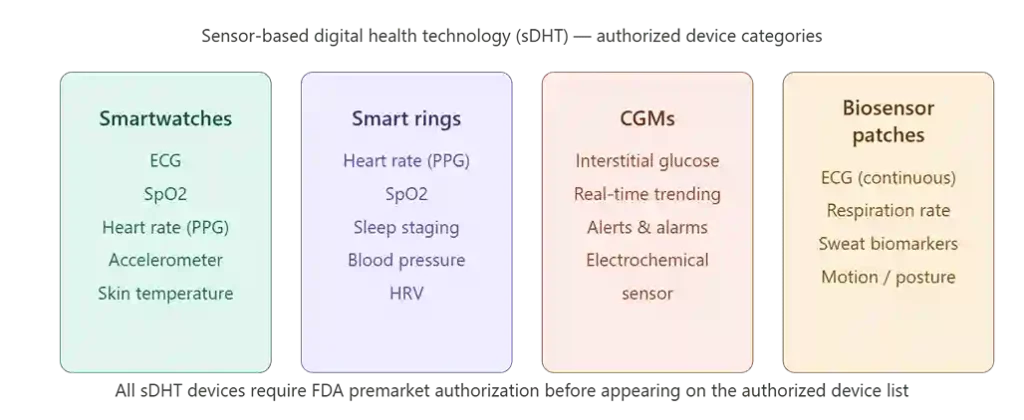
The sDHT list currently covers over 250 authorized devices, spanning:
- Smartwatches
- Smart rings
- Adhesive biosensor patches
- Continuous glucose monitors (CGMs)
- Blood pressure monitoring systems
- Sleep aids
Why wearable biosensors are gaining regulatory attention
Care delivery has been moving out of hospitals and into homes for years. Wearable biosensors and SDHT devices allow health data to be captured continuously and in real time, which changes how clinicians monitor patients, conduct clinical trials, and manage chronic conditions.
The SDHT list helps digital health innovators understand the current device landscape and regulatory expectations, providing transparency to healthcare providers and patients about when AI-enabled medical devices use sensor-based technology.
Some of the real-world examples are:
- Dexcom (a medical device company making continuous glucose monitors), its CGMs provide real-time glucose monitoring and are cleared as medical devices.
- Apple Watch ECG app cleared via the De Novo pathway as a Class II device for detecting atrial fibrillation.
- Optical blood pressure wearables, under the 2026 guidance, may now qualify as wellness products if non-diagnostic.
- Oura Ring (a smart ring known for sleep and recovery tracking), exploring blood pressure features under the updated framework for AI wearables.
The line between these categories is not always obvious from the outside, which is precisely why the 2026 guidance matters.
Clinical Decision Support Software and AI-Enabled Medical Devices

- CDS software vs. autonomous AI decision systems
Clinical decision support (CDS) software is designed to help healthcare professionals make decisions, not to make decisions for them. The legal distinction matters because Section 520(o)(1)(E) of the Food, Drug, and Cosmetic Act excludes CDS software from the medical device definition when it meets four specific criteria:
- Not intended to acquire or process signals from in vitro diagnostic devices or signal-acquisition systems.
- Intended to display, analyze, or print medical information about a patient.
- Intended to support or provide recommendations to a healthcare professional.
- Intended to enable the HCP to independently review the basis for recommendations, so the software is not the sole basis for clinical action.
Autonomous AI systems that make decisions without meaningful human review are a different category. These tools, particularly those that act on patient data without a clinician in the loop, are far more likely to be treated as regulated AI-enabled medical devices.
- When AI features trigger FDA oversight
Any implied or explicit diagnostic, treatment, or disease claims will trigger device status and related quality and premarket obligations. The FDA has also signaled priority enforcement against higher-risk use cases, particularly where AI outputs guide clinical care without adequate human oversight or validation.
In practical terms, an AI feature in digital health devices or AI wearables is more likely to require FDA clearance when it:
- Generates diagnoses or specific treatment protocols without clinician review.
- Processes signals directly from wearable biosensors or diagnostic devices as its primary input.
- Produces outputs that are the sole or primary basis for clinical decisions
- Operates in time-sensitive care scenarios where errors could harm patients.
How FDA Guidance Affects AI-Enabled Medical Devices
- Data accuracy and validation requirements
Labeling something as “wellness” doesn’t lower the engineering bar. As Omer Inan, a medical device researcher at Georgia Tech, put it:
“Calling something ‘wellness’ doesn’t reduce the need for rigorous validation.”
For CDS software and AI-enabled medical devices, the guidance is specific: software using input data without established clinical relevance will fail the exemption criteria. Similarly, any software relying on unverified data sources to generate specific diagnostic recommendations falls outside the CDS exemption, regardless of how it is labeled.
- Software updates and model changes
AI and ML models are not static. When algorithms update, retrain, or change their output logic, this can affect whether a device continues to meet the conditions under which it was originally cleared or exempted. This is a particularly live issue for AI wearables that use on-device machine learning.
For teams building AI-enabled medical devices, this means:
- Documenting model versioning in quality management systems.
- Assessing whether algorithm changes alter the intended use or risk profile.
- Determining whether post-market surveillance obligations apply when significant changes occur.
The FDA has signaled in prior AI/ML guidance that it expects a Predetermined Change Control Plan for adaptive AI, but specific enforcement for consumer-facing AI wearables remains unsettled under the current framework.
- Real-time health monitoring implications
The updated guidance sharpens the distinction between “medical information” and systems that measure physiological signals or patterns.
Signal-measuring systems are those that collect continuous, near-continuous, or streaming data from the body for medical purposes, and are more likely to be treated as regulated devices than products that display data locally for personal awareness.
This has direct implications for wearable biosensors:
| Use Case | Likely Classification |
| Consumer checks wellness trends on their own device | General wellness product |
| Device streams data to physician for real-time chronic condition monitoring | AI-enabled medical device |
Practical Implications for Teams Building Digital Health Devices
[Suggested image: Decision tree graphic: “Is my wearable an AI-enabled medical device?” with branches based on invasiveness, claim type, and clinical use]
- Compliance considerations for startups
The 2026 guidance offers a cleaner path to market for wellness-positioned products, but it also creates new documentation expectations. The updates provide clearer and more predictable pathways to market, particularly by expanding the FDA’s non-device safe harbors.
Practical steps for startups:
- Clearly define intended use from day one, since this drives every downstream regulatory decision for AI-enabled medical devices.
- Avoid language in marketing, labeling, or app interfaces that implies diagnosis, screening, or disease management.
- If the product outputs physiologic parameters through wearable biosensors, confirm they are paired with non-diagnostic messaging
- Review whether any AI features present single recommendations and whether those recommendations pass the four CDS criteria.
- Documentation and risk management expectations
Even wellness-positioned digital health devices benefit from maintaining internal documentation of:
- The basis for classifying the device as a general wellness product or non-device CDS.
- How the product handles edge cases (e.g., out-of-range readings from wearable biosensors).
- What claims appear in marketing materials, app UI, and user notifications.
- How software updates are managed and whether they could shift the product’s regulatory status to a regulated AI-enabled medical device.
For SDHT devices and any devices seeking 510(k) clearance, documentation expectations are significantly more extensive and include safety and effectiveness data, comparisons to predicate devices, and performance testing results.
Product design implications
The guidance has direct implications for how AI wearables are designed, not just labeled. Teams should:
- Design notification systems carefully, as the language around “evaluation by a healthcare professional may be helpful” is acceptable, but ongoing disease-management alerts are not.
- Avoid microneedle or other invasive sensing technologies in wearable biosensors if the goal is a wellness classification.
- Ensure AI outputs are explainable and reviewable by clinicians if the product is positioned as CDS software.
- Treat real-time health monitoring features as a potential trigger for medical-device classification if they involve continuous data transmission to clinical workflows.
What Remains Unclear in AI Wearable Regulation
Evolving FDA interpretation of adaptive AI
The 2026 guidance doesn’t address AI systems that learn and adapt over time. Key open questions include:
- What happens when a model updates itself post-deployment and shifts outputs in ways not covered in the original submission?
- The FDA has signaled it expects a Predetermined Change Control Plan for adaptive AI, but enforcement for consumer-facing wearables remains unsettled.
- Black-box and generative AI outputs in medical contexts face continued risk-based oversight, with no clear exemption pathway yet.
Regulatory gaps in consumer health AI
Intended use and actual use are not always the same thing. The guidance applies to products with defined intended uses, but the lines blur quickly:
- A wellness wearable becomes clinically adjacent the moment a user shares biosensor data with their physician.
- Dashboards that surface data with medical-sounding confidence can drive clinical reliance, even when that wasn’t the design intent.
- The FDA has not addressed how this real-world drift interacts with wellness classification.
Future updates expected
- In March 2026, the FDA published a Request for Information on digital health technologies in clinical investigations.
- Public comments are open through June 1, 2026.
- More regulatory activity around AI-enabled medical devices and sDHT is expected through the rest of 2026 and beyond.
- Teams building in this space should monitor FDA guidance updates closely.
Conclusion
The FDA’s 2026 updates are a meaningful step forward for anyone building AI wearables, wearable biosensors, or clinical decision support software. The wellness classification is clearer, the CDS exemption is broader, and the path to market for lower-risk digital health devices is more predictable than it has ever been.
But the fundamentals haven’t changed. Intended use drives everything. Documentation matters. As the market evolves, companies developing AI-enabled medical devices will need to balance innovation, validation, and regulatory compliance more carefully than ever. As adaptive AI and real-world use drift continue to outpace regulation, the grey zones will only grow. Watch the FDA’s response to its March 2026 Request for Information, and what comes out of that process will likely define the next wave of enforcement priorities for AI-enabled medical devices.
For anyone building at the intersection of AI and wearables right now, the right move is to read the original guidance documents, not just summaries of them, and to engage with regulatory counsel early in product development.
Want to stay ahead of where money and technology are heading? At Yaabot, we cover the latest in AI, fintech, machine learning, and the tech developments reshaping how you work, spend, and invest.
FAQs
- Is FDA Guidance on AI-Enabled Medical Devices Legally Binding?
No. FDA guidance documents are nonbinding recommendations that reflect the agency’s current thinking on policy. They do not carry the force of law, though they significantly influence how the FDA exercises enforcement discretion in practice.
- How to Check if a Device Is FDA Approved?
You can search the FDA’s 510(k) database, De Novo database, or PMA database at fda.gov. The FDA also maintains a dedicated SDHT device list that links directly to each authorized device’s clearance or approval documentation.
- What Types of Wearable Biosensors Require FDA Clearance?
Any wearable biosensor intended to diagnose, treat, monitor, or manage a disease or condition requires FDA clearance or approval. Non-invasive sensors used solely for general wellness purposes, without diagnostic claims, generally do not require premarket review under the 2026 guidance.
- What Is the Difference Between Digital Health Devices and AI-Enabled Medical Devices?
Digital health devices broadly include any technology using sensors, software, or connectivity for health purposes. AI-enabled medical devices are a subset that incorporate artificial intelligence or machine learning to analyze data and support or make clinical decisions, often requiring additional regulatory scrutiny depending on their risk level and intended use.
