



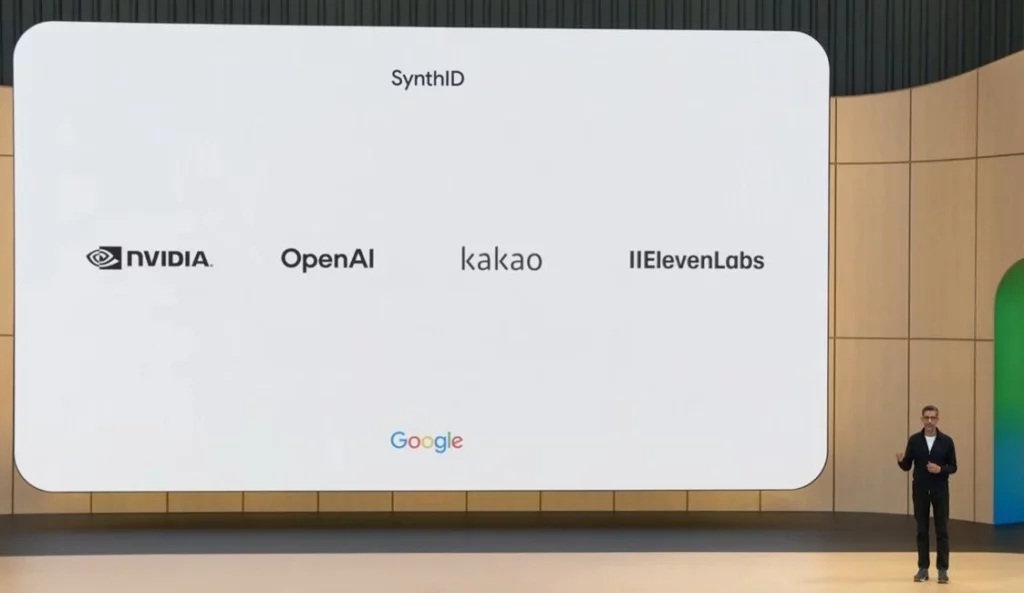
In May 2026, Google got its biggest competitors to adopt its own technology. Nvidia has adopted SynthID, while OpenAI, Kakao, and ElevenLabs announced plans to bring SynthID to more of their AI-generated content. It’s Google’s own AI watermarking system. SynthID is a pixel-level watermark your eyes can’t detect, but a machine can. Google has watermarked over 100 billion images and videos across its own products. That number keeps climbing.
This is the most serious cross-industry attempt at AI content provenance so far. It also has real limits most coverage skips past.
Key Takeaways
- SynthID is a pixel-level AI watermark developed by Google DeepMind that is invisible to humans but detectable by a paired classifier.
- As of May 2026, five platforms have adopted it: Google, OpenAI, Nvidia, Kakao, and ElevenLabs.
- Over 100 billion images and videos and the equivalent of 60,000 years of audio have already been watermarked.
- SynthID survives screenshots, cropping, and compression. Standard metadata like C2PA does not.
- SynthID only works with cooperating generators. Open-source models like Stable Diffusion and Midjourney are not on the list.
- A missing SynthID watermark does not mean an image is real. That is the biggest gap the standard has not solved.
- Google is not being altruistic here. Making SynthID the default AI watermarking layer means Google controls the standard.
What Is SynthID and How Does Google’s AI Watermark Work
SynthID is a digital watermarking system built by Google DeepMind. It embeds an imperceptible signal directly into AI-generated content at the moment of creation.
The signal sits inside the pixels of an image, the frames of a video, or the waveform of audio. You can’t see it. You can’t hear it. But a machine trained to look for it can detect it.

That’s what separates SynthID from other approaches to AI content detection. It doesn’t analyze writing style or scan for artifacts. The watermark is baked in at the source, before the file ever leaves the generator.
How SynthID embeds an invisible signal into AI-generated content
The mechanism is important to understand because it explains why the technology is harder to defeat.
SynthID modifies the pixel values of a generated image in a way that is statistically detectable but visually invisible. It’s not a logo stamped in the corner. It’s not a metadata field in the file header. It’s not a separate attachment either. The modification lives inside the content itself.
This matters for one single reason. You can strip metadata from a file, but you can’t strip a pixel-level signal without degrading the image. And even degraded versions often retain enough of the signal for the classifier to detect it.
Why the digital watermark survives alterations
Standard metadata can’t survive changes at any level. A re-upload or a format conversion can delete it. SynthID was designed with this in mind.
The watermark survives cropping, compression, and color adjustment. It’s not invincible. Aggressive recompression, repeated lossy format conversions, and targeted removal attacks can degrade it. But it outlasts the handling that kills standard metadata by a wide margin.
For example, C2PA, the other major AI content standard, is a cryptographically signed metadata manifest. A single screenshot removes it completely. SynthID keeps working after that screenshot.
Why AI Watermarking Matters Now: Deepfakes, Regulation, and the Trust Gap
Here’s the scale of the problem SynthID is trying to address.
Generative AI tools now produce an estimated 34 million images per day, based on 2023 figures. By 2026, with ChatGPT, Midjourney, Imagen, Flux, and dozens of smaller models in widespread use, the real number is way higher. And most of that content carries no origin signal. It just looks like a photo.
And the downsides are huge. In early 2026, German newsrooms encountered a disinformation campaign. Some fabricated images were used and tied to a fictional Iran-war narrative. The images, traced to the SalamPix operation, came from generators with no watermarking.
A few numbers that show the scale:
| Stat | Figure | Source |
| Estimated daily AI image generation (2023 baseline) | 34 million images/day | Visual Capitalist |
| Deepfake incidents tracked globally in 2023 | 95,820 detected videos | Sumsub Identity Fraud Report |
| Governments with active AI content-labeling legislation | 18+ jurisdictions | OECD AI Policy Observatory |
How AI content detection tools have fallen short before SynthID
Classifier-based AI content detection tools analyze an image or text and decide whether a human or AI made it. They are brittle in ways that matter:
- False-positive rates are high: Some content detection tools flag human-written text as AI-generated at rates above 15% in some conditions.
- Post-processing defeats them: Filters, noise, color temperature, sharpness, etc., changes can drop detection accuracy significantly.
- They don’t require generator cooperation: They always react after the fact with no signal from the source.
Which Companies Have Adopted Google SynthID and What They’re Using It For
By the time of the Google I/O announcement, five platforms had committed to SynthID integration. Here is the full picture:
| Company | Product/Platform | Content Type Watermarked | Date Adopted | Verification Tool |
| Imagen, Veo, Lyria, Gemini | Images, video, audio | 2023 (internal rollout) | Google Search “About this image,” Gemini app, Chrome | |
| OpenAI | ChatGPT, Codex, OpenAI API | Images | May 19, 2026 | OpenAI Verify tool |
| Nvidia | Cosmos world foundation models | AI-generated video | 2025 | Not publicly specified |
| Kakao | Image generation platform | Images | 2026 | Not publicly specified |
| ElevenLabs | Audio generation | AI-generated audio | 2026 | Not publicly specified |
OpenAI’s SynthID integration: ChatGPT, Codex, and the public verify tool
OpenAI’s adoption covers every image it generates. OpenAI also announced a public verify tool that lets anyone upload an image and check whether it carries a SynthID watermark or a C2PA manifest.
What I find notable is how OpenAI explained the decision. The company said watermarking can be more durable through transformations such as screenshots, while metadata can provide more information than a watermark alone. They aren’t claiming the system is foolproof. They are saying the two layers cover each other’s weaknesses. OpenAI shipped SynthID and C2PA together for that reason.
Nvidia, Kakao, and ElevenLabs: What each adoption extends
Each of these three adds something distinct.
- Nvidia adopted SynthID in 2025. Its generative models run on GPU infrastructure powering a significant share of enterprise AI generation, so the adoption has upstream effects beyond Nvidia’s own products.
- Kakao is South Korea’s dominant messaging and content platform. Its adoption extends SynthID into one of the largest content ecosystems in East Asia.
- ElevenLabs is the most distinct adoption by content type. SynthID for audio embeds the watermark in the waveform itself. Given how much ElevenLabs-generated voice content circulates online, this adds a verification layer to a content type that had almost no provenance tooling before.
The Scale of SynthID Digital Watermarking in 2026: By the Numbers
Google has applied SynthID to over 100 billion images and videos across its own products. Separately, the equivalent of 60,000 years of audio has been watermarked through Lyria and related tools. Those figures predate OpenAI’s integration. Now that ChatGPT’s image traffic is included, the daily volume of newly watermarked content is substantially higher.
Volume matters for a standard because a watermark is only useful if verifiers expect to encounter it. The more content carries the signal, the more meaningful a detection result becomes.
- 100B+ images and videos already tagged by Google alone.
- 60,000 years of audio watermarked across Google’s audio products.
- 5 major platforms onboarded as of May 2026.
SynthID vs. C2PA: Two AI Watermarking Layers, Two Different Jobs
SynthID and C2PA both serve AI content provenance, but they solve different problems. OpenAI ships them together because each covers what the other can’t.

Here is the direct comparison:
| Property | SynthID | C2PA |
| Mechanism | Imperceptible signal in pixel data | Cryptographically signed metadata |
| What it reveals | “This came from a participating AI model.” | Who made it, when, with which tools, what edits |
| Survives screenshot | Yes, with some degradation | No |
| Survives metadata stripping | Yes | No |
| Human-readable | No | Yes |
| Requires generator cooperation | Yes | Yes |
C2PA is richer. If you want to know which model generated an image and what edits followed, C2PA carries that. But a screenshot or a re-upload to most social platforms removes it.
Where to Verify SynthID Watermarks: Platforms and Tools Available Now
Knowing SynthID exists is useful. Knowing where to actually check for it is more useful.
Google Search, Chrome, and Gemini App: What users see
Google has integrated SynthID and C2PA verification into three surfaces. Within Google Search, the “About this image” panel surfaces AI-origin information and C2PA Content Credentials when present. Meanwhile, Chrome uses an overlay to flag AI-generated images on webpages. Lastly, the Gemini app labels content generated by Google’s models directly at the point of creation.
OpenAI Verify Tool: How to check AI-generated content
OpenAI’s Verify tool is a standalone upload interface. Drop in an image, and it reports whether it detects a SynthID watermark, a C2PA manifest, or neither. The only downside is that it detects watermarks from participating models. So, if an image comes from Midjourney or a local checkpoint, the result comes back empty.
What SynthID Can’t Do: Four Limits of AI Watermark Technology
This is the part that gets skipped the most. But Google and OpenAI deserve credit for being more honest about these limits.
1. Non-cooperating generators produce unmarked content: Any image from Flux, Stable Diffusion, locally hosted models, or state-sponsored infrastructure carries no SynthID watermark. The standard only applies to platforms that choose to implement it.
2. Targeted removal attacks exist: According to research, multi-resolution spectral bypass can reduce the detectability of SynthID watermarks in images. But Google has been honest about this limitation. Their goal is to raise the cost of misuse rather than defeat determined adversaries.
3. Aggressive edits degrade the signal: Aggressive cropping and compression can push the watermark below the detection threshold. SynthID is more durable than metadata, but it’s destructible.
4. Detection doesn’t give a verdict: SynthID gives you a likelihood score, not a binary yes or no. A photo competition recently disqualified an entry after a SynthID watermark was detected. So, there’s no straightforward way to audit the result.
Who is NOT using SynthID, and the Deepfake detection gap this creates
The non-adopters matter as much as the adopters. Stability AI, Midjourney, Flux/Black Forest Labs, and the broader open-source ecosystem haven’t implemented SynthID. Locally hosted models are outside any cooperative framework by definition.
This creates a specific logical trap, no SynthID watermark, so this must be real. That reasoning fails. An unmarked image could be an authentic photograph, output from a non-participating generator, or a watermarked image that degraded in distribution. The SalamPix disinformation case is the real-world version of this. The manipulated images carried no watermark, and that absence told journalists nothing about whether the content was synthetic.
SynthID, AI Regulation, and Google’s Standard-Setting Play
Two things are happening simultaneously here, and they are worth separating.
The first is regulatory pressure. The EU AI Act includes requirements for labeling AI-generated content. The US, UK, Canada, and South Korea are at various stages of developing similar frameworks. Voluntary adoption ahead of mandates is the standard industry response.
The second is competitive strategy, and it is more interesting.
Google is giving SynthID to its rivals. If SynthID becomes the default AI watermarking layer across the industry, Google controls the infrastructure that the whole sector depends on for content provenance. That is a very different position from having a good product.
Who has signed C2PA but not SynthID:
- Adobe has committed to C2PA and ships Content Credentials in its products, but has not adopted SynthID specifically.
- Microsoft has signed onto C2PA through its participation in the Coalition for Content Provenance and Authenticity, but has not announced SynthID integration.
- Meta participates in C2PA and labels AI-generated content on its platforms, but has not adopted SynthID.
What SynthID Adoption Means for Creators, Journalists, and Enterprises
The verification landscape is shifting in ways that affect different groups differently.
For photographers and content creators, the key issue is asymmetry. SynthID actively marks AI-generated content. Real photographs carry nothing. But the absence of a watermark doesn’t mean an image is real. It just means it came from a non-participating source, which could be a camera or a Stable Diffusion checkpoint.
For newsrooms and editorial workflows, this creates an operational issue. Editors will soon have more structured information about which AI model generated a synthetic image than about which camera captured a genuine one.
For enterprises using AI generation APIs, the regulatory exposure is a real issue. If mandatory AI content labeling becomes law in the EU and US, enterprises generating customer-facing content through AI APIs will need documented provenance.
What you should do now:
- Check whether your AI content generation tools are on the SynthID adopter list before assuming output is labeled.
- Treat absence of a watermark as neutral evidence, not as proof of authenticity.
- Start mapping your content generation pipeline against EU AI Act labeling requirements before enforcement begins.
Final Thoughts
SynthID is the most credible attempt at AI content provenance the industry has made. Five platforms, 100 billion tagged pieces of content, and a verification infrastructure that is starting to show up in the tools people actually use; that’s real progress.
But the standard only covers one side of the trust gap. It can tell you that a cooperating AI model made something. But it can’t tell you that an image without a watermark is real. Closing that gap requires photographs to be proactively signed at capture, using the same C2PA standard. And until cameras do that by default, the provenance picture remains problematic. The SynthID coalition is a necessary step. It’s not the whole answer.
FAQs
SynthID is a digital watermarking system from Google DeepMind. It embeds an imperceptible signal into AI-generated images, video, and audio at the moment of creation. The signal is invisible to humans but detectable by a machine classifier, and it survives many transformations that strip standard metadata.
No. SynthID only applies to content from platforms that have implemented it. Midjourney, Stable Diffusion, Flux, and locally hosted models are outside the coalition. Images from these tools carry no SynthID watermark.
Yes. Academic research has demonstrated targeted removal attacks. Lossy recompression can degrade the signal below the detection threshold.
They solve different problems. C2PA carries rich provenance information but doesn’t survive a screenshot. SynthID carries minimal information but survives most post-processing that kills C2PA.
In the EU, AI Act transparency obligations for AI-generated content apply from 2 August 2026. Providers must make certain AI-generated or manipulated content machine-readable and detectable, while some deepfakes require disclosure. Requirements in the US, UK, and other jurisdictions vary, and voluntary adoption remains common outside the EU.
Google Search (“About this image”), Chrome, the Gemini app, and OpenAI’s Verify tool. These surfaces detect SynthID watermarks or C2PA Content Credentials, or both. Third-party tools outside Google’s classifier cannot detect SynthID from non-participating generators.
