


Somewhere between your driveway and the grocery store, your car has probably started filing a report on you. Not a metaphor. If you’ve opted into a telematics program, an app or a small plug-in device has been logging your acceleration, your braking, and the exact minute you hit the highway on a Friday night.
That’s usage-based insurance, or UBI. It’s a car insurance model that prices your premium on how you actually drive, instead of demographic guesses like your age or your ZIP code.
This guide is for anyone who has looked at their renewal bill and wondered why a driver who has never filed a claim pays the same as one who has, or why a 19-year-old with a spotless record still gets quoted like a liability.
Key Takeaways
- Usage-based insurance ties your premium to real driving data like braking, speed, mileage, and time of day, not just age, credit, and location.
- Progressive’s Snapshot program pays an average of $328 a year in savings, but savings aren’t guaranteed, and some insurers can raise your rate.
- A 2022 JD Power study found more than 40% of UBI enrollees saw their rate increase, not decrease.
- Telematics data typically comes from a plug-in OBD-II device, a smartphone app, or a system already built into the car.
- UBI tends to reward low-mileage, daytime drivers and can penalize night-shift workers and long commuters.
What Is Usage-Based Insurance?
Usage-based insurance is a car insurance pricing model that calculates your premium from real-time or recently collected driving data.
As per National Association of Insurance Commissioners, UBI is auto insurance that tracks mileage and driving behavior, usually through in-vehicle telematics, to align what you pay with how you actually drive.
Traditional insurers price you against people like you on paper. UBI prices you against yourself behind the wheel.
Also known as pay-how-you-drive or telematics insurance, UBI adoption has been climbing globally for over a decade, with the U.S. and Italy as the two markets where it all started. That head start explains why American drivers now see UBI offered as a standard option at nearly every major insurer.
How usage-based insurance differs from traditional car insurance
| Factor | Traditional Insurance | Usage-Based Insurance |
| Primary inputs | Age, ZIP code, credit history, vehicle type | Braking, acceleration, speed, mileage, time of day |
| Data source | Static profile, updated at renewal | Ongoing telematics data from a device or app |
| Pricing logic | Risk grouped by demographic and vehicle | Risk scored against your own driving pattern |
| Can it get worse | Rate rises only at renewal after a claim | Rate can shift mid-program based on behavior |
How Does Usage-Based Insurance Work?
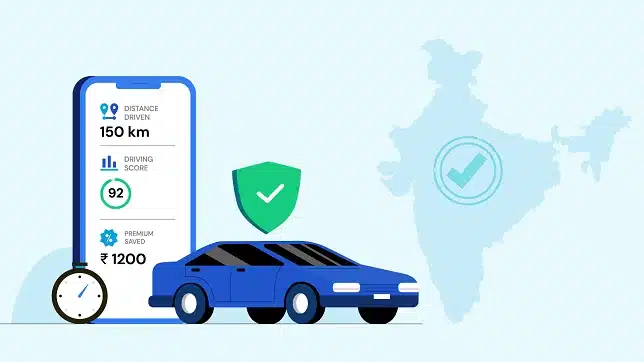
You enroll, usually for a review period of a few months to six months. And during that window, a device collects your driving data, the insurer scores it, and your premium gets adjusted. Either as a discount applied going forward or, with some carriers, an increase if the data shows risky habits. Traditional factors like your driving record, credit, and vehicle type stay part of the math too.
The role of the telematics device
“Telematics device” covers three different setups, and which one you get depends on your insurer:
- Plug-in OBD-II device: Plugs into the port under your dashboard and transmits driving data directly.
- Mobile app: Uses your phone’s GPS and accelerometer; no hardware required. This has become the most common method because it’s cheaper for insurers to deploy and easier for drivers to install.
- Embedded system: Telematics already built into the car by the manufacturer, common on newer connected vehicles.
Whichever method your insurer uses, the data collected is similar: miles driven, where and when you drive, acceleration, braking and cornering, speed, and in some programs, airbag deployment.
How your driving score is calculated
Your driving score weighs several behaviors, though the exact formula is proprietary to each insurer:
- Hard braking and rapid acceleration.
- Speeding relative to posted limits.
- Phone handling while driving.
- Time of day, with late-night driving weighted more heavily.
- Total miles driven.
A good driving score generally means smooth, consistent inputs and limited driving between midnight and 4 a.m., the window insurers flag most often because that’s when the chances of having an accident are the highest.
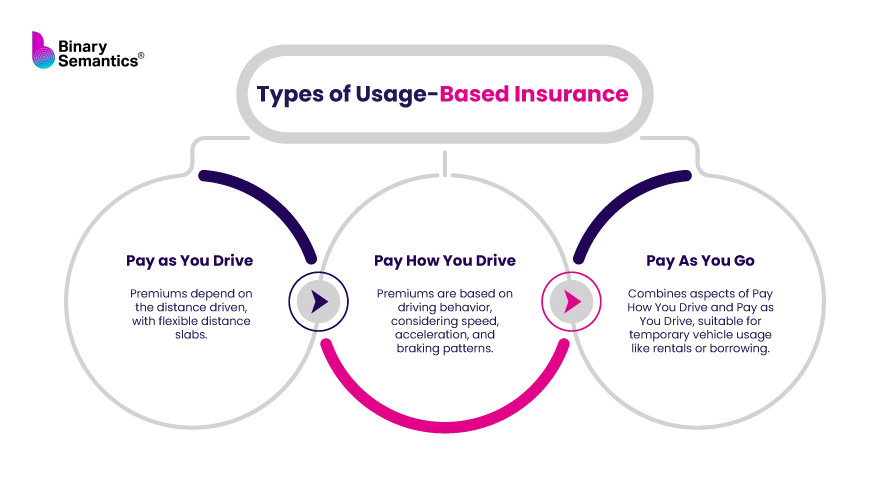
Types of Usage-Based Insurance Programs: Pay-How-You-Drive vs. Pay-Per-Mile
UBI is not one product. There are two structurally different models sold under the same umbrella term, and mixing them up leads people to pick the wrong one.
| Model | How It’s Billed | Best For | Typical Savings |
| Pay-How-You-Drive (PHYD) | Behavior score adjusts a base premium | Drivers confident in their habits, regardless of mileage | Program discounts commonly range 5% to 40% depending on insurer |
| Pay-As-You-Drive (PAYD) | Base rate plus a per-mile rate | Low-mileage or occasional drivers | Scales directly with miles driven, can be costly if mileage creeps up |
| Pay-per-mile (a PAYD variant) | Flat per-mile charge, no behavior scoring | Drivers who genuinely barely drive | Can be expensive fast if daily use resumes |
Pay-how-you-drive is what most major insurers mean when they advertise “usage-based insurance.” Pay-per-mile is a narrower product, less common, and generally not the better deal unless your annual mileage is genuinely low. Progressive splits its own usage-based options into these same two basic categories.
What Data Does Telematics Insurance Collect (and Who Can See It)?
This is the part that deserves a straight answer. Telematics insurance programs collect miles driven, your location and the times you drive, acceleration and braking patterns, cornering, and vehicle speed. Some programs also log phone handling and airbag deployment events, and insurers argue this same data speeds up and sharpens fault determination after an accident, which can work in your favor if you weren’t at fault.
Where this data goes matters as much as what gets collected:
- Insurers state the data stays private and secure and is used to price your policy and, in a claim, to help establish fault.
- Privacy advocates have raised concerns that data could be shared with third parties or used against a policyholder during a claims dispute.
- In 2024, New York Times reporting found some automakers had shared driver data collected through connected-car features with data brokers, who in turn sold it to insurers. And in some cases, without drivers clearly understanding their driving was being scored for pricing.
Before enrolling, find out exactly what your program tracks, whether it records you as a passenger in someone else’s car, whether the insurer requires your consent before sharing data with a third party, and what happens to your discount if you opt out mid-program.
How Usage-Based Insurance Affects Your Premium
The theory’s simple; drive well, pay less. But reality has two sides.
On the upside, Progressive reports its Snapshot users save an average of $328 a year, and most programs apply an automatic discount just for enrolling, before any data comes back. But on the downside, a JD Power study cited by Forbes found over 40% of consumers who enrolled in a UBI program in 2022 saw their rate increase instead of decrease.
Cross-referencing discount structures across 11 major carriers shows why. 7 of them, including Allstate, Geico, and Travelers, can raise your rate based on the data, while only 4, including State Farm and USAA, cap the program as discount-only with no downside.
It’s not a universal discount. It’s like a bet, and the odds depend entirely on which insurer’s program you join and how you actually drive.
The Rise of Insurance Technology Behind UBI
UBI exists because the insurance technology behind it got cheap enough to deploy at scale. The usage-based insurance market was valued at $46.95 billion in 2024 and is projected to reach $70.46 billion by 2030, a 7.0% CAGR, driven by rising connected-vehicle adoption and insurers’ appetite for more accurate risk pricing than demographic data alone can offer.
Pay-as-you-drive is currently the dominant UBI type worldwide, and the same market research found that drivers enrolled in PAYD programs cut their annual mileage by an average of 12%-15%, which directly lowers their accident exposure and gives insurers a cleaner signal to price against. North America accounts for roughly 67% – 75% of the global UBI market, which is why most of the household-name programs, Snapshot, Drivewise, SmartRide, are American products first.
For insurers, telematics data settles claims faster by establishing fault more precisely. And it lets a carrier charge a careful 22-year-old less than an identical peer who brakes hard at every stop sign, something a pure age-and-ZIP model can never do.
The same market research flags electric vehicle owners as a growing UBI segment, since EVs have historically carried higher premiums due to thinner repair-cost data, and usage-based pricing gives insurers a faster way to close that pricing gap than waiting years for more EV claims history to accumulate.
Pros and Cons of Usage-Based Insurance
| Pros | Cons |
| Rewards genuinely safe, low-mileage driving with real savings | Roughly 4 in 10 enrollees see rates rise instead, per JD Power |
| Sign-up discounts on many programs apply before any data is collected | Location and time-of-day tracking raises legitimate privacy concerns |
| Ongoing feedback can help you spot and correct risky habits | Night-shift workers and long-commute drivers get penalized structurally |
| Faster, more precise claims resolution when fault is disputed | Opting out mid-program can forfeit part or all of your discount |
| Available from most major insurers, so shopping around is easy | Formula and weighting are proprietary and not fully disclosed |
Is Usage-Based Insurance Right for You?
UBI tends to make sense if you drive under the average mileage for your state, keep a consistent daytime schedule, and you are genuinely comfortable with an app or device tracking your location and speed for months at a time. It’s important to check whether your specific insurer’s program is discount-only or can raise your rate before you sign up, since that single detail changes the risk calculus entirely.
But this isn’t for everyone.
If you work nights, drive long rural commutes with few other cars around, or you are planning a heavy-mileage stretch like a move or a road trip, a UBI program is more likely to cost you more than save you. If your driving is genuinely careful but happens mostly after midnight because of your job, no telematics score is going to see the difference between a cautious night driver and a risky night driver. It will just see the clock.
One more catch worth knowing before you enroll; some programs give you only a narrow window, as little as 10 days with certain insurers, to flag a trip where someone else was driving your car. If you regularly lend the car to a partner, a roommate, or a teenager, a single bad trip logged under your name can drag down a score you had nothing to do with.
Final Thoughts
Usage-based insurance is not a trick, and it is not a guaranteed win either. For a careful, low-mileage daytime driver, it is one of the few honest ways to pay less than the insurance industry’s broad demographic averages would otherwise charge.
For everyone else, it is a real privacy trade for a coin-flip discount, and the fine print on whether your specific insurer can raise your rate is the one detail worth reading before you plug anything in.
The technology behind UBI is not going away, and it is only getting cheaper for insurers to deploy, so the more useful question is not whether to engage with it eventually, but which program’s terms you are willing to accept when you do.
For more info on AI and tech, visit Yaabot.
FAQs
Sometimes. While Progressive’s Snapshot users save an average of $328 per year, a JD Power study shows that more than 40% of all Progressive users saw their rates go up, so the benefits will vary based on your driving habits and the insurer you use.
Yes, from most of the big names such as Allstate, Geico, and Travelers. Some, such as State Farm, USAA, and Nationwide, offer only discount plans with fixed rates that can’t go up based on the data, so remember to check before you sign up.
Usually, your speed, hard braking, acceleration, cornering, total miles, and time of day you drive. In addition, some programs record phone handling and the deployment of airbags in fewer instances.
Insurers state that data is kept safe and utilized for pricing and claims. However, some automakers were found to be giving connected-car data to resellers, known as brokers, who then shared it with insurers for 2024 reporting, so it’s worth checking with the individual automaker to see if their data is available for third parties.
This will differ depending on the insurance company. Some programs will allow you to retain your earned discount if you withdraw, while others will deduct or waive the earned discount; be sure to read the specific requirements before enrolling.
Less phone use, consistent braking and accelerating, staying within the speed limits, and driving between midnight and 4 a.m., when accidents are more common, are the areas insurers will take an extra hard look at.

